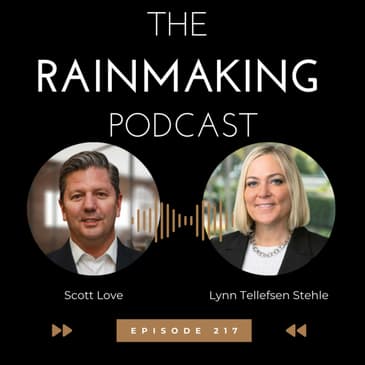
In this episode of The Rainmaking Podcast, host Scott Love speaks with Lynn Tellefsen Stehle, a law firm marketing and business development expert, about how to improve lawyer engagement in business development. Lynn shares insights from her extensive experience in legal marketing, emphasizing that successful business development requires a shift in mindset, structured systems, and leveraging individual strengths. She explains that many attorneys struggle with business development because it’s not a skill taught in law school, and some feel uncomfortable with the idea of self-promotion. However, by focusing on relationship-building and providing value, lawyers can engage in business development in an authentic and effective way.
Key topics include how law firms can structure their teams for business development success, the importance of assigning roles based on individual strengths, and how firms can support lawyers through training, coaching, and technology. Lynn discusses how law firm leaders can create a culture of collaboration, ensuring that attorneys feel supported rather than pressured in their business development efforts. She also explores how firms can use modern CRM and data-driven marketing strategies to track and enhance business development outcomes. Additionally, she shares insights on how firms can use business development as a recruiting tool to attract lateral partners, emphasizing that rainmakers are drawn to firms with strong business development infrastructure. This episode provides practical strategies for law firms looking to increase engagement, improve business development results, and create a sustainable growth strategy.
Visit: https://therainmakingpodcast.com/
----------------------------------------
“My journey began in legal technology, where I spent 15 years developing and marketing IP software systems and services. Later, as the head of marketing and business development for three AmLaw 100 firms, I helped lead growth initiatives that resulted in profitable expansion, leveraging technology to enhance productivity, and strengthening of key client relationships.
“Throughout my career, I've excelled at developing highly responsive and effective marketing and business development operations and initiatives, coaching lawyers in business development, tailoring strategies to their individual strengths and firm cultures. I've consistently implemented successful initiatives that have profitably expanded and strengthened the business. My "superpower" is the ability to effectively coach and engage lawyers by meeting them where they are at to help them chart their unique pathway to growth.
“Today, as the head of Client Collaboration at Nexl, I help law firms find better ways to grow. By leveraging Nexl’s platform, I help our clients to adapt modern tech to expand lawyer engagement, participation in business development, and marketing activities that lead to stronger client relationships and profitable new business.
“I'm passionate about bridging the gap between legal services and technology, helping firms overcome change management challenges and embrace modern tech for growth. If you're interested in discussing legal marketing trends, innovative business development strategies, interested in how modern technology can transform law firm operations, let's connect!”
----------------------------------------
This show is sponsored by Leopard Solutions Legal Intelligence Suite of products, Firmscape, and Leopard BI. Push ahead of the pack with the power of Leopard. For a free demo, visit this link:
https://www.leopardsolutions.com/index.php/request-a-demo/
Links:
https://www.linkedin.com/in/lynntell/
https://go.nexl.cloud/rainmakerconfidential
Learn more about your ad choices. Visit megaphone.fm/adchoices
[00:00:10] [SPEAKER_00]: You're listening to the Rainmaking Podcast.
[00:00:16] [SPEAKER_00]: Who's did by High Stinks Head Hunter, author and professional speaker, Scott Love?
[00:00:41] [SPEAKER_01]: Management in Business Development.
[00:00:43] [SPEAKER_01]: If you're not a lawyer, this is still going to work for you if you're in professional
[00:00:46] [SPEAKER_01]: services.
[00:00:47] [SPEAKER_01]: Then my guest is Lynn Tellefsen Stehle.
[00:00:51] [SPEAKER_01]: Lynn is an expert in law for marketing.
[00:00:54] [SPEAKER_01]: In business development, in fact she worked as a business development manager for
[00:00:57] [SPEAKER_01]: Dentons and worked for almost 12 years with K-Hill as their global director of marketing
[00:01:03] [SPEAKER_01]: and communications.
[00:01:04] [SPEAKER_01]: She works for a company called Nexel, which is a software company.
[00:01:08] [SPEAKER_01]: She's their head of client collaboration and their company helps lawyers, marketers
[00:01:12] [SPEAKER_01]: and business developers work together to grow the firm.
[00:01:15] [SPEAKER_01]: Make sure you connect with Lynn, look for her contact info on the show notes so wherever
[00:01:20] [SPEAKER_01]: you listen to the podcast, go to the show notes and you'll be able to connect directly
[00:01:24] [SPEAKER_01]: with Lynn.
[00:01:25] [SPEAKER_01]: And if you've got some time, I'd really appreciate going to Apple Podcast and writing
[00:01:29] [SPEAKER_01]: a nice five-star review and mentioning Lynn by name.
[00:01:33] [SPEAKER_01]: I know she'd appreciate that and I would also.
[00:01:35] [SPEAKER_01]: As always, this show is sponsored by Leopard Solutions Legal Intelligence, suite of
[00:01:40] [SPEAKER_01]: products, firmscape and leopard BI.
[00:01:43] [SPEAKER_01]: Push ahead of the pack with the power of leopard.
[00:01:45] [SPEAKER_01]: And now here's my conversation with my friend, Lynn Tellefsen Stehle.
[00:01:49] [SPEAKER_01]: Thanks for listening.
[00:01:52] [SPEAKER_01]: Hey, this is Scott Love with the Rain Making podcast.
[00:01:55] [SPEAKER_01]: Our special guest today is Lynn Tellefsen Stehle.
[00:01:59] [SPEAKER_01]: And today we're talking about how to improve lawyer engagement in business development.
[00:02:04] [SPEAKER_01]: Lynn, thanks for joining me on the show today.
[00:02:06] [SPEAKER_01]: It's great to be here.
[00:02:08] [SPEAKER_01]: Scott, thanks for having me.
[00:02:10] [SPEAKER_01]: Absolutely.
[00:02:10] [SPEAKER_01]: I'm excited to dig into this.
[00:02:12] [SPEAKER_01]: You've got a rich depth of expertise in this area.
[00:02:16] [SPEAKER_01]: And even though we're talking about improving lawyer engagement if somebody's listening
[00:02:20] [SPEAKER_01]: and they're not in the legal industry, if they're in professional services, I'm sure these
[00:02:24] [SPEAKER_01]: concepts can be malleable and still apply.
[00:02:28] [SPEAKER_01]: So let me ask you this in terms of somebody that's listening to this that might be in a leadership
[00:02:33] [SPEAKER_01]: role.
[00:02:34] [SPEAKER_01]: What do you think the main problems are that keep lawyers from getting more engaged in business
[00:02:40] [SPEAKER_01]: development?
[00:02:41] [SPEAKER_01]: Let's kind of start in that line of conversation.
[00:02:44] [SPEAKER_02]: Sure thing, I think the first would be the recognition that the skills in business development
[00:02:51] [SPEAKER_02]: are different from the skills it takes to practice law and deliver good service.
[00:02:59] [SPEAKER_02]: So there's that recognition and whether or not it's a priority.
[00:03:04] [SPEAKER_02]: And I think in my experience, those who are very successful in their business development
[00:03:12] [SPEAKER_02]: prioritize business development activities.
[00:03:15] [SPEAKER_01]: Yeah, right.
[00:03:16] [SPEAKER_01]: Right.
[00:03:16] [SPEAKER_01]: Let me kind of go down this line because I know partners, very successful partners,
[00:03:22] [SPEAKER_01]: they are amazing.
[00:03:24] [SPEAKER_01]: That's their practice at what they do, very detailed.
[00:03:27] [SPEAKER_01]: They earn the client trust because of the work that they do.
[00:03:31] [SPEAKER_01]: But some of them have confessed to me, they feel this almost this hypocrisy and they
[00:03:38] [SPEAKER_01]: feel it's contrived when they feel like they have to go out and sell themselves and actually
[00:03:43] [SPEAKER_01]: do the work it takes to get and build those relationships.
[00:03:46] [SPEAKER_01]: They feel I don't know maybe they feel it's beneath them, maybe they shouldn't have
[00:03:50] [SPEAKER_01]: to do that.
[00:03:51] [SPEAKER_01]: But it's kind of start at attenently what do you think people should, what should their
[00:03:57] [SPEAKER_01]: philosophy be to overcome that hurdle?
[00:03:59] [SPEAKER_01]: What do you think about that?
[00:04:01] [SPEAKER_02]: Yeah.
[00:04:01] [SPEAKER_02]: That's a great question.
[00:04:02] [SPEAKER_02]: I think it's a matter of comfort and proclivity frankly.
[00:04:06] [SPEAKER_02]: I mean business development training isn't typically given in school, right?
[00:04:12] [SPEAKER_02]: So there has to be a comfort level number one and an integration of those activities
[00:04:18] [SPEAKER_02]: into the day to day.
[00:04:19] [SPEAKER_02]: So making it a habit and making it just as a matter of course in how you serve your
[00:04:25] [SPEAKER_02]: clients.
[00:04:26] [SPEAKER_02]: So for instance, being a connector typically there's a value to your network and those
[00:04:32] [SPEAKER_02]: in your network.
[00:04:33] [SPEAKER_02]: So at attenently I think the answer is to how can I be of service to those in my network?
[00:04:40] [SPEAKER_02]: Whether that's a referral source or a prospect or a client, I think that should be
[00:04:45] [SPEAKER_01]: top of mind.
[00:04:46] [SPEAKER_01]: I like that because I think when that person that I'm thinking about, that person is
[00:04:52] [SPEAKER_01]: not what I would categorize as a swash buckling rainmaker.
[00:04:55] [SPEAKER_01]: He's not going to be the life of the party.
[00:04:58] [SPEAKER_01]: Sure.
[00:04:58] [SPEAKER_01]: But I know that person would feel really comfortable thinking how can I be of service
[00:05:03] [SPEAKER_01]: to those in my network?
[00:05:05] [SPEAKER_01]: I like that idea a lot.
[00:05:06] [SPEAKER_02]: That just brings up another thought for me that I'd love to share, which is the composition
[00:05:11] [SPEAKER_02]: of the composition of a team and in this case the composition of a team of lawyers is something
[00:05:18] [SPEAKER_02]: that's important to take into consideration.
[00:05:21] [SPEAKER_02]: So for leadership of the firm, look at who has the different skills and plug them in
[00:05:28] [SPEAKER_02]: where their interests intersect.
[00:05:31] [SPEAKER_02]: So what do I mean by that?
[00:05:32] [SPEAKER_02]: Yeah, right.
[00:05:32] [SPEAKER_02]: Some folks who are geared toward client planning and client service, they're great
[00:05:38] [SPEAKER_02]: with the clients, they help strengthen relationships improve the service delivery.
[00:05:43] [SPEAKER_02]: And then there are other folks who are more comfortable on the golf course, comfortable
[00:05:48] [SPEAKER_02]: in the cocktail party.
[00:05:50] [SPEAKER_02]: So recognizing that and allowing folks to participate where it intersects with their comfort
[00:05:57] [SPEAKER_02]: level, I think is a really helpful way to look at it.
[00:06:01] [SPEAKER_02]: And I do know some firms that are focusing their lawyers on either client development
[00:06:08] [SPEAKER_02]: and client planning or on what we would call business development or growth or new client
[00:06:14] [SPEAKER_02]: intake.
[00:06:15] [SPEAKER_02]: So recognizing that and meeting folks where they're at, I think, provides a level of comfort
[00:06:22] [SPEAKER_02]: and a greater likelihood of success.
[00:06:24] [SPEAKER_01]: Okay, that's great.
[00:06:25] [SPEAKER_01]: So maybe we could kind of go down this path and kind of segment what are those areas
[00:06:32] [SPEAKER_01]: of a high functioning business development organization, a team of lawyers, so to speak.
[00:06:37] [SPEAKER_01]: So we can identify, okay, I need to have a quarterback over here, I need to have somebody
[00:06:42] [SPEAKER_01]: in this position, you know, who's going to be first base, who's going to be the left
[00:06:45] [SPEAKER_01]: field?
[00:06:46] [SPEAKER_01]: Well, what are the different team parts that you've seen within teams of lawyers that are effective
[00:06:52] [SPEAKER_01]: in doing business development?
[00:06:53] [SPEAKER_02]: Sure.
[00:06:54] [SPEAKER_02]: Well, there's typically the point of contact or your contact partners, your relationship
[00:07:00] [SPEAKER_02]: partners.
[00:07:01] [SPEAKER_02]: Those folks who are kind of front and center on top of existing and future client needs,
[00:07:08] [SPEAKER_02]: There are folks on the administrative side who are helping connect the data.sodes speak
[00:07:15] [SPEAKER_02]: to help show how clients are consuming content.
[00:07:19] [SPEAKER_02]: What is our participation in events look like all of those stuff?
[00:07:23] [SPEAKER_02]: Wow, no, I think things.
[00:07:26] [SPEAKER_02]: And delivery in that internally so that there's a proactive sustained focused effort on
[00:07:33] [SPEAKER_02]: client needs both today and tomorrow.
[00:07:36] [SPEAKER_02]: So it is a team sport and everyone plays a role.
[00:07:40] [SPEAKER_02]: And obviously, in the law firm contacts, there's different expertise that the lawyers are
[00:07:46] [SPEAKER_02]: coming in matter to matter as it were and as it grows.
[00:07:52] [SPEAKER_02]: So taking that all of that into consideration is important.
[00:07:55] [SPEAKER_02]: So client teams, sector focused marketing, strategic initiatives that are happening throughout
[00:08:02] [SPEAKER_02]: the firm that every lawyer is engaged in and knows his or her role.
[00:08:09] [SPEAKER_02]: And that different firm to firm whether you're a boutique, firm with, you know, 300
[00:08:13] [SPEAKER_02]: lawyers or you're a much larger firm.
[00:08:15] [SPEAKER_02]: So the structure is changed.
[00:08:17] [SPEAKER_01]: Yeah, absolutely right.
[00:08:18] [SPEAKER_01]: That's great.
[00:08:19] [SPEAKER_01]: What if there's somebody that's just not chipping in to where they need to be on the
[00:08:25] [SPEAKER_01]: team?
[00:08:25] [SPEAKER_01]: Let's say there's somebody that people know what their roles are but they're just not whatever
[00:08:30] [SPEAKER_01]: reason.
[00:08:30] [SPEAKER_01]: They're just not contributing to the team.
[00:08:32] [SPEAKER_01]: What do you think that leaders should do with that individual?
[00:08:34] [SPEAKER_01]: How do you think they should handle that person?
[00:08:37] [SPEAKER_02]: Yeah, that's a great question.
[00:08:38] [SPEAKER_02]: And I think ideally there would be some support in the form of coaching.
[00:08:44] [SPEAKER_02]: I think business development coaches are really important and whether they're internally
[00:08:48] [SPEAKER_02]: provided, so you have your very specialized marketing and BD folks internally.
[00:08:54] [SPEAKER_02]: And I'll share with you that in my experience in 17 years at law firms in the business development
[00:09:01] [SPEAKER_02]: marketing capacity, I was really underutilized in my team.
[00:09:05] [SPEAKER_02]: There are resources and these resources absolutely should be recognized and used.
[00:09:13] [SPEAKER_02]: But I do believe that coaching is important because people's lives change, right?
[00:09:19] [SPEAKER_02]: So we need to understand why that's the case is one of the same Scott.
[00:09:23] [SPEAKER_02]: And people have situations and it's been closed.
[00:09:26] [SPEAKER_02]: And that's why it's so important to make business development a habit and to integrate it
[00:09:31] [SPEAKER_02]: into your day to day.
[00:09:32] [SPEAKER_02]: And when you do that, when the stuff hits the fan so to speak and life takes a curve ball,
[00:09:39] [SPEAKER_02]: you have that momentum to sustain you and also working in a team is important because
[00:09:45] [SPEAKER_02]: you have the rest of the team to also help.
[00:09:48] [SPEAKER_02]: So my answer to that is you need to understand specifically what's at the root of that
[00:09:53] [SPEAKER_02]: and meet folks where they're at to provide them with the level of support they need
[00:09:58] [SPEAKER_02]: and that level of support is going to change its dynamic.
[00:10:03] [SPEAKER_01]: You know, one thought I had as you're describing this and I'm envisioning here's a firm
[00:10:08] [SPEAKER_01]: whether it's a small medium or large firm, it doesn't matter a team that's working together.
[00:10:11] [SPEAKER_01]: They go out of team leader that understands how to lead the team.
[00:10:14] [SPEAKER_01]: They know how to do the things that you're talking about.
[00:10:17] [SPEAKER_01]: What are the strengths and deficits people have?
[00:10:19] [SPEAKER_01]: How can I put them in these roles?
[00:10:21] [SPEAKER_01]: How do we get regular habits and habits as you know those carry you forward?
[00:10:26] [SPEAKER_01]: Even when you don't feel like it the habits are going to do that because you've got that.
[00:10:30] [SPEAKER_01]: You've got that rhythm and that cadence so to speak.
[00:10:32] [SPEAKER_01]: What I've seen is that this is a good story to recruit other rainmakers.
[00:10:37] [SPEAKER_01]: If a firm has this, this is a story that they can tell to prospective laddorals.
[00:10:45] [SPEAKER_01]: Let me tell you about our team.
[00:10:46] [SPEAKER_01]: Let me tell you about the rituals that we have and the recognition that we have.
[00:10:49] [SPEAKER_01]: Let me tell you about how we're structured internally, not just the marketing
[00:10:53] [SPEAKER_01]: and the business development people are colleagues, but the attorneys.
[00:10:57] [SPEAKER_01]: And how we work and how we take our non-billable time and we're working together in the service of our clients
[00:11:03] [SPEAKER_01]: and by the way we benefit because we get the call and we get more business from that.
[00:11:08] [SPEAKER_01]: I think what you have described, I think we could take that.
[00:11:12] [SPEAKER_01]: The double advantage of that is oh yes it's going to be good for business development
[00:11:16] [SPEAKER_01]: but it's also going to be good for recruiting partners and what most people don't realize
[00:11:21] [SPEAKER_01]: is that you recruit a partner that has big book of business.
[00:11:23] [SPEAKER_01]: It's not the book, look at the client relationships.
[00:11:27] [SPEAKER_01]: That relationship that follows that new partner on day one, the trust starts on day one also.
[00:11:33] [SPEAKER_01]: The trust that he or she is built with the several dozen seesweet executives over decades.
[00:11:40] [SPEAKER_01]: All that trust starts on day one and as you know trust is where business development really
[00:11:44] [SPEAKER_01]: really begins.
[00:11:46] [SPEAKER_01]: So let me ask you this, can you tell me a story of an organization
[00:11:50] [SPEAKER_01]: where and you don't have to say who it is or anything like that or who the leader was,
[00:11:55] [SPEAKER_01]: but this person made a decision.
[00:11:57] [SPEAKER_01]: I want to get my people more involved.
[00:12:00] [SPEAKER_01]: I want to help improving law or engagement.
[00:12:03] [SPEAKER_01]: What was it like when they before they decided to do that?
[00:12:08] [SPEAKER_01]: What action steps did they take to build that team or maybe to lead it or kind of shift the focus
[00:12:14] [SPEAKER_01]: and then what were the results of that?
[00:12:16] [SPEAKER_02]: Yeah sure, I'd be happy to do that.
[00:12:18] [SPEAKER_02]: And you brought up some really good points that shouldn't be, I just want to make one point
[00:12:23] [SPEAKER_02]: before I answer that question which is the business development infrastructure and foundation
[00:12:29] [SPEAKER_02]: has I've seen increasingly become important in that lawyer lateral recruiting Scott because
[00:12:37] [SPEAKER_02]: they expect an infrastructure, they expect to have certain levels of support.
[00:12:43] [SPEAKER_02]: And so it's really important if you're a progressive forward reaching firm to make sure
[00:12:48] [SPEAKER_02]: you have that so that folks know before they get there.
[00:12:52] [SPEAKER_02]: And I will also share with you that I have been in several instances when I was in firms,
[00:12:58] [SPEAKER_02]: conference room E would call and I would be called down to conference room E and I would be
[00:13:04] [SPEAKER_02]: met with a new perspective lateral partner.
[00:13:08] [SPEAKER_02]: And the reason I was there was because that's exactly what they were asking.
[00:13:12] [SPEAKER_02]: I want to speak to your head of marketing and business development and I want to understand
[00:13:16] [SPEAKER_02]: what kind of support I and or my team is going to receive if we are to be here.
[00:13:23] [SPEAKER_02]: And so I think I just want to point that out that I think that's becoming increasingly important.
[00:13:29] [SPEAKER_02]: I've seen that become a far more common question.
[00:13:33] [SPEAKER_02]: And then the work I do today at Nexel, there is certainly positioning
[00:13:40] [SPEAKER_02]: within firms that this resource is for your professional development
[00:13:46] [SPEAKER_02]: as well as for the well-being of the firm.
[00:13:51] [SPEAKER_02]: So getting back to your question, I know you asked a question.
[00:13:53] [SPEAKER_02]: So getting back to the question, there was a recognition that there was a strategy
[00:13:59] [SPEAKER_02]: and there was both goals. And so the question became how do we achieve our growth goals?
[00:14:05] [SPEAKER_02]: And so the first step was looking at the infrastructure that we had and the composition of the team.
[00:14:10] [SPEAKER_02]: And we conducted feedback interviews. So there was a survey and some interviews that we did
[00:14:18] [SPEAKER_02]: internally to really get a better handle on what the needs of the group would be relative
[00:14:24] [SPEAKER_02]: to the growth goals. And then from there there was an infrastructure put in place internally
[00:14:31] [SPEAKER_02]: to help to identify the needs, fulfill the satisfy those needs, and then grow the program.
[00:14:38] [SPEAKER_02]: And the first step was a pilot program. And so that program was carefully kind of put together and chosen.
[00:14:47] [SPEAKER_02]: And the pilot ran, it was extremely successful and then it expanded from there.
[00:14:52] [SPEAKER_02]: So I don't think that's unusual for really any organization.
[00:14:57] [SPEAKER_02]: But certainly for a law firm organization when it comes to something new,
[00:15:02] [SPEAKER_02]: having a pilot and being really close to it and handling it exclusively internally.
[00:15:09] [SPEAKER_02]: Then shaping it and satisfying it seemed to be a winning formula.
[00:15:15] [SPEAKER_01]: And so how long did you know that you had proof of concept? This pilot program, this is working,
[00:15:20] [SPEAKER_01]: how long did it take before you actually saw the that you were bearing fruit from your efforts?
[00:15:25] [SPEAKER_02]: Sure, that's a great question. I recall it to be about three months.
[00:15:28] [SPEAKER_02]: Yeah, wow. And six months was the duration of the program before it became sort of institutionalized.
[00:15:35] [SPEAKER_02]: That's great. And yes, I would also say that I think it's sort of,
[00:15:40] [SPEAKER_02]: I do think it's common for folks to especially provide training and development in the business
[00:15:45] [SPEAKER_02]: development in a sense for newly made partners. Yeah, tell me about that. What do you mean by that exactly?
[00:15:51] [SPEAKER_02]: So you know, the shift in transition as a support mechanism,
[00:15:55] [SPEAKER_02]: I've certainly worked with firms that find it's important to provide that layer of support at that
[00:16:01] [SPEAKER_02]: flexion point. So you've just your transitioning from being an associate to being a partner.
[00:16:08] [SPEAKER_02]: Obviously, there's a whole range of concerns and new responsibilities and activities
[00:16:14] [SPEAKER_02]: and providing the a more intensive structured business development curriculum,
[00:16:23] [SPEAKER_02]: uh-huh. Hence to be appreciated and put to good use and not to say that there,
[00:16:31] [SPEAKER_02]: there isn't value or that it isn't common to have associate business development programs.
[00:16:36] [SPEAKER_02]: Those that see those happening far more frequently today than I did say 10 and 15 years ago.
[00:16:42] [SPEAKER_02]: But to provide that level of support, when you're a assuming a new position is really important
[00:16:48] [SPEAKER_02]: and business development is a purposeful initiative, ongoing initiative. And if you've not had that kind of training,
[00:16:58] [SPEAKER_02]: I mean, really how can you expect anyone to feel comfortable with it?
[00:17:02] [SPEAKER_02]: To sustain interest and to sustain interest, you need the skills,
[00:17:07] [SPEAKER_02]: you need a system, an approach that's sustainable for you. And you need to be plugged in by your firm
[00:17:14] [SPEAKER_02]: into the places that you feel most comfortable and also have an opportunity to grow your own skills.
[00:17:22] [SPEAKER_01]: That's great. Yes. Do you think that firms should they say, okay, here it is,
[00:17:26] [SPEAKER_01]: your introduction to business development and six weeks later, good luck or should they have some sort of
[00:17:32] [SPEAKER_01]: regular ongoing training development related to that pretty much for younger partners, any partner
[00:17:39] [SPEAKER_01]: or associate's what have you seen as most effective in that regard?
[00:17:41] [SPEAKER_02]: Yeah. I think that you need to have a full structure. The firms should provide a full structure.
[00:17:48] [SPEAKER_02]: So it's not a one and done. Absolutely not. I mean, I think folks can uplevel their skills.
[00:17:54] [SPEAKER_02]: I believe in coaching and business development coaching. I think there are some great coaches out there
[00:18:00] [SPEAKER_02]: and great systems out there. David Acre comes to mind. Ross Fishman comes to mind. I learned
[00:18:07] [SPEAKER_02]: my business development for legal training from the Flanary Institute, you know, way back when
[00:18:15] [SPEAKER_02]: the point is to find a system or an approach that works for you in your firm and help
[00:18:24] [SPEAKER_02]: folks to adopt it and support them along the trajectory of their business development journey. The goal
[00:18:32] [SPEAKER_02]: I think is for lawyers to have a business that's intentional where they can find the matters and
[00:18:42] [SPEAKER_02]: the clients that they most want to work for and actualize their niche. So how do I find and
[00:18:50] [SPEAKER_02]: merchandise my expertise? Let's say you're an FCPA lawyer. Right. I've done some great work in
[00:18:57] [SPEAKER_02]: investigations for some big clients. How can my marketing team help me to identify
[00:19:03] [SPEAKER_02]: similarly situated prospects? Those are the matters that I want and that comes down to, you know,
[00:19:12] [SPEAKER_02]: client planning, good marketing, sustained marketing and creating the network and creating that
[00:19:20] [SPEAKER_02]: comes ultimately, comes down to your ability to strengthen and nurture relationships and
[00:19:28] [SPEAKER_02]: organize them. And to handle as many of them as you can using all of the resources that are available
[00:19:35] [SPEAKER_02]: to you. That's technology. And internal resources. That's integrations that allow you to kind of
[00:19:43] [SPEAKER_02]: connect the data dots to tell a story and peak around the corners so you can anticipate your clients
[00:19:49] [SPEAKER_02]: needs. It's been in the right place at the right time. Yeah. To do these days and ever be
[00:19:54] [SPEAKER_02]: fuller, but it is more important and it takes focus and it takes a team. I think it takes a team anyway.
[00:20:01] [SPEAKER_02]: If you get, if you have the resources, you should be using them. Absolutely right. And I've seen
[00:20:06] [SPEAKER_01]: some firms I think they've done really well and finding innovative ways to do it. I think one of the
[00:20:19] [SPEAKER_01]: developers chief sales officer you have the S word in a title in a big really good firm. And I
[00:20:25] [SPEAKER_01]: remember talking about that and he said, really, I mean it summarized it succinctly in account
[00:20:30] [SPEAKER_01]: management where you're looking at those specific clients as a count. How do we develop them?
[00:20:35] [SPEAKER_01]: How do we find them developed? I thought that was really good. I think even our good friend
[00:20:38] [SPEAKER_01]: Darrell Cross with Norton Rose Fulbright internally business coach. I mean who's a real better
[00:20:44] [SPEAKER_01]: coach than someone that's really coach than him. And so I think some firms had done really well
[00:20:49] [SPEAKER_01]: by really making this a priority because and I know we talked about this earlier, I think some
[00:20:56] [SPEAKER_01]: partners they just have this hesitation. Maybe they think it's low brow. Maybe they think I'm an introvert.
[00:21:02] [SPEAKER_01]: I can't do this. I'm an attorney. That's why I went to law school and I want to be an attorney,
[00:21:06] [SPEAKER_01]: but they've got to be successful in earning trust. And I like the way you talked about that earlier
[00:21:11] [SPEAKER_01]: that how can you be of service to other people? Think of it as a selfless endeavor where you're
[00:21:16] [SPEAKER_01]: giving and of course it's going to come back to you and all that. But let me ask you this,
[00:21:21] [SPEAKER_01]: how do you think COVID has impacted how people do business development? I can't believe it's been
[00:21:27] [SPEAKER_01]: years since that happened. What do you think over the last four or five years? What do you think
[00:21:32] [SPEAKER_01]: some of the changes are in how attorneys do business development? Sure, on my mind is still thinking
[00:21:39] [SPEAKER_02]: about what you said a few minutes ago and I just want to note that I'm a real big fan of both
[00:21:45] [SPEAKER_02]: Darrell and Steve for both of the reasons that you mentioned and their great examples of both
[00:21:51] [SPEAKER_02]: external and internal folks. But I hear what you're saying about sales is an appetizing thought
[00:21:59] [SPEAKER_02]: to me if I'm a lawyer in some instances. So to your question, COVID has changed the world dramatically
[00:22:07] [SPEAKER_02]: in terms of business development. We see a greater return to in-person events but we don't see
[00:22:14] [SPEAKER_02]: folks in their offices as often. So there's more competition for those coveted spots where someone
[00:22:21] [SPEAKER_02]: is in the office. For instance, I live in the New York metro area. Folks in New York City,
[00:22:27] [SPEAKER_02]: they're basically Tuesday, Wednesday, Thursday. That's what you're seeing. So you have more
[00:22:32] [SPEAKER_02]: in-person events and an appetite for in-person events because folks are starved of in-person
[00:22:37] [SPEAKER_02]: events. It was much more difficult to do business development. And I think there's a fatigue,
[00:22:42] [SPEAKER_02]: then like a webinar fatigue. I know people, I don't know about you, but I know folks who sign up for
[00:22:46] [SPEAKER_02]: webinars knowing that they can't attend but they're interested in the content and so they'll listen
[00:22:52] [SPEAKER_01]: to it later. Do you know? Like that? Oh, I do. I do. Download it. I'll listen to it when I'm on the
[00:23:02] [SPEAKER_02]: right. Absolutely. So there and there's a lot of content now that used to be the problem,
[00:23:07] [SPEAKER_02]: right? There wasn't enough content. Well, COVID created a situation where firms were creating
[00:23:13] [SPEAKER_02]: more content than they ever had before. So that it kind of solves the problem of how do we create
[00:23:19] [SPEAKER_02]: content, whether that's audio, video or written alerts or memoranda. So they've cured that. So
[00:23:26] [SPEAKER_02]: there's a plethora. There's a lot of content. There's not a lot of competition for attention.
[00:23:35] [SPEAKER_02]: There's a lot of problems with focus. There's problems with what I call context switching. You
[00:23:42] [SPEAKER_02]: really, it's much more difficult today to capture someone's attention and to keep it.
[00:23:48] [SPEAKER_02]: So that is one way that has changed. And I think you're less likely you want to get folks in person.
[00:23:55] [SPEAKER_02]: That's the ultimate goal. How do we get folks to come to our event? And I think that that's harder
[00:24:01] [SPEAKER_02]: than ever before because folks just aren't in the office as much as they used to be and everyone
[00:24:08] [SPEAKER_02]: has a life. Yeah, right. Right. You can't, and you see it when you plan any kind of events
[00:24:13] [SPEAKER_02]: because when there's something going on in the city, there's so many more events and you can really
[00:24:20] [SPEAKER_02]: feel that that's a challenge. And I think what you said, I agree and I think that's interesting
[00:24:27] [SPEAKER_01]: and I hadn't really thought of it like that. I think people, they're like, well instead of six
[00:24:32] [SPEAKER_01]: events a year, I might only go to two maybe three in which ones are they? They're going to be conferences
[00:24:36] [SPEAKER_01]: of trade associations or like with rain dance for LSSO legal sales and service organization.
[00:24:43] [SPEAKER_01]: That's one that people are like, you know, I'm definitely going to go there. So I think I think
[00:24:47] [SPEAKER_01]: that's good. People can figure out, okay, what are the events that they're clients are going to
[00:24:50] [SPEAKER_01]: go to and how can you put yourself in their path by sitting on a panel at that event? Now you
[00:24:55] [SPEAKER_01]: look like the expert, right? Those are some tactical things that I'm sure we can dig into at some other
[00:25:00] [SPEAKER_01]: time. But Lynn, let me ask you this. You've been a great guest on our show. You've given us some really
[00:25:05] [SPEAKER_01]: good actionable content. If somebody wanted to implement some of these ideas and really get started on
[00:25:12] [SPEAKER_01]: this, what are three action steps you'd recommend that they should take to do so? She
[00:25:16] [SPEAKER_02]: were step number one adopt a systematic approach. As a seller do we need to have a systematic approach
[00:25:24] [SPEAKER_02]: to client planning and business development that's sustainable? Right. One of our types of particularly
[00:25:31] [SPEAKER_02]: like is the snowball system by mobile and one of the reasons I like that is because it's so simple.
[00:25:37] [SPEAKER_02]: It could be for any professional service. It's easy to follow and it's easy to integrate into
[00:25:45] [SPEAKER_02]: your day to day and I think that's a big thing these days. How do we integrate this into your
[00:25:51] [SPEAKER_02]: day to day? Step two, commit to business development, make relationship management important.
[00:25:59] [SPEAKER_02]: It is a priority and you will have to carve out the time. Use your specialized resources
[00:26:06] [SPEAKER_02]: the Darrell process if you're fortunate enough to have someone like him. Use those resources.
[00:26:14] [SPEAKER_02]: Step three, get support. Put modern technology to work for you. I have the insight from working
[00:26:22] [SPEAKER_02]: at Nexel to tell you that connecting the data dots to see the story and to be of greater service
[00:26:29] [SPEAKER_02]: to those near professional network is easier than ever before. I've heard from numerous business
[00:26:35] [SPEAKER_02]: development coaches, maybe a lawyer can handle 9 to 12 relationships at a time. Maybe it's more
[00:26:43] [SPEAKER_02]: but use technology. So the three steps got. That's great, Lynn. Mittman support. I love it.
[00:26:50] [SPEAKER_01]: I love it. Tell us about your company. Tell us about your offerings. What do you have? What do you
[00:26:54] [SPEAKER_02]: do that you would like for? Listeners to know. Yeah, thank you. So I work at Nexel. Nexel is an
[00:27:01] [SPEAKER_02]: all-in-one collaboration cloud. It's CRM, it's ERM and it's a marketing system. And that's the
[00:27:07] [SPEAKER_02]: former law firm CMO. Nexel Scott was the system that I always wanted but didn't exist at the time.
[00:27:15] [SPEAKER_02]: And I wanted it both for my lawyers and the business development aspect and for my marketing team.
[00:27:21] [SPEAKER_02]: So imagine this. Imagine one system that unites top of funnel and true business development
[00:27:27] [SPEAKER_02]: functionality into a single system. And that's Nexel. A big fan of less systems and more functionality.
[00:27:37] [SPEAKER_01]: Yeah, that's great. I love it. Well, that's great. We're going to, in for everybody listening,
[00:27:41] [SPEAKER_01]: we're going to put Lynn's contact info on the show notes. So wherever you listen to this podcast,
[00:27:46] [SPEAKER_01]: go there. We'll put her LinkedIn profile link as well as your company's website and other contact info.
[00:27:52] [SPEAKER_01]: Lynn, thank you so much for being on the show. You've given us some really good content.
[00:27:56] [SPEAKER_01]: I'm going to have you back on in the future. And thank you so much again for the generous of you
[00:28:00] [SPEAKER_02]: your wisdom today. Oh, thank you Scott. My pleasure. My pleasure.