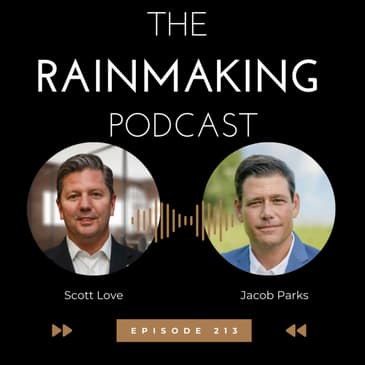
In this episode of The Rainmaking Podcast, host Scott Love speaks with Jacob Parks, business strategist and author of Never Say Sell, about the anatomy of a rainmaking organization and how firms can build a culture of business development excellence. Jacob explains that while many professional service firms rely on a few standout rainmakers, the most successful organizations embed business development into their structure, incentives, and culture. He emphasizes that firms should shift from focusing on individual sales stars to creating a scalable system where every partner and leader contributes to growth.
Key topics include the biggest institutional barriers to rainmaking success, such as misaligned incentives, lack of cross-selling between partners, and underutilized technology tools like CRM systems. Jacob shares strategies for breaking down silos within firms, improving collaboration between practice areas, and leveraging AI and automation to streamline business development. He also discusses the importance of training new partners in sales and networking skills, how to use rainmaker panels to transfer knowledge, and why measuring and incentivizing business development contributions can drive firm-wide success. This episode provides practical insights for firm leaders looking to improve collaboration, increase revenue, and create a sustainable rainmaking culture.
Visit: https://therainmakingpodcast.com/
----------------------------------------
President of Strategy for PIE, Jacob Parks is the author of Never Say Sell, a guide to how professional firms expand their business with key clients. His expertise includes partner remuneration and incentive plans, account planning, trigger of engagement, and how to expand a brand to include new service offerings, new industries, or new geographies. He has led client teams for McKinsey, Accenture, and KPMG among others. He leads The PIE Professional Services CMO and CGO network and is a graduate of Gonzaga’s MBA program, having previously taught undergraduate business students.
----------------------------------------
This show is sponsored by Leopard Solutions Legal Intelligence Suite of products, Firmscape, and Leopard BI. Push ahead of the pack with the power of Leopard. For a free demo, visit this link:
https://www.leopardsolutions.com/index.php/request-a-demo/
Links:
https://www.linkedin.com/in/jacob-parks/
https://www.profitableideas.com/about/meet-our-team/jacob-parks/
Learn more about your ad choices. Visit megaphone.fm/adchoices
[00:00:10] You're listening to the Rainmaking Podcast, hosted by high-stakes headhunter, author and
[00:00:19] professional speaker, Scott Love.
[00:00:23] You're listening to the Rainmaking Podcast.
[00:00:26] And my name is Scott Love.
[00:00:27] Thank you for joining me on the show.
[00:00:29] Our guest today is Jacob Parks.
[00:00:31] And our topic is The Anatomy of a Rainmaking Organization.
[00:00:35] Jacob and I go pretty deep on how organizations function and what you can do to improve
[00:00:40] yours.
[00:00:40] If you're in the business of getting business, this is an episode that you don't want to
[00:00:44] miss.
[00:00:45] Let me tell you a little bit about Jacob.
[00:00:47] He's a very impressive individual.
[00:00:49] He's a president of Strategy for Pi, Profitable's Idea Exchange.
[00:00:53] He's also the author of Never Say Sell, a guide to how professional firms expand
[00:00:58] their business with key clients.
[00:01:00] Jacob's the real deal.
[00:01:01] He's done the work.
[00:01:02] He also leads the Pi Professional Services CMO and CGO network.
[00:01:07] And as a graduate of Gonzaga's MBA program, having previously taught undergraduate
[00:01:12] business students, he's led client teams for McKinsey, Accenture and KPMG, among others.
[00:01:19] I hope you get some great ideas from my conversation with Jacob.
[00:01:21] I've put all of his contact information, including his LinkedIn link and his company
[00:01:26] link on the show notes.
[00:01:27] And no matter where you listen to the show, go to the show notes and you'll be
[00:01:30] able to connect with Jacob directly.
[00:01:32] As always, this show is sponsored by Leopard Solutions Legal Intelligence, sweet
[00:01:37] of products, FirmScape and Leopard BI.
[00:01:40] Push ahead of the pack with the power of Leopard.
[00:01:43] And now here's my conversation with my friend, Jacob Parks.
[00:01:46] Thanks for listening.
[00:01:49] Hey, this is Scott Love with the Rain Making Podcast.
[00:01:51] I've got a special guest today.
[00:01:53] I'm really excited about this topic.
[00:01:55] And our topic is the anatomy of a rain making organization.
[00:01:59] And our guest is Jacob Parks.
[00:02:01] Jacob, thanks for joining me on the show today.
[00:02:03] Thanks for having me.
[00:02:03] It's got him thrilled to be here.
[00:02:04] Yes.
[00:02:05] So let's get right into it, man.
[00:02:06] So the anatomy of a rain making organization, what does that look like?
[00:02:10] How would you describe that?
[00:02:11] Let's kind of get started with some definitions.
[00:02:13] What do you think the ideal rain making organization looks like?
[00:02:16] Yeah, so I think it's a great question, Scott, although I don't think
[00:02:19] it's that easy to define.
[00:02:21] Traditionally, I think we spend a lot of our time talking about people who do
[00:02:25] great business development and professional services as rain makers
[00:02:28] and appropriately so.
[00:02:29] But too often, I think we focus on the individual and the focus on
[00:02:33] the individual sort of lends itself to some of our corny sales cliches
[00:02:38] that in professional services, we really want to avoid.
[00:02:41] And so I always talk about this.
[00:02:42] But what we don't want to have are people saying things like,
[00:02:45] I can sell a ketchup popsicle to a woman and white gloves,
[00:02:47] or I can sell a furnace in the Mojave Desert.
[00:02:50] All of that is like those analogies are wholly inappropriate to our world.
[00:02:54] And in fact, I think a lot of times when I see great rain makers,
[00:02:57] they're not necessarily the outbuilding gregarious star that you think
[00:03:01] they are. They're contemplative, thoughtful client delivery people.
[00:03:05] And so we've sort of tried to learn a lot about what rain makers look like.
[00:03:10] But interestingly to me, there are a bunch of institutional barriers
[00:03:14] that exist when it comes to building a fully-fledged rain making organization.
[00:03:19] Having a few that do it well can carry your firm forward.
[00:03:23] But I actually think moving toward world class business development
[00:03:26] is having a cohesive team where everybody's kind of playing their role.
[00:03:30] Absolutely. I think that is ideal, but institutional barriers.
[00:03:34] Let's kind of talk about that.
[00:03:35] What do you think are some of the more problematic and more common
[00:03:39] institutional barriers that you've seen?
[00:03:41] Well, I think so one is just the obvious kind of incentive part
[00:03:44] of delivering for clients.
[00:03:46] So let's just say that you're an attorney
[00:03:48] and you have an eight million dollar book of business
[00:03:50] and six million dollars of that book is with one single client.
[00:03:54] And there are probably opportunities to introduce your litigation partners
[00:03:57] or your tax partners or other people into that opportunity.
[00:04:00] But you're paying for your nice house and putting your kids through college.
[00:04:04] The incentives don't necessarily line up for you to take on more risk
[00:04:07] with your trusted relationship in order to create value for the firm.
[00:04:11] And so I think there is sometimes just a natural resistance to doing it
[00:04:15] because I think that we are somewhat programmed to mitigate risk
[00:04:18] as opposed to seize opportunities.
[00:04:20] So I think that's a big part of it.
[00:04:21] I actually think that there's like a what do my partners do problem as well.
[00:04:27] What do you mean by that again?
[00:04:28] Let's tease this up as our second issue.
[00:04:29] The first is the incentive part for delivering for clients.
[00:04:32] What's the second one?
[00:04:33] The second one is just that we don't know everything that our partners do.
[00:04:36] So as you grow in your career of professional services,
[00:04:40] typically you build a business on a narrow niche.
[00:04:43] You start out as an associate delivering hours and doing different kinds of projects.
[00:04:48] And then in order to become partner and build a practice,
[00:04:50] you might have a very specific niche on some type of law.
[00:04:54] Well, you don't know every single niche that your partners do.
[00:04:57] And so the idea that you're going to cross sell other opportunities
[00:05:00] for your partners is hard to do if you don't understand it.
[00:05:03] And so how do we fix that?
[00:05:05] It's incredibly difficult.
[00:05:07] And I think that, you know, that probably brings me to my next challenge,
[00:05:11] which is the technology challenge,
[00:05:13] which is the technology that we have for business development,
[00:05:16] the tech stack that exists with CRM and outreach tools
[00:05:21] and all of these different things is incredibly powerful.
[00:05:24] And it never gets taken advantage of.
[00:05:26] Yeah, yeah, why do you think that is?
[00:05:28] I mean, I kind of know the answer.
[00:05:29] Nobody puts information into CRM.
[00:05:31] I was talking actually to an attorney this morning,
[00:05:33] a partner in a firm, and he was saying, you know,
[00:05:35] there are some weeks when I work 70 hours a week
[00:05:38] on a litigation case or something like that.
[00:05:40] The idea that I'm going to go home at the end of that
[00:05:42] and put multiple fields into Salesforce
[00:05:45] or into whatever the CRM system is, is just not likely.
[00:05:50] But I think that there's really good news on this subject,
[00:05:52] which is that I do believe that this is one of the areas
[00:05:55] that AI is going to solve on our behalf.
[00:05:58] Oh, yeah, not that far from like, let's say
[00:06:00] I'm having a conversation with you, Scott, and you're like,
[00:06:02] geez, this person out in Texas is suing me for something I did.
[00:06:06] And these are kind of the factors in real time.
[00:06:10] We're going to be able to sort of query our AIs internally
[00:06:13] and say lawsuit, Texas oil rights or whatever the case may be
[00:06:17] and be able to spit out in real time.
[00:06:20] This is the work we've done.
[00:06:21] This is the right partner to introduce.
[00:06:23] And here's a case study or a story that might reflect
[00:06:25] how we can serve this client.
[00:06:27] I actually think this challenge isn't that important
[00:06:30] over the next 10 years, because I do think
[00:06:32] that there's a realistic chance that technology solves it
[00:06:35] and helps us.
[00:06:36] But I have one tip for people on this,
[00:06:38] which is to rather than talk about what you do,
[00:06:42] the sort of mechanism by which you deliver value to your clients
[00:06:46] and flip that on its head and try to get the firm
[00:06:49] to only talk about how you solve problems for clients.
[00:06:52] Not ideal litigation, but I go in and I help people
[00:06:56] get the most outstanding outcome they possibly can
[00:06:59] when they confront an unfortunate situation with this,
[00:07:02] this or this, right?
[00:07:03] And what that does is it positions everybody
[00:07:05] in the client's mind.
[00:07:06] They're all thinking about how clients' problems get solved.
[00:07:10] The intricacies of my unique practice of law
[00:07:13] or consulting or engineering are relatively unimportant.
[00:07:16] I just need to know what the outcome is that you can deliver
[00:07:19] because as a generalist in this particular specialty,
[00:07:23] I can talk about the outcomes you deliver,
[00:07:25] but I can't really talk about the workload
[00:07:27] that goes into creating that outcome.
[00:07:29] Yeah, right, right.
[00:07:29] So let me ask you this for a second, Jacob.
[00:07:32] So we were talking about the incentive part
[00:07:34] of delivering for clients.
[00:07:36] We don't know what every all the other partners do.
[00:07:38] And the third is a technology challenge.
[00:07:40] And I like what you talked about here
[00:07:42] is rather than talk about what you do.
[00:07:44] And I would say this might be a framework
[00:07:46] or maybe a paradigm perspective
[00:07:49] because we've all been taught,
[00:07:51] well, I'm an intellectual property litigator.
[00:07:52] I do patent litigation for Barma Life Science
[00:07:55] on the branded side. That's what I do.
[00:07:58] But instead, this might be kind of,
[00:08:01] I mean, would this be a training thing
[00:08:02] that leaders have to do with their people?
[00:08:04] Let me, so this is kind of,
[00:08:05] we're going down a different area here
[00:08:07] about let's just call it paradigm shifts.
[00:08:10] I'm trying to get some structure.
[00:08:12] Let's call it the paradigm,
[00:08:13] the paradigm of how we have to think.
[00:08:15] And so tell me then with this issue,
[00:08:19] is this paradigm issue an institutional issue
[00:08:23] or just the way it is
[00:08:25] across most professional services organizations?
[00:08:28] It tends to be the way it is
[00:08:29] across most professional services organizations.
[00:08:31] And you ask that this is sort of a training thing.
[00:08:33] It's a key part of what we do in a lot of workshops is
[00:08:36] instead of doing like an icebreaker,
[00:08:38] one of the icebreakers that we will institute is
[00:08:41] introduce the person next to you
[00:08:42] and tell me what problem they solve for clients.
[00:08:45] Oh, that's interesting.
[00:08:46] Hi, this is Scott and Scott finds
[00:08:49] lateral partners for firms
[00:08:51] when someone's looking to move or whatever.
[00:08:53] Right? I come up with a pithy way of saying it.
[00:08:55] And so you start to learn
[00:08:56] the mechanism of introducing your peers.
[00:08:59] Oh, wow.
[00:09:00] I also think that's great.
[00:09:02] And maybe for structure there,
[00:09:03] I think there's an interesting thing with training, too,
[00:09:06] which is that pre-COVID training
[00:09:09] oftentimes acted as what we call a sidewalk coaching,
[00:09:12] which is to say you get brought to a pitch
[00:09:14] or you get brought to a client site
[00:09:16] and you have an hour along with the client
[00:09:18] or with the key person.
[00:09:19] And our chairman always jokes.
[00:09:21] The only thing you get to do in the first meeting
[00:09:23] is not pick your nose.
[00:09:24] And that's a joke.
[00:09:25] But like you're just learning how to be in these meetings
[00:09:28] and you walk outside the meeting
[00:09:29] and on the sidewalk, you say, Scott, what did you hear?
[00:09:33] And without fail, the partner heard 30 things
[00:09:35] that the associate did not hear in that meeting.
[00:09:38] And it builds this muscle for business development.
[00:09:40] But unfortunately we had a pandemic
[00:09:43] and all of those activities atrophied.
[00:09:46] And increasingly people are not quite as active
[00:09:49] on staying another night in the city
[00:09:51] and having dinner with a client
[00:09:52] or coming in early and having dinner.
[00:09:54] All of those kinds of skills have atrophied a little bit.
[00:09:57] And so I think that there is a need for training
[00:10:00] in business development skill, particularly for new partners.
[00:10:03] But I don't think getting that training right
[00:10:06] is actually that easy.
[00:10:07] Yeah, I would agree.
[00:10:09] And let me kind of come back to that in a second
[00:10:11] because I've got a couple of questions and thoughts about that
[00:10:14] that I think people would want to hear about.
[00:10:16] Let me go back over the institutional barriers that exist.
[00:10:20] The incentive part for delivering.
[00:10:21] We don't know everything partners do
[00:10:23] that tech challenge any other institutional barriers
[00:10:25] that you've seen from your years of experience in doing this.
[00:10:29] I think one of the other ones,
[00:10:31] I don't know that I would call it an institutional barrier,
[00:10:33] but I think that the structure of the organization
[00:10:35] creates limitations.
[00:10:36] And there's a bunch of different really interesting stuff
[00:10:39] going on here.
[00:10:40] So you know this too well,
[00:10:41] but all these professional service firms are in big matrices.
[00:10:45] Right? So it's like we go first by industry,
[00:10:47] second by service line, third by geo overlay of services
[00:10:51] or executives we serve or whatever, right?
[00:10:54] They're quite complex.
[00:10:54] And so without fail,
[00:10:56] those structures create difficulties
[00:10:59] in the way that we grow clients internally.
[00:11:02] And each flavor creates a different difficulty.
[00:11:04] But one of the fascinating things I think that's going on
[00:11:07] more so outside of legal right now
[00:11:10] is the impact that the profit creation engine
[00:11:14] takes on the organization.
[00:11:15] And what I mean by that is,
[00:11:16] is it a partnership with sort of, you know,
[00:11:19] a thousand partners who have their own P&Ls
[00:11:22] with all sort of a lot of little power centers everywhere?
[00:11:25] Or is it a company like an Accenture or a Cognizant
[00:11:27] that's gone public
[00:11:29] and faces public company scrutiny on a quarterly basis?
[00:11:33] Right. Because those institutions develop wildly different
[00:11:37] business development strategies.
[00:11:39] Yeah.
[00:11:40] You know, let me make a comment
[00:11:41] and I wanted to get your perspective on this.
[00:11:43] And when we talk about the structure of the organization
[00:11:46] we're also talking about partner compensation
[00:11:49] and is it open, meaning everybody knows
[00:11:51] what everybody else makes or closed?
[00:11:54] Nobody knows.
[00:11:55] And I've had actually guests on here talk about partner comp
[00:11:59] and this only relates to law firms
[00:12:01] and maybe it relates to other professional services firms.
[00:12:04] I'm not sure.
[00:12:05] But he said,
[00:12:06] I agree that the best model is to have a closed comp
[00:12:10] where the chairman or whoever the managing partner
[00:12:12] and that partner,
[00:12:13] that's it nobody else knows
[00:12:15] how much that person is making.
[00:12:17] Why is that good?
[00:12:18] It works because it takes out the variable of,
[00:12:21] gosh, what happens if I share my client?
[00:12:24] Now there are two things you need to have for that to work.
[00:12:27] Number one, you have to trust your leadership.
[00:12:29] And number two, you have to trust your colleagues.
[00:12:31] That's why in some firms,
[00:12:32] if the trust isn't there, it's not going to work.
[00:12:36] So anyway, those are my thoughts.
[00:12:37] What do you think about that, Jacob?
[00:12:38] What's been your experience in terms of
[00:12:40] how that relates to sharing work?
[00:12:42] I tend to agree because
[00:12:44] I've never thought that someone deserved
[00:12:46] to be paid more than me.
[00:12:47] I'm kidding, but I think that's a real issue in the world.
[00:12:50] It's like, I'm adding a lot of value.
[00:12:52] Why is it not making more than me?
[00:12:53] And we all create value in different ways.
[00:12:56] An equally interesting question to me is,
[00:12:59] do you make public the contribution
[00:13:01] to business development at a partner level?
[00:13:03] Oh wait, tell me about that.
[00:13:04] Tell me about that.
[00:13:05] Say that again.
[00:13:06] Do you make public,
[00:13:06] tell me that again, please.
[00:13:08] Do you make public the compensation
[00:13:09] or the business development contribution
[00:13:12] of any given partner?
[00:13:13] So like a lot of firms now
[00:13:15] have been able to do this cool thing
[00:13:16] with their technology where
[00:13:17] each partner has a dashboard of their stuff, right?
[00:13:21] Their utilization,
[00:13:22] how many cases they have going on,
[00:13:24] what they've sold this year.
[00:13:26] And there is a decision that every firm confronts
[00:13:28] which is, do I make this technology sortable?
[00:13:32] Can I sort myself
[00:13:34] to sort of stack rank myself against my peers
[00:13:37] in terms of my business development output?
[00:13:39] And I think the answer is like every time
[00:13:41] in consulting, it depends.
[00:13:43] I think some firms probably need
[00:13:46] a little competitive pick in the butt.
[00:13:48] And the ability to search and see where you are
[00:13:51] at the force rank is one of the most impactful things.
[00:13:54] We all know that most of these partners
[00:13:56] make very good salaries, very good compensation.
[00:14:00] And so moving the needle
[00:14:01] with a little bit of incremental increase in comp
[00:14:04] is not always the most effective motivating factor.
[00:14:07] But if you can search where you are against your peers
[00:14:10] and you're in the bottom third,
[00:14:12] you start to take action.
[00:14:13] And we have seen firms will make it available,
[00:14:17] people will look at their rank
[00:14:19] and the bottom third instantly start taking on
[00:14:21] more business development activity.
[00:14:23] Like you can get a predictable future
[00:14:25] that they will do that.
[00:14:26] But it also creates problems.
[00:14:29] It creates people angry.
[00:14:30] It creates credit issues where you go,
[00:14:32] Scott didn't really actually sell that.
[00:14:34] He needed fear.
[00:14:35] I took that guy out to lunch that one time.
[00:14:38] And so my boss Tom, who used to live in Africa
[00:14:40] for a long time calls this the antelope down
[00:14:42] on the Serengeti.
[00:14:43] There's a new deal and everybody flies out of their office
[00:14:46] and says, I know him, I took her to lunch.
[00:14:49] I went to prep school with her
[00:14:51] and you start to fight over credit
[00:14:53] instead of pushing the firm forward and growing.
[00:14:56] And so it's a balance, but sometimes it can be impactful
[00:14:59] and sometimes it can disrupt the culture.
[00:15:01] Yeah.
[00:15:02] Wow.
[00:15:02] This is just definitely mind blowing what you're saying,
[00:15:05] Jacob, because these are things that I've seen a lot.
[00:15:08] And this also, I think when it comes to some of these issues,
[00:15:12] this is that first thread off the sweater
[00:15:15] that starts being pulled.
[00:15:16] And if there's no trust in the organization,
[00:15:19] it's like you're not gonna have a sweater left
[00:15:21] because everybody's gonna leave.
[00:15:23] And then you're gonna get critical mass.
[00:15:25] I don't wanna be the last one here.
[00:15:27] I don't wanna be read.
[00:15:28] I don't wanna have my name in the press release
[00:15:29] of me, one of 30 partners left at XYZ firm.
[00:15:32] That's why I think this is interesting,
[00:15:34] special services, especially big law firms,
[00:15:36] very interesting three-dimensional chess type organizations
[00:15:40] where one thing, it's the butterfly effect
[00:15:42] through the whole organization.
[00:15:44] If you tweak this here, wow,
[00:15:46] you might have three people leave a year later.
[00:15:48] And so how do you think leaders can mitigate the risk
[00:15:53] of unintended negative consequences
[00:15:56] when making these kind of changes in their organization?
[00:15:59] Yeah.
[00:15:59] So I would just say proceed cautiously.
[00:16:02] So there's always a conversation
[00:16:03] when you're hiring people like,
[00:16:04] what is it hire slow, fire fast,
[00:16:06] fire fast, hire slow, whatever it is.
[00:16:08] And I think the same is true with this.
[00:16:10] And I do think you can test some of this stuff out
[00:16:12] on a unit by unit level.
[00:16:14] Like you can roll this out to a practice group
[00:16:16] and see how they tolerate it
[00:16:18] before you roll it out to other people.
[00:16:20] So I think testing some of that,
[00:16:22] but I would say like my tendency is to lean harder
[00:16:25] on our culture than on competitive output.
[00:16:29] Like the culture matters and really good cultures
[00:16:31] who are collegial, like working with each other,
[00:16:34] they develop business together.
[00:16:36] And I would just say that is probably more important
[00:16:39] than juicing the performance
[00:16:41] at the bottom third of your team.
[00:16:42] But again, it can be very useful in certain contexts.
[00:16:47] That's interesting.
[00:16:48] Let me ask you about this.
[00:16:49] And I appreciate what you just said
[00:16:51] in terms of training,
[00:16:53] training partners to know how to make introductions,
[00:16:57] how to look for opportunities.
[00:16:59] I'll give you my own perspective on this.
[00:17:01] One of the things I've done,
[00:17:02] the recent change I made was changing my model
[00:17:04] to where I'm working on a retainer basis
[00:17:05] with the small number of firms.
[00:17:06] And part of that includes me training their partners
[00:17:09] on how to interview their firm,
[00:17:11] which really means how do you sell the opportunities
[00:17:13] to the people you want to hire?
[00:17:14] That's what an interview really is.
[00:17:16] And I'm good at being able to manage this nuance
[00:17:21] and earning their trust and talking to them in a way
[00:17:23] of doing it, but this is how I've explained it
[00:17:24] to some of the director level staff
[00:17:27] is that a partner's correct client facing persona is,
[00:17:32] I have all the answers.
[00:17:34] I know what to do.
[00:17:35] I know it all, I can solve your problem.
[00:17:37] That is the correct client facing persona.
[00:17:39] The problem is that persona permeates itself
[00:17:41] into other areas of that professional
[00:17:44] and other professional areas of his or her life.
[00:17:47] So let me ask you this, when you're teaching people
[00:17:49] how to do this, and by the way,
[00:17:51] have you seen that also?
[00:17:52] And how does someone like you manage that
[00:17:55] when you go into an organization
[00:17:56] and you're teaching them and training them?
[00:17:58] How do you share?
[00:17:59] How do you sell work?
[00:18:00] Things like that.
[00:18:01] Yeah, so it's a hurdle.
[00:18:03] And I think one of the things I often do
[00:18:05] is I just be, I'm just very frank about the content.
[00:18:10] I'm like, there is business development content out there
[00:18:13] and I have written a fair bit of it.
[00:18:15] It's not gonna blow your hair back.
[00:18:17] It's all the stuff you already know.
[00:18:19] And what we're working on today in this training
[00:18:21] is not learning content or you listening to me
[00:18:24] go through slides.
[00:18:25] We're trying to turn the dial 20%
[00:18:27] on our business development performance.
[00:18:29] And the way we're gonna do that today is through role play,
[00:18:32] exercises to help you get used
[00:18:34] to introducing your colleagues and other activities,
[00:18:37] including your suggestions for how the firm
[00:18:39] can support your crew a little better
[00:18:41] on business development.
[00:18:43] But the best outcomes, this Walt Schill character,
[00:18:45] the guy I'm writing the second book with,
[00:18:47] he's like 90% of our training should be role play.
[00:18:51] He's like nobody likes it.
[00:18:52] And so we have another role that we do,
[00:18:54] which is I do the first one.
[00:18:55] So I stand up in front of the room
[00:18:57] and I humiliate myself, introducing a colleague
[00:19:00] or trying to like sell illegal matter or whatever.
[00:19:03] And once I am up there and I laugh at myself,
[00:19:06] a lot of times the firm takes their guard down
[00:19:08] and they're willing to participate in a training
[00:19:10] that is not about me presenting how you're supposed
[00:19:13] to do it but then actually engaging
[00:19:15] in the activities to drive business.
[00:19:16] So you're getting partners and big fancy firms to do this?
[00:19:20] Yes.
[00:19:21] That's great.
[00:19:22] One of the things we do that I love
[00:19:23] is we have this game that we used to play
[00:19:25] in our firm as like an ice breaker
[00:19:27] called justified or poor form.
[00:19:29] And so a lot of times I'll start a training
[00:19:31] with justified or poor form
[00:19:32] and you'll put silly things on there,
[00:19:34] like taking your shoes off on an airplane
[00:19:36] and they'll both justify their poor form,
[00:19:38] like that's gross or that's not gross.
[00:19:39] Another one we do is like leaving the butter
[00:19:41] on the counter, you know,
[00:19:43] counter versus fridge, justified or poor form.
[00:19:45] And then I always have the last one be justified
[00:19:48] or poor form asking world-class clients,
[00:19:50] asking world-class lawyers to do a role play.
[00:19:53] That's great.
[00:19:54] Without fail they say justified.
[00:19:56] That's great.
[00:19:56] Wow, that's great.
[00:19:58] I mean, I like that the gravitas
[00:19:59] with self-deprecating humor and light professional humor,
[00:20:02] I think that's a good combination
[00:20:04] to get people like that on board
[00:20:06] and they give you the answer,
[00:20:08] that's justified, we should do that.
[00:20:09] Oh, well thanks for the idea.
[00:20:11] Let's talk about what we're doing now.
[00:20:13] Exactly.
[00:20:13] Since you brought that up.
[00:20:15] Exactly.
[00:20:16] So tell me a story
[00:20:18] and you don't need to mention the name of the firm.
[00:20:20] What were the problems that they had
[00:20:21] before you started working with them?
[00:20:23] What did you do in terms of addressing
[00:20:26] these institutional barriers,
[00:20:28] affecting the paradigm shift and instituting,
[00:20:32] well I don't know if you call it instituting training,
[00:20:33] but doing training.
[00:20:35] And what was the outcome?
[00:20:36] What's kind of the arc?
[00:20:37] What did they result in?
[00:20:39] What were their results?
[00:20:40] Yeah, so I think the place where we have
[00:20:41] the biggest impact and we do a bunch of these
[00:20:44] different kinds is in new partner trainings.
[00:20:47] So I think the first thing that you,
[00:20:49] like the first bridge to cross is your job has changed.
[00:20:52] They didn't teach you this in law school
[00:20:54] and now you're a salesperson.
[00:20:55] I wrote a book called Never Say So,
[00:20:58] but you're a salesperson.
[00:20:59] Your job is to build a pyramid underneath you
[00:21:02] of productive profitable work for the firm.
[00:21:04] And I think the most important thing that we do actually
[00:21:07] is we interview every person who participates in advance.
[00:21:10] So we know their proclivities,
[00:21:12] their concern areas,
[00:21:13] where they're really strong.
[00:21:15] And so I try to borrow credibility
[00:21:17] of the people in the room to say,
[00:21:20] you know, and this last one I did,
[00:21:21] there was a great person in there who was very,
[00:21:23] you know, sort of business development focused.
[00:21:25] And instead of saying, hey, you're a salesperson now,
[00:21:27] I called on him and I said, hey,
[00:21:28] you shared something in an interview about the importance
[00:21:30] of this class of people driving the growth
[00:21:32] of the firm in the future.
[00:21:33] Maybe you could share that.
[00:21:34] And so I'm borrowing his credibility
[00:21:36] to get my message in.
[00:21:38] And so we did a bunch of exercises,
[00:21:40] a bunch of workshops,
[00:21:41] and then we sent them off for six months to do it.
[00:21:45] And most importantly is you have to have accountability
[00:21:47] after the training.
[00:21:49] And so we did an hour long,
[00:21:51] we always do this,
[00:21:52] but I'm thinking of one in particular,
[00:21:53] we did an hour long session with those partners
[00:21:56] after their six months.
[00:21:57] And we were just honest with each other.
[00:21:59] What worked?
[00:22:00] Tell me a story about a pitch you lost.
[00:22:02] We had people telling stories
[00:22:04] about trying cold outreach,
[00:22:05] all kinds of stories coming out.
[00:22:07] And so what I find so interesting is oftentimes
[00:22:11] it's not the development of a hard skill.
[00:22:13] It's more like getting comfortable with doing it
[00:22:16] and giving each other the right
[00:22:17] to not be 100% successful.
[00:22:20] Partners in both law firms have been 100% successful
[00:22:23] at every single thing they've done since second grade.
[00:22:26] Like they get the best grades,
[00:22:27] they go to the best schools
[00:22:29] and to sort of wade into some water
[00:22:30] where they're very uncomfortable,
[00:22:32] you kind of have to, I think,
[00:22:33] give them the right to not be perfect at it first.
[00:22:36] I think that's great.
[00:22:37] I think that's a really good style.
[00:22:39] And obviously you know what you're doing,
[00:22:41] that's terrific.
[00:22:42] So tell me how has this helped organizations?
[00:22:44] What were some of the results
[00:22:45] that you've seen from organizations
[00:22:47] like this that you've developed?
[00:22:48] Did they increase their revenue
[00:22:50] or what were some of the metrics
[00:22:52] that you looked at along the way?
[00:22:54] Yes, always look at revenue increase.
[00:22:55] But I think more importantly,
[00:22:56] what I'm trying to look at is I like to look at,
[00:22:59] and we saw a good result with this most recent one is,
[00:23:02] I like to look at the number of deals being proposed
[00:23:06] in that six months with multiple partners attached to it.
[00:23:10] Because when you first start doing business development,
[00:23:12] when you become a partner,
[00:23:12] you are only comfortable trying to grow out there
[00:23:14] and win the work that you know.
[00:23:16] And if we're successful,
[00:23:18] our new cohort of people are working together
[00:23:20] as well as with their other colleagues in the firm
[00:23:24] who are not in the new partner class to do that.
[00:23:27] One more addition I would add for training
[00:23:29] is just that getting the perspective of people
[00:23:32] who do it incredibly well is important.
[00:23:34] And so I did a separate training
[00:23:35] and the one I'm talking about where we did,
[00:23:38] again, this is a great word,
[00:23:39] a Rainmaker panel with three different senior partners.
[00:23:43] And we just talked about how do you get referrals?
[00:23:46] How do you use references?
[00:23:48] How do you reach out to someone
[00:23:49] and ask for a piece of business?
[00:23:51] I think we're the three ones.
[00:23:52] But learning from the people who came before them
[00:23:55] and who do it well is the ideal outcome.
[00:23:57] And so we're trying to, you know,
[00:23:59] utilize a bunch of different techniques
[00:24:01] to engender that activity.
[00:24:03] Yeah, wow.
[00:24:04] That's fantastic, Jacob.
[00:24:06] Well, before we go here,
[00:24:07] I want to ask you what I've done
[00:24:09] with every guest three action steps.
[00:24:12] If there's a leader of a law firm
[00:24:14] or professional services firm,
[00:24:15] whether it's large or small,
[00:24:16] they've got a team of people
[00:24:17] and their business depends on them sharing work,
[00:24:20] them being highly functional in that.
[00:24:23] If there were three action steps
[00:24:25] they can take to get started
[00:24:26] with these ideas that you've shared,
[00:24:28] what would those three action steps be?
[00:24:30] Yeah, so I think one would be
[00:24:31] an evaluation of your current incentive system.
[00:24:34] And you have to ask yourself,
[00:24:35] do I have an incentive or do I have a bonus?
[00:24:38] So if you walk around and you ask your various partners,
[00:24:40] hey, what are we trying to incentivize you to do this year?
[00:24:44] And their response like it often is,
[00:24:45] is I don't really know how that works.
[00:24:47] I sort of just try to be successful with my matters,
[00:24:50] bring in some work and help my colleagues.
[00:24:52] And if I do that well, it usually works out.
[00:24:54] Well, that's a bonus and that's okay.
[00:24:56] But an incentive is something completely different.
[00:24:58] An incentive drives specific behavior.
[00:25:00] So ask yourself,
[00:25:01] do I want to have a bonus
[00:25:03] where I'm just rewarding really good performance
[00:25:04] or am I trying to incentivize something very specific
[00:25:07] and incentives don't have to be the same across the board?
[00:25:10] You can incentivize one practice unit
[00:25:11] to be better at cross-selling
[00:25:13] and one other one to make more connections.
[00:25:15] It's okay to have different incentives,
[00:25:17] but have a clear strategy on what you're trying to do
[00:25:20] as a firm in order to create that incentive.
[00:25:23] That could be a whole topic.
[00:25:25] We'll have you back on, kind of go deep in that.
[00:25:27] So tell me about number two, Jacob.
[00:25:29] So I think number two would be,
[00:25:30] and this is a little bit more advice for an individual,
[00:25:33] but the way that firms become outstanding
[00:25:35] at winning work with existing clients
[00:25:37] is not more complex than curiosity.
[00:25:40] I want to understand every single thing
[00:25:43] that's going on in your business,
[00:25:45] not just whether or not there is like
[00:25:47] an Arisa litigation opportunity for me,
[00:25:50] but I want to understand your business
[00:25:51] because on some level you're serving that client,
[00:25:54] but you're also serving that individual.
[00:25:57] And you're helping that individual be successful
[00:25:59] in their job and in order to do that
[00:26:01] you have to understand how their priorities fit
[00:26:03] into the larger ecosystem and strategy of that business.
[00:26:06] And really good consulting partners understand that
[00:26:10] and how their value fits into that person's roadmap.
[00:26:13] That's great, good, good.
[00:26:14] And what's number three, Jacob?
[00:26:15] Help your colleagues.
[00:26:17] If you're senior, mentor, younger partners
[00:26:19] and help them learn business development,
[00:26:22] make introductions, reach out to them
[00:26:24] and ask them about their practice.
[00:26:26] This stuff is sort of like rolling a log down a hill.
[00:26:29] It can be hard to get started,
[00:26:30] but once you build the cultural fabric of curiosity,
[00:26:34] wondering what people are up to,
[00:26:36] trying to bring other partners in, it's huge.
[00:26:39] I always ask when I do these trainings,
[00:26:41] I say presumably you have an all firm meeting coming up,
[00:26:43] where you're all gonna be in a place together.
[00:26:45] And presumably you do the same thing
[00:26:47] that so many attorneys do,
[00:26:48] which is you spend your time
[00:26:49] with the five people you know from your office.
[00:26:52] And I would challenge all of you at each meal
[00:26:54] to sit at a table where you don't know anybody
[00:26:57] and ask them what they do in their practice.
[00:26:59] And that will actually have a big impact
[00:27:02] on business development in the future,
[00:27:03] much larger than you think.
[00:27:04] So help your colleagues and be curious
[00:27:06] about how they sort of add value for their clients too.
[00:27:10] These are great ideas, Jake.
[00:27:11] And one thing I've seen is that this isn't,
[00:27:13] I mean, these are simple ideas.
[00:27:15] They're important, they're not overarching impossible goals.
[00:27:20] It's something that you just have to do.
[00:27:22] But then again, we're dealing with people
[00:27:23] and that's the hard part, right?
[00:27:25] That's right.
[00:27:26] And so, and that's where your company's expertise
[00:27:28] comes in taking these fuzzy ideas into results
[00:27:31] and bridging that gap.
[00:27:32] So tell us about your company, about your offerings.
[00:27:35] What would you like our listeners to know
[00:27:36] about what your company does, Jake?
[00:27:39] Yeah, so we spun out of Anderson
[00:27:40] just right before the Enron debacle.
[00:27:42] So we've been in...
[00:27:43] And it was the profitable ideas exchange, is that right?
[00:27:45] That's right, profitable ideas exchange.
[00:27:47] And many of our clients just referred to us as PI.
[00:27:49] PI got it.
[00:27:50] But we basically want to be helpful
[00:27:52] to the entire spectrum of growth.
[00:27:55] So all the way from thinking about structure,
[00:27:59] incentive, training, even going as far as sort of
[00:28:02] segmentation and who we should be serving.
[00:28:04] And all the way through the value chain
[00:28:06] of business development, whether that's...
[00:28:07] So one thing that I find to be one of my favorite projects
[00:28:10] is like an event audit.
[00:28:12] So I think one of the things we do as firms
[00:28:14] is we go to an event every year
[00:28:15] because we're supposed to go to it.
[00:28:17] And we show up and we have a nice time
[00:28:19] and maybe we're not as focused as we should be on outcomes.
[00:28:22] And so one of the ways we've helped clients
[00:28:23] is to go in and to do an audit of
[00:28:25] what is the actual ROI of these different events
[00:28:28] that you're spending money on?
[00:28:30] And not to say these are good or these are bad,
[00:28:32] but to go one of two ways.
[00:28:33] One is we're not going to this event anymore.
[00:28:35] It doesn't attract the right people.
[00:28:37] We're gonna take that investment
[00:28:38] and we're gonna deploy it somewhere else.
[00:28:39] Or two, this is a good event
[00:28:41] but we're just not getting our ROI out of it.
[00:28:43] And here is the plan, the playbook
[00:28:45] for getting meetings in advance, meeting senior people
[00:28:48] and not just wandering around the conference hall
[00:28:50] grabbing stress balls.
[00:28:51] Because there's really no big opportunities
[00:28:53] on that conference hall, right?
[00:28:54] Like the opportunities happen at dinners and breakfast
[00:28:57] outside of the conference.
[00:28:59] Wow, that's great.
[00:29:00] And how do you report back to the leaders
[00:29:04] of your clients on that?
[00:29:05] Yeah, and I think there's an interview process
[00:29:07] that goes along with it, right?
[00:29:08] Which is why do you wanna go to this?
[00:29:09] How are you utilizing this?
[00:29:10] Who's attending?
[00:29:11] How much does it cost?
[00:29:12] All of those kinds of things
[00:29:14] because there are some events where
[00:29:16] there is just such a dominant event
[00:29:18] in a particular industry where you can rightfully say
[00:29:20] we're not getting any sort of business development
[00:29:23] ROI out of there.
[00:29:23] But we have to be there.
[00:29:25] It's just we have to be at that event.
[00:29:27] And that's okay too, but there are many events
[00:29:29] we invest in that we definitely don't need to be going to.
[00:29:31] Yeah, I get that.
[00:29:32] Well, that's great.
[00:29:33] Well, this is good.
[00:29:33] I'm really glad you're on the show today, Jacob.
[00:29:35] I wanna have you back on later on.
[00:29:37] I'm gonna put your book link information
[00:29:41] on the show notes.
[00:29:42] Everybody that's listening
[00:29:43] if you wanna connect with Jacob,
[00:29:44] just go to the show notes
[00:29:46] wherever you listen to this podcast
[00:29:48] and you'll be able to connect with him directly.
[00:29:50] Thanks again, Jacob.
[00:29:51] Good job.
[00:29:51] And I look forward to having you back
[00:29:52] on the show in the future.
[00:29:54] Thank you, Scott.
[00:29:54] Appreciate it.
[00:29:58] Thank you for listening to the Rain Making Podcast.
[00:30:01] For more information about our recruiting services
[00:30:04] for international law firms,
[00:30:06] visit our website at attorneyssearchgroup.com
[00:30:10] To inquire about having Scott speak
[00:30:12] at your next convention,
[00:30:14] conference, sales meeting or executive retreat,
[00:30:17] visit therainmakingpodcast.com.