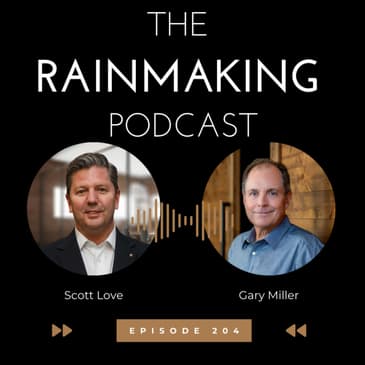
In this episode of The Rainmaking Podcast, host Scott Love speaks with Gary Miller, owner of Miller Resource Group, about building long-term client relationships and establishing a powerful personal brand in executive search. With over 47 years of experience in the recruiting industry, Gary shares real-world insights on how to develop trust with clients, stay top-of-mind, and consistently generate new business. He emphasizes that success in business development isn’t about quick wins—it’s about showing up, building authentic connections, and delivering value over time.
Key topics include the importance of genuine care in client relationships, how industry involvement through conferences and associations strengthens credibility, and why rainmakers need to focus on being present where their clients are. Gary shares his strategic approach to networking at industry events, explaining how attending conferences—not just trade shows—positions professionals as trusted advisors. He also discusses leveraging LinkedIn for personal branding, the role of consistency and persistence in business development, and why a single phone call or introduction can change the course of a business. This episode provides actionable insights for professionals looking to build trust, gain more clients, and create a sustainable business development strategy.
Visit: https://therainmakingpodcast.com/
----------------------------------------
Gary Miller has been in the recruiting industry for 47 years and is the CEO of Miller Resource Group, and executive search firm based in the Chicago area that focuses on manufacturing.
----------------------------------------
This show is sponsored by Leopard Solutions Legal Intelligence Suite of products, Firmscape, and Leopard BI. Push ahead of the pack with the power of Leopard. For a free demo, visit this link:
https://www.leopardsolutions.com/index.php/request-a-demo/
Links:
https://www.linkedin.com/in/bestrecruitingfirm/
Learn more about your ad choices. Visit megaphone.fm/adchoices
[00:00:01] You're listening to The Rainmaking Podcast, hosted by high stakes headhunter, author and professional speaker, Scott Love. This is The Rainmaking Podcast, and my name is Scott Love. Thanks for joining me on the show. Our guest today is not a speaker on client development.
[00:00:32] He doesn't go to conferences speaking about how to get business. He actually does it. His name is Gary Miller, and he's the owner of Miller Resource Group, an executive research firm in Chicago. Why do we have Gary on the show?
[00:00:44] Because he brings 47 years of experience in building and keeping and growing client relationships. In our conversation, we're going to talk about what he actually does to build a brand, to build a name, to put himself in the right place at the right time, and to earn
[00:01:01] that client trust. I hope you get some great ideas from my conversation with Gary. And I'd recommend this is one of those shows. I'd recommend going back and listening to it again, because there's some real nuggets in here.
[00:01:12] Ideas that you can take today and see an immediate improvement in how you make those connections with your clients and how you move those relationships forward. I hope that you enjoy the conversation with Gary. And as always, this show is sponsored by Leopard Solutions, Legal Intelligence,
[00:01:27] suite of products, firmscape, and Leopard BI. Push ahead of the pack with the power of Leopard. And one other thing I wanted to mention, I wanted to thank the National Association of Personal Services for putting me on their calendar for their conference in October in
[00:01:42] Phoenix at the Wigwam Resort. So check out NAPS360.org if you're in the executive search industry for that conference information. And also, thank you to the Legal Sales and Service Organization for inviting me to speak at your Raindance Conference several weeks ago in Boston.
[00:01:59] It was great meeting all of you. Thank you so much for that. Anyways, here's my conversation with Gary. And I hope you get some great ideas out of this. Thanks for listening. Hey, this is Scott Love with the Rainmaking Podcast.
[00:02:12] I've got a good friend, an old friend of mine, Gary Miller, talking about a rainmaker's journey. Gary, thanks for joining me on the show. Hey, happy to be here, Scott. This could be fun. Absolutely. Now you've built up a very successful executive search practice, a firm.
[00:02:27] You've got a great reputation. People in the industry that have known you always say good things about you. So you know the power of having a name. Let me ask you this. In terms of developing client trust, what do you think it is that causes people to
[00:02:43] trust you and your colleagues more than your competitors when giving you work? That's a good question. I mean, I've said this to clients before. I think the operative word there is care. I've said to clients, they said, you may find people that care as much about
[00:02:59] a good outcome as I do, but you won't find anybody that cares more about a good outcome than I do. They say sometimes a strength is a weakness. I grew up the youngest child. I had three older sisters that used to beat me up and batter me.
[00:03:16] And I was always like, I recognized very early on that pleasing my parents was better than being in the doghouse. So my sales assessments and whatnot say more of a pleaser. That seems to have helped me build a clientele.
[00:03:36] I mean, I want to do a good job for people. I don't want... I mean, early, early, early in my career back in the 70s, somebody told me one time I was doing a search for a client and he gave me some feedback after he said,
[00:03:52] that candidate was so bad. If you ever send me a candidate like that, we're finished. And it kind of like gave me like a jolt of seriousness about, hey, I got a reputation to protect here. That's not what the client asked for.
[00:04:06] I got to give the client what the client wants. So anyway, it's just kind of like it's kind of a built in care about doing a good job is probably where it all starts. Yeah, that's great. And so how long have you been in the recruiting industry, Gary?
[00:04:18] When did you start? Well, July 5th coming up here, that'll be my 47th anniversary. Wow. Wow. All with the same company. I'm supposed to have a lot of empathy. Recruiters are supposed to have empathy. I have no idea what it's like to change jobs.
[00:04:34] I mean, never going through an interview process myself since I got hired. And so in your career, when do you think things really took off? At what point do you think you really finally understood what your work is all about
[00:04:51] and how earning client trust became easier for you? I think probably in somewhere around my first year was the first time that I had a client say, hey, you did a great job. I need you to find more people like that for me.
[00:05:10] I need three more like that. And back then it was, again, there's no internet. There's no email. There's no fax machines. Everything was based on my ability to persuade and influence the client that I heard what you said. I found that in this candidate.
[00:05:28] Here's why I like them. Here's where I see the fit. You should see them. I've got Friday open. It's just a sales process. But you had to really communicate, you had to intuit what's a good candidate as much as check the boxes or do a keyword match.
[00:05:47] So early on, the clients were recognizing my ability to match chemistry as much as skills. I remember convincing a client one time to interview somebody that was absolutely nowhere near the job description that he said, I said, trust me, just see this guy.
[00:06:04] And he went up hiring and the candidate went on to be a great salesperson and whatever. So that gives you confidence that you know people, can read people. And so that was early on. That's probably what made me stick with it.
[00:06:19] That's great. So let me kind of summarize what we have so far. You talked about really caring. I also think you mentioned the competence. You've got to be good at what you do. Have you ever been in situations where clients looking at you and another provider,
[00:06:33] another search firm, and they end up choosing you or maybe not choosing you before? Have you ever had that happen before? Or sure all the time. Yeah. Tell me about that. Well, as being a I think besides being a rainmaker is one opening the door,
[00:06:46] being able to open the door, but into somebody's life, build rapport in 20, 30 seconds and then earn another 20 seconds and earn another two minutes. That's a skill in and of itself. But we also specialize in some niches that are, you know,
[00:07:03] we work a lot as in factory automation, robotics and whatnot. And we're very present, very much present at trade shows, conferences, whatever we're invested in the industries that we serve. And we've had many clients tell us why they chose us is because we're there.
[00:07:24] Yeah, I like going to industry conferences. Some people like going to trade shows. I don't like trade shows as much. They're fine to meet people. But at a trade show, people are there to sell their wares. They'll spend a million dollars on a boost to bring in customers.
[00:07:41] And if I go there as a freeloader, just, you know, and they got other priorities. When I go to a conference and pay the same freight that they pay, and I'm a member of the association, I go to a conference
[00:07:54] and I'm sitting elbow to elbow with them, listening to a speaker or an educator. I'm interested in what they want, what they're interested in. And that kind of sets you in a puts you in a different realm, so to speak. I've had clients.
[00:08:11] It's funny when clients have asked me to do a search on something that I'm not that familiar with, and I've tried to win them over. It's pretty hard to win against an industry expert in a field.
[00:08:23] If I got to search for a lawyer right now, I could talk a good game, but I would be no match for you. Well, I think you would because you're good at this, Gary. I mean, you're good.
[00:08:32] You're the kind of person that's good at everything that you do. And so let me kind of go back to what you talked about with conferences, because I've also found that to be an effective use of time.
[00:08:42] And if you think of the hierarchy of how do people make buying decisions, they're going to buy from someone that they know more than someone that they don't know. And the fact that you're at a conference, it's an organic introduction. There's no scheme.
[00:08:54] There's no scheme about I'm going to meet this person. I mean, maybe there is, but when you just allow those relationships to happen naturally, there's real trust that's being built. So when you look at your plan for the year, when you and your colleagues do this,
[00:09:07] when you go to a conference, what are the goals that you have when you go to a conference that's within your industry niche? Tell me more about that. I'd like to say, or maybe your audience would like to hear that I'm super strategic and KPI oriented
[00:09:23] and whatnot, like I'm going to get so many clients, meet so many people. I actually take more of a Zen-like approach and just show up. Yeah. I know there's people I'm going to see and there's people I'm going to meet.
[00:09:37] Every time I've been to a conference, I do a recap of everybody that I met. And usually it's about 10 to 15 good conversations a day. Yeah. And I know if I go to breakfast, if I go to the coffee break,
[00:09:56] if I mingle during the exhibits, if I sit with a stranger at lunch, if I go to happy hour, I go on the walk, I play in the golf tournament. I'm going to meet a whole bunch of strangers.
[00:10:09] And if you think about 10 minutes of conversation or five or 10 minutes of conversation, it's to be about 10 to 15 people a day. So I know I'm going to have 30 to 40 meaningful conversations every conference I go to. I'll bring some of my team with me.
[00:10:26] They'll be much more focused and try to set up appointments and set up meetings. But I think, who was it? Woody Allen or somebody? 90% of success is just showing up. Showing up. Yeah, I like that. And let me kind of talk about that.
[00:10:40] 30 to 40, what you said, meaningful conversations. How would you describe, what's your definition of a meaningful conversation? Well, in some cases, somebody pulls your sleeve as you're walking away and says, hey, I need to talk to you. You're the recruiting firm, right?
[00:10:55] That's going to turn into a meaningful conversation. Right. But if you think about, go back to the old days, the initial prospecting when there was no internet email, whatever. And it was a phone call. And you're trying to butt into a stranger's life, like I said,
[00:11:10] and earn 20 seconds to earn another 20 seconds to earn two minutes. You're at a conference. You're both there for the same reason, to learn, to grow, to meet people. And so somebody says, so what is Miller Resource Group do? You're standing there having coffee.
[00:11:27] What does Miller Resource Group do? You got a badge. Miller Resource Group. Oh, we're in the executive search firm. We specialize in this industry. We work with companies just like you to help them find talent. Tell me about your firm. What are you famous for?
[00:11:40] How long you've been there? And it's just such a natural dialogue. Yeah, yeah. And it's like, hey, give me your card. We have some things to work on. We got to talk when we get back. Fine, I'll follow up when we get back.
[00:11:53] I mean, it's just so natural. It's like meeting somebody at a neighborhood cocktail party. It's just so natural. Yeah, do you think people have a fear of that? Do you think that people just, I hate networking. They might say it's expensive. I don't want to go.
[00:12:11] Do you think people think that? Or do you think most people just hesitate to go to those kinds of meetings? Yes. And I know I thought it the first time I went. I was talking to an old client who was on the board of one of these associations.
[00:12:26] And by the way, this is a relationship that goes back 35 years. I mean, the relationship podcast would be a good sequel to the rainmaking podcast. Right. Anyway, he said, Gary, I'm on the board of this association and I'm going to be retiring soon.
[00:12:41] And there was a headhunter who was part of the association and he's retiring. In our last board meeting, we said, who's going to be our new go-to guy? He said, you should go. And I'm like, really? They would have me? Like, they don't want a headhunter.
[00:12:55] They're, you know, and I was very anxious about going and I sucked it up and bought a ticket. I joined the association. And I remember being really nervous about like, you know, I'll be, they don't want to talk to me. That's the headhunter. Stay away from him.
[00:13:10] He'll steal your people. All kinds of things go on in your head. But I showed up first guy I walked up to at a cocktail party and said, hey, what do you do? I am Miller Resource Group. I'm new to the association. So-and-so said I should join.
[00:13:22] We're a recruiting firm. We work with companies in this industry. What do you do? I'm the vice president of sales at this kind of company. We have to talk. We need to hire about five or six people.
[00:13:31] That was in five minutes of walking in the door, my first association. Wow. And so we've used that as a business development training model for new people for quite some time. It doesn't always pay off. I don't guarantee.
[00:13:45] There's no guarantee you're going to go to association and win the day at a meeting. But it certainly gives people chances. Absolutely right. It gets them to see their marketplace through a different lens. And really, it's the lens of the clients, the people you're trying to serve. Absolutely.
[00:14:04] And that's where all the big issues of the day are being discussed within that industry. Look at the breakout session topics. Then you can find out what everybody's thinking about. And then you get to find management consultants, other business experts that work in your niche,
[00:14:18] develop alliances and friendships with them also. Have you or any of your colleagues ever gotten involved in speaking at conferences or sitting on panels or things like that? Yep. It happens all the time. Tell me about that.
[00:14:29] Well, I would say this, and this is the conferences we go to, but I've heard this in almost every association you go to. They do surveys. How's business? What's your forecast look like? What are the top issues facing you?
[00:14:45] Talent acquisition, talent development is usually in the top one or two. Reassociation. So people want to hear our views. And if you think about the data set that we have, especially with our tenure, your tenure, I mean, you count the placements you've made, you count how many interviews
[00:15:06] had to take place to make those placements, you count how many candidates you had to interview to refer that many people, and then you take the collective feedback from tens of thousands of interviews that have taken place from both candidates and clients
[00:15:23] and what they thought of the other party after an interview. That's one of the most, in a world where talent acquisition and talent attraction and hiring is, that's like the most valuable data set that there is to share. And people want to hear from you.
[00:15:40] And so yeah, public speaking is not for everybody. I mean, I did it when I was young. I remember being nauseous the night before, didn't throw up. But the second time I was a little queasy.
[00:15:52] But still, if you're speaking in front of a group of strangers, you should be appropriately anxious. Right. Zig Ziglar would say, it's OK to have butterflies, just get them to fly in formation. That's right. That's right.
[00:16:06] And one thing I want to come back to what you just said, you talked about, we're talking to people all day, the data set that we have, I think most people in the recruiting industry, and not everybody that listens to the show is in the recruiting industry, obviously.
[00:16:19] But I don't think we understand the depth of value that we have in terms of knowledge because we talk to people every day. We do what CEOs of companies can't do. We talk to their competitors, best people every day, and we know what's on their mind.
[00:16:32] We know why they move. We know why they stay. And so I think that just the whole talent and I find what's interesting is that even though there seems to be increased trend in terms of demand for
[00:16:44] talent, it seems to be harder to get them because everybody else is looking for people with even more effectiveness as well. So it means that people like you and me, our demand is higher because we have that skill.
[00:16:57] But one thing you said that I wanted to go back to about conferences, I think it's probably if we were to look at the dollars per hour, 2080 work hours in the course of a year, if we were to look at our highest
[00:17:13] value in terms of how are we being paid in that unit of time, those two days at a conference, let's just say 16 hours, we're probably billing $20,000 an hour in those two days in terms of what we actually get out of it compared to everything else.
[00:17:32] And I think when people look at it that way, what you said, 30 to 40 meaningful business conversations in a compressed period of time. And what I've also noticed by being at conferences as well is that it's appropriate to get right to the point because that's what they're there for.
[00:17:48] We don't have to develop some sort of cheap plastic rapport. Oh, you fish. I like to fish. Where do you like? You know, so what do you do? Oh, tell me about that. I need to talk to you because that's why we're there.
[00:17:58] It's kind of like speed dating. We all know why we're there. You know, we all know why we're there. We can just get right to it. So I think, I think the wisdom that you have is rich. I think the perspective that you have is spot on.
[00:18:10] I don't see a lot of people in any professional service. I think everybody should be doing it. I don't think a lot of people do. So let me ask you this. What would be your advice to somebody that is in a professional
[00:18:22] service, whether they're a recruiter, investment management person, investment banker, management consultant lawyer, if they're kind of at that point where they need to start getting their own clients, they need to start getting their name out there. What would be three things you would recommend that that person do?
[00:18:41] If there are three actions that they would take, what would those three actions be? Well, my mother passed away. This is a strange start to this answer, but my mother passed away a few years ago. She was 97. She was in her hospice and she was still pretty lucid.
[00:18:57] But I said, mom, in your life, what's the biggest change that you remember that impacted your life? And she's thought for a minute and she said hot water. And for me, it was LinkedIn. If you are not maximizing LinkedIn as a networking tool, a branding
[00:19:19] tool, you are just missing a huge opportunity to build a brand and to build your reputation. You said people like to do business with people that they know. One of my young guys works for me is a LinkedIn aficionado.
[00:19:35] He's creative, he's funny, he's talented, but he adds value. And he cold called somebody the other day and the guy said, John Freeman, John Freeman, your name is familiar to me. Are you on LinkedIn? Yeah, I am.
[00:19:49] As a matter of fact, that was all it took just the guy that was slightly familiar with him. So the opportunity there to build your brand is there. Number two, geez, I don't know. I mean, I get philosophical about this.
[00:20:03] I mean, say, I forget the quote, but something like when one truly commits oneself, Providence moves too. I can't, when you are absolutely dedicated to your profession and committed to behaviors that are going to promote your brand and
[00:20:19] serve customers, simple example, I can't tell you how many times in my, especially in my youth, I'd be committed like this is the week I'm going to kill it. I'm going to map out 200 companies that I'm going to go after. I got my script ready.
[00:20:35] I'm ready to go at nine o'clock. I'm going nine o'clock sharp Monday morning. I'm going to hit phones, 40 dials a day every day by, by 10 o'clock somebody's calling me and giving me some business. Yeah. Right. Right. Because I put this commitment out in the universe.
[00:20:52] So, I mean, have a plan and execute it. And, uh, I don't know. I mean, you gotta keep them. I mean, those 40 dials or the, excuse me, those 40 meetings at that conference and does not live on 40 interactions at a conference alone. Right. There's still a telephone there.
[00:21:12] I mean, I, I'm trying to get people don't dial a phone that much anymore because people don't answer the phone that much. Right. I think there's a huge opportunity there to stick to metrics that, you know, use that telephone to lead messages, to tell stories, you know,
[00:21:28] stick to it, block out that time, make it work. The internet is like the, somebody called it one time weapons of mass distraction. I mean, there's so many, it's good that you can look up a prospect before you call them.
[00:21:44] It's good that you can see how long they've been there. It's good that you can see what college they went to. It's not good to go to the college website and start following their football team. I mean, you can get pulled in so many directions. I know.
[00:21:57] So take advantage of LinkedIn. Take a long view, keep a positive mindset, make commitments to metrics. They have sufficient conversations. Yeah. Yeah. And then I love that Jim Rohn quote, work harder on yourself than you do on your job. Yeah.
[00:22:15] I mean, if as soon as you think you arrive, you're, you're done. Yeah. You're absolutely right. Yeah. I love it how in professional services, it's character business. And if you look at those people that are successful, it's usually some sort of virtue that drives them.
[00:22:29] People that aren't successful. Same thing. I really liked what you said about LinkedIn. I did a deal probably about a year and a half ago. It wasn't my biggest deal, but it's like in the top five.
[00:22:39] It was actually a merger where the firm founder reached out to me on LinkedIn and his line to me just said this, I want to talk to you about your business. That's what it was.
[00:22:49] And I really got to know him and he's such a great person and the firm emerged them in a really big firm. They love them and they were just really pleased. It worked out for everybody. I asked him, how did you hear about me? It is social media.
[00:23:02] And when people say you don't get inbound, well, you do. And whenever you do, it's like, boy, that's just gold. I think when you can build a brand and what I've learned, Gary, is that, you know, I have somebody that works for me, Gabriella.
[00:23:15] She's been with me over three years. She does all my LinkedIn posts. I might maybe do one out of 20 where it's something personal picture of me and my son on the golf course or something like that, but all of the social media, I'm able to delegate.
[00:23:27] So I think LinkedIn can be a tool that you can delegate just to keep people like you and me in front of clients, in front of prospects, more person to person and use technology to your advantage. I think my personal philosophy is that the whole point of
[00:23:42] technology is relationship. It's to move relationships forward, perhaps in a way that it can be scaled, perhaps in a way that can accelerate it, but also in a way that helps you grow deeper. I think that's what technology is all about.
[00:23:55] But Gary, you've been a great guest today. I appreciate your insight. I like the fact that you're not a BD coach. You're a regular BD professional. You're a business development expert because you do this. So I think that gives a ton of credibility and we're going to put
[00:24:11] your contact info for your company on the show notes. So if people want to reach out to you, they'll know where to find you. And thank you so much for being a guest on the show today, Gary.
[00:24:21] You are welcome, Scott, but I would like to add one more thing. Sure. Yeah, if I could, because, you know, again, over 47 years with the first half of it, the telephone being the only tool that we had tens of thousands of dials, whatever.
[00:24:37] Yeah. But I could probably point to a handful of calls, just a handful count on one hand that those calls led to relationships that built the significant chunk of our business over 40 years. And so the expectation that you're going to win on every call is folly.
[00:25:00] Yeah. But if you make 100, something good might come up out of one. You know, so just don't ever underestimate the power of numbers. And if you're prepared and ready, one of those calls could change your life, that person's life, your family's life. It's just a mind boggling.
[00:25:20] So now thank you for having me on the show. Thank you so much, Gary. I hope that last tidbit was helpful. Let's plan on you coming back on in the next couple of months and we'll have like part two and continue the conversation.
[00:25:33] How does that sound? Part two. I love it. Great. Thank you, Gary. Thanks again. All right. Take care. Thank you for listening to the Rain Making Podcast. For more information about our recruiting services for international law firms, visit our website at AttorneysSearchGroup.com
[00:25:54] to inquire about having Scott speak at your next convention, conference, sales meeting or executive retreat. Visit therainmakingpodcast.com.