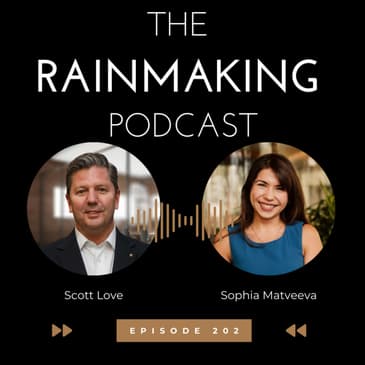
In this episode of The Rainmaking Podcast, host Scott Love speaks with Sophia Matveeva, CEO and founder of Tech for Non-Techies, about how professional service providers can attract and work with tech clients. Sophia, an expert in tech education for business professionals, explains that technology is reshaping every industry, making it a lucrative and forward-thinking niche for consultants, lawyers, and other service providers. She emphasizes that understanding the language and mindset of tech founders, venture capitalists, and startup executives is essential for building relationships and winning business in this sector.
Key topics include the importance of learning the fundamentals of tech without becoming a coder, how to segment the tech industry into consumer and enterprise sectors, and how professionals can leverage tech accelerators and networking opportunities to gain credibility. Sophia shares three actionable steps: 1) Acclimate to tech language by listening to tech podcasts and industry news, 2) Engage with the industry by attending tech accelerators and networking events, and 3) Build credibility by mentoring startups or advising at incubators. She also highlights common pitfalls, such as trying to learn coding unnecessarily instead of focusing on industry fluency and relationship-building. This episode provides practical strategies for professionals looking to break into the tech sector, position themselves as trusted advisors, and capitalize on the rapid growth of digital transformation.
Visit: https://therainmakingpodcast.com/
----------------------------------------
Starting on June 25 at 1 PM Eastern time, Scott Love will lead a virtual six-session masterclass with a small group of professional services providers on the topic of rainmaking. Space is limited. Get your seat today at www.rainmakingseminar.com. Use discount code “podcast” for a $200 tuition discount.
Sophia Matveeva is the CEO & founder of Tech For Non-Techies, an executive education and consulting company.
Sophia has contributed to the Harvard Business Review, Financial Times, The Guardian, and Forbes on entrepreneurship and technology, and hosts the top-rated Tech for Non-Techies podcast.
She has also guest lectured at the University of Chicago, London Business School, and Oxford University.
Sophia is a start-up mentor at the Chicago Booth Polsky Center of Entrepreneurship and has advised leading accelerators including Chicago Booth’s New Venture Challenge and the Techstars x Blackstone Launchpad.
She holds an MBA from Chicago Booth, and a BSc (Hons) in Politics from Bristol. She speaks English, Russian, and French.
Sophia also sits on the Advisory Board to Riviter, which uses AI to predict consumer trends for the world's biggest brands.
----------------------------------------
This show is sponsored by Leopard Solutions Legal Intelligence Suite of products, Firmscape, and Leopard BI. Push ahead of the pack with the power of Leopard. For a free demo, visit this link:
https://www.leopardsolutions.com/index.php/request-a-demo/
Links:
https://www.linkedin.com/in/sophia-matveeva-556365a/
podcasts.apple.com/gb/podcast/tech-for-non-techies/id1516475320
Learn more about your ad choices. Visit megaphone.fm/adchoices
[00:00:01] You're listening to The Rainmaking Podcast, hosted by high stakes headhunter, author and professional speaker, Scott Love. You're listening to The Rainmaking Podcast and my name is Scott Love, your host. Thank you for joining me on the show today. I've got a special announcement for you.
[00:00:32] Now my core focus is to recruit corporate partners, private equity partners for global law firms, but I've also done a lot of keynote speaking and training over the years. It's something that I enjoy doing.
[00:00:43] One thing I'm offering up for listeners of the podcast is to join me on my six session virtual masterclass on rainmaking for professional services providers. This is six different sessions. One of those is going to include a one-on-one group coaching session and we're going to go deep.
[00:01:02] How can you get more cache from your clients? How can you build a name in your industry niche so that when you walk into a room of professionals in your niche, people that haven't met you before, they already know who you are.
[00:01:15] This is the key to getting more business to come to you and how can you use thought leadership as an active way to get new clients in the short term? I'm going to share all that with you in six different recorded Zoom sessions.
[00:01:30] Like I said, five of those are going to be as a group and a small group cohort of no more than 10 professional services providers. Regardless of the industry that you're in, consider making an investment for yourself.
[00:01:43] The tuition is $1,500 per attendee and I've also got a special discount of $200 if you use the coupon code podcast. When you type it in, it'll take $200 off your registration. You've got to do that soon because I know people are going to sign up.
[00:01:59] Just go to rainmakingseminar.com and that'll take you to that link and you can go to the show notes and find that. Thanks for listening to my very mild and brief commercial. Like I said, I don't do these types of virtual sessions very often but I'd love
[00:02:15] to share with you what I know. Let's get right to our program now. Sophia Metviva is a startup mentor. She's the CEO and founder of Tech for Non-Techies, an executive education and consulting company. Our topic for today is how to get tech clients and professional services.
[00:02:34] She's someone that's deeply involved in tech. I know there's advantages and disadvantages of looking at any industry niche but I think even the business development concepts that she mentions here are things that can be applied
[00:02:45] to what you do even if you don't look at tech as a potential niche. It's really interesting and I hope you enjoy my conversation with Sophia. As always, this show is sponsored by Leopard Solutions Legal Intelligence Suite of Products, FirmScape and Leopard BI.
[00:03:01] Push ahead of the pack with the power of Leopard. Now here's my conversation with Sophia Metviva. Thanks for listening. Hey, this is Scott Love with the Brain Making Podcast. Our guest today is Sophia Metviva and our topic title is how to get tech clients in professional services.
[00:03:22] Sophia, thanks for joining me on the show today. Thank you for having me, Scott. I'm really excited about this conversation. Me too and I'm really interested in this niche topic and this is something that those
[00:03:34] people listening, I would be willing to bet a lot of them would love to get tech clients as their clients and if they're in a business that's not necessarily pursuing tech like me, I actually have many clients whose clients are tech clients.
[00:03:48] So I'm interested in this topic also. And so let me kind of get some working definitions here when you talk about how to get tech clients. What is included in that definition of a tech client? Is that software, hardware? What does that mean to you?
[00:04:03] Well, I would include software and hardware in that. But also I would include venture capital because venture capital, they fundamentally most of the time they are supporting the tech industry. And when you are learning how tech companies work and what tech companies see as success,
[00:04:23] you are by default also learning how venture capitalists think. And so not only is that a useful skill set, but if you then end up representing, for example, a tech startup, so maybe I don't know, an AI startup that goes from
[00:04:40] seed to series A to series B, then eventually to IPO. And so then you're representing a listed business and you have also got to know their investors and then you start representing the venture capital community.
[00:04:53] Well, not only do you have a very lucrative business, you're also, I think, doing something really interesting, just doing something very intellectually stimulating because it is these businesses that right now are changing the world. We're living in the digital age.
[00:05:10] So it's software companies and it's the venture capitalists that support those companies that are essentially really changing the business world. And I think being an advisor and being at the forefront of that innovation is incredibly lucrative, obviously. But it's also, I think, just fun. Yeah, interesting.
[00:05:28] So what is it then in terms of the life cycle of tech? Is this something, have all the tech companies already been built? Is this at a, would you consider this a mature industry? Where do you think that is in terms of the industry's life itself?
[00:05:45] You know, I know this sounds kind of unbelievable, but I think we're right at the beginning or maybe if not kind of day one, then day two, but definitely not day 100. And the reason is if you actually look at the Fortune 500 today,
[00:06:00] less than 10% of the Fortune 500 are classified as tech companies. And this might sound kind of counterintuitive because big tech, they're so dominant, right? Whenever we open the Financial Times or the Wall Street Journal, it's big tech everywhere, big tech regulation and so on.
[00:06:19] But actually that's a small set of companies. And so this shows that there is a huge amount of room to grow and that innovation is only speeding up. I mean, look, we didn't even really know about chat GPT this time last year
[00:06:34] and look at where we are today and how much industries and how much companies are already being changed by this and look at what people are saying about the future of work. So that's point one. Point two is that digital transformation is on the minds
[00:06:50] of every single CEO of any kind of large company. So whether that's an energy company, real estate or whatever it is. So yes, I know that we're talking about getting tech lines specifically, but a lot of businesses are now becoming so tech enabled that actually the opportunity,
[00:07:11] I think we want to think about the tech sector. But also how is that tech sector enabling the rest of the economy? Because software is now kind of like electricity, it's everywhere. This is why I do think that if you're a lawyer or you're a consultant or
[00:07:28] you're an accountant and you're thinking well, I need to pick a niche. I need to figure out who my ideal client avatar is so then I can create a strategy. If you're not sure which way to go, I suggest tech and
[00:07:43] digital transformation, they're basically going to be a gift that can keep on living. Because if you look at say the energy industry, it's really lucrative, it's really interesting, but it's long term prospects. I'm not sure about them. I'm not a specialist, but
[00:08:00] I'm not sure about where that industry is going because obviously with natural resources they are being depleted, there are issues there. With tech, I'm confident that in 20 years time, this is still going to be an industry that is incredibly lucrative and
[00:08:14] that's not going to go anywhere for a long time. Well, this is really interesting. And so if we were to look at certain sectors within tech, how can we segment those? The first one I think of is fintech companies in banking that do
[00:08:30] the payment processing companies, even Apple became a fintech company. What are kind of the segments within tech that you think we could kind of parse them into? So you can either think of it that way. So basically technology for specific industries.
[00:08:44] So is it going to be travel tech? Is it going to be fintech? Is it going to be legal tech? There is that way of doing it. Then there's another way of doing it, which is consumer versus enterprise because they're very different things.
[00:08:57] Enterprise software is all about enterprise sales and who knows more about enterprise sales than B2B sales professionals. So basically the people who are listening to your podcast, because if you're a lawyer or you're an accountant, you are doing enterprise sales basically, you're selling to business clients.
[00:09:16] So you might even kind of feel a natural affinity to these people because they're also trying to get B2B clients. Whereas consumer companies, a lot of the time they're focused on digital marketing and advertising via Facebook, you know, advertising
[00:09:29] campaigns on TikTok, which maybe you are less familiar with, but all maybe it's the opposite. So I often think that consumer versus enterprise can be a good way of looking at it because for example, let's say you are focusing on
[00:09:46] consumer tech companies and one of your clients is, let's just imagine Uber so that ride hailing and another one is a dating app. Right? So at first they look like very different things. You know, the end product of an Uber is that you go from A to B.
[00:10:07] The end product of a dating app is that, you know, you meet the law of your life or at least have a very pleasant evening. So these are two very different outcomes. But actually in terms of the strategy, in terms of the marketing
[00:10:21] and in terms of the actual tech product that these companies would make, it's very, very similar because both of them are consumer platforms. So if you understand consumer platforms, then actually if you understand one, then you can kind of translate it to the other ones.
[00:10:37] So there are different ways of focusing. And so what I would say to people is that sitting there by yourself and thinking, OK, well, I've decided I want to focus on tech, but which bit of the tech industry shall I pick? Right.
[00:10:53] I don't think that's a very useful way of doing it because that assumes that you are sitting there by yourself and you have all of this infinite choice. And I don't think that's true, right? That's not true for any of us. Yeah, I like to segment this.
[00:11:08] I think that's brilliant. Besides consumer versus enterprise, are there any other variables that we could segment clients into besides that? Well, so also what I often suggest to people is that essentially every single industry, every single traditional industry is being changed by technology. So you mentioned fintech.
[00:11:28] So there's obviously fintech. Then there's ag tech. So that's advertising technology. And that field is absolutely huge. Then there's insurance. Then there's health tech. Health tech is absolutely massive, especially it exploded with the pandemic. So there are all sorts of different fields.
[00:11:47] And so when you're thinking which one of these, let's say, tech sub-industries do I go to? Because you can literally look at every single industry that exists and basically make it a sub-industry of the tech industry. Does that make sense? It does. That's interesting.
[00:12:01] So then you can think of, if you're thinking of transitioning and say you're working with the energy industry. And what I just said to you about the energy industry and future prospects made you think, oh, hang on. I'm not sure about this. Maybe I need to diversify.
[00:12:17] Then you can start thinking, OK, what are the tech companies? What are the software companies that are working with energy companies? Because it's all about transferable skills. So for example, if you've been working with energy companies, it's not really likely that you're then going to pick up
[00:12:37] a dating app client. The jump is just too big. But there are lots of tech companies that are focusing on, say, supply chain, industrial supply chain, that would work with the likes of Shell and BP and so on. And so then working with one of those companies,
[00:12:56] becoming an advisor to one of those companies, that's much more realistic. And then that's kind of how you make that transition from an industry that's going in one direction to an industry that's going in a different direction. Does that make sense? It does. That's a great idea, Sophia.
[00:13:12] So do you think tech companies, are they easier to sell to or harder? What do you think about that? So I'm going to speak from my experience and from the experience with the people that I work with.
[00:13:24] So I'm not a lawyer, but I have been a tech company CEO. And I have hired lawyers, I've hired accountants, and I've hired advertisers. And what I've seen is that the mindset of professional services often is very, very conservative, especially if you're speaking about lawyers and accountants.
[00:13:46] Usually these are very traditional professions, and they are trained to look at precedent. Now, tech innovators are literally the other side of the spectrum. They are innovators, and I'm not saying this in a kind of, let's idolize these people. What I'm saying is that tech innovators
[00:14:05] are using the scientific method to figure out what to do next. So they don't really have a clear plan. They certainly don't have much precedent. They basically have an idea of what they think will work, and then they just do a bunch of experiments, most of which fail,
[00:14:19] to then see what next step is the right one. And so one is a very iterative approach, that's the tech approach. And the professional services approach is very much based on planning and precedent. And so when you have these two very different mindsets colliding,
[00:14:39] well, you have lots of misunderstandings, which I think is a real... I think it's a shame, obviously, for the lawyers and the accountants listening to this, but also for us, for the tech clients, it's a real shame, because every single client wants to have
[00:14:54] a great relationship with their service provider, right? Especially about something as emotional as legal matters or financial matters. So to answer your question, I think that tech lines are harder to get for people who are classically trained in professional services, because the mindset is so different.
[00:15:18] But if you work on that mindset, and if you understand that the way you've been trained is perfect for drafting legal agreements or for drafting accounts, but the way your client operates is in a very different way, then you'll be able to kind of understand
[00:15:35] that they're a different creature to you. And when you understand that you're not wrong and they're not wrong, you're both just different, then you can respect and learn from each other. And when you have that relationship, mistakes can be forgiven, contracts can get renewed and so on.
[00:15:52] And it's a beautiful thing. This is really interesting. Let me ask you this, Sophia, what is the perspective that the decision maker in a tech company has in terms of choosing a professional service provider? What do you think is important to them?
[00:16:07] If we're going to pitch our professional services, what's the lens through which they're looking in terms of who they choose to buy from and who to hire? So I'm sure everybody says this, but it's about relationships. So how have I, for example, hired any service providers
[00:16:24] when I was running a tech company? I would ask my investors and I would ask my fellow founders, who are you using and whom did you like? So relationships matter. Also what matters is essentially who you worked with before. And so then this puts professional services providers
[00:16:42] who want to get into this space into this really annoying situation when you're like, okay, well I need experience to get experience. What am I supposed to do? And so this is why there are all sorts of ways that you can, I suppose,
[00:16:59] game the system in order to get that experience. So for example, a really good way is to participate in tech accelerators and get involved as a mentor to startups because that's the way you get inside the industry. And you start doing what I call speaking tech
[00:17:21] because if you can come in and you can say, I have advised these startups, even if it's a bunch of startups that nobody's ever heard of, if these startups have existed, they've done some stuff and you also speak in a way that shows
[00:17:37] that you have actually spent some time around these people. You understand what they're thinking about. You understand what they're worried about. You've heard them talk about product metrics and how they measure success, which is usually different from the way, different kind of business would measure success.
[00:17:54] Then the founders, the decision makers, they're going to be able to pick it up because you can see it. And I'm sure it's the same with real estate or any other kind of company that every industry has its own jargon.
[00:18:08] And so when you are speaking to the decision maker, do you understand the jargon that they're using? Because they probably don't even know that they're using jargon. Because for example, in tech, we're always talking about product metrics. We're talking about engagement metrics, for example.
[00:18:24] If that makes no sense to you, then I would recommend go and figure out what that is because sometimes you can ask questions and say, can you clarify that? But some things you do just basically have to know. Yeah, that's great advice. And here's another bonus tip.
[00:18:39] I remember hearing this from another sales trainer. He said, if you work in a new niche and you're getting familiar with it, write down 50 buzzwords that you hear. And when I converted my niche to legal back in 2009, I wrote down 75. I was able to get 75 buzzwords
[00:18:55] that helped me become move from conversational to fluent. What do you think about that idea, Sophia? I think this is really brilliant, Scott. And so just before you hit record, I told you that I was in Barcelona. So right now I'm in Barcelona and listeners,
[00:19:13] if you've never been, you've got to visit. It's amazing. I'm here doing a keynote speech. And my Spanish lessons were a while ago. So I was practicing on my DioLingo app, just basically practicing some vocab before I actually got to Spain. But when I got to Spain
[00:19:30] and I actually needed to get out of the airport and get a taxi and navigate my way through the city, that's when my vocab actually made contact with humans. And that's one thing that's got scary, right? Because it's all very well and good practicing by yourself,
[00:19:49] but when you're actually faced with a real conversation, then kind of like I found I was frozen, I forgot what I was supposed to say, I was mixing words and so on. And I think it's the same thing with buzzwords in any industry.
[00:20:01] It's great to do what people are doing right now, listening to podcasts, learning, reading. I think writing down the buzzwords, knowing what they mean and kind of practicing by yourself, that's really important. And then the next stage is actually going out into the country.
[00:20:23] So going to a conference or going to an accelerator, going to an event where that language, that tech language is being spoken and then seeing what happens, are those words being used? Do you know how to use them yourself? Basically have some conversational practice
[00:20:41] because just like with learning a foreign language, we get better with conversation with people who are natives in that language. What do you think of that energy? I think that's great. I think that's brilliant, Sophia. So let me ask you this question in terms of pitfalls.
[00:20:59] What have you seen are the pitfalls, people that are looking to go deeper into tech, what should they avoid? What should they watch out for when they start doing more of what you're suggesting? Well, the most typical thing is that
[00:21:13] people start going too deep for no reason whatsoever. And by that I mean, is that they start signing up to coding and data science courses because they want to learn about the industry. And I run an education company. So of course I am pro education.
[00:21:29] I've also taught at business school. So I think education is a wonderful thing. However, I want it to be education that actually gives you utility or pleasure. If it's not useful and it's not pleasant, then you shouldn't be doing it. And I find that especially for example, lawyers,
[00:21:46] lawyers are, it's a very word heavy industry. And when I've seen lawyers then signing up to a coding course and attempting to learn Python because they think, well, if I do this, if I learned this, then I'll be able to understand my clients better.
[00:22:01] It really hurts them because often their brains are just not really wired that way because they went into a word heavy industry for a reason, they're not coders for a reason. And then they're forcing themselves to do it
[00:22:15] and kind of it drives them into a pit of despair. And I always say to people, if you wanted to work for the real estate industry, would your instinct be to build a wall or to install your own bathroom? No, you know that becoming a plumber
[00:22:32] is not going to help you understand your hotel industry clients. It's the same with tech. What you want to do is you want to understand the concept, learn the jargon, get comfortable with that jargon, understand the basic idea of how does an idea,
[00:22:50] so if I'm a founder, I have an idea and I don't have anything yet. How does that idea go from idea to prototype to minimum viable product, to a product that's scaling, to a product that's monetizing, to a product that's then used by millions?
[00:23:07] Like what does that journey look like? What has to happen? But in order to understand that journey, you don't actually need to build it with your bare hands. So the mistake that people make is they try to build things in order to understand what their clients are doing.
[00:23:26] And often this is a very expensive and unpleasant waste of time. Right. Well, Sophia, what would be three action steps people can take if they want to start pursuing what you're recommending? What would those three action steps be? So the number one thing is
[00:23:47] start acclimatizing and learning that language. So one of the things that I would recommend is literally if you're listening to a podcast, you can listen to some tech podcasts. So there are lots of tech podcasts I can recommend including mine,
[00:23:58] but it's very easy for you to find some tech podcasts, listen to tech founders speaking about their journeys and how they build their companies. And you could just do that on your daily walk. So that's number one. That will make you kind of start feeling comfortable.
[00:24:13] Number two, get involved. So number one is kind of like learning the language but by yourself. It's like me on my Duolingo app doing that Vogue app. But then what you need to do is speak to a native in that language, right? So how do you do that?
[00:24:27] I would recommend find a tech accelerator near you. And there are now so many accelerators pretty much everywhere that you'll be able to find one. And a lot of them now also do online demos. So basically there is no excuse. And you can go to an accelerator demo
[00:24:46] and literally, usually it's kind of a networking event. You see what startups are presenting, what they're pitching, why they're pitching. And usually after that, there's a networking event where there are the founders, the investors and the advisors in the industry all having drinks and having a chat together.
[00:25:03] And some of them are super exclusive like Y Combinator is super exclusive, but a lot of them are basically free entry. So find those and start going. First you'll feel awkward and shy, but eventually you'll start talking to people and kind of become part of the sector too.
[00:25:20] So that's step two. And step three is after you have acclimatized and started speaking to the natives, start adding value to them. And what's a really good useful thing to do is if you could become officially an advisor to a tech startup or a mentor at an accelerator.
[00:25:43] Now, if you're literally transitioning into the industry and you've never done anything before, this will usually be unpaid at first. Sort of like, we had to do kind of unpaid work experience or unpaid internships at the beginning of our careers. Kind of have to do that
[00:25:58] till when we're transitioning into an industry. But if you are a genuine professional services provider who does essentially really know their craft, you can without a huge amount of difficulty offer your services to be a mentor at an accelerator. So you basically mentor some startup founders
[00:26:18] and then you have this thing that you can put on your LinkedIn that you can basically advertise and say, I am working with startups and investors at this accelerator. So it's not only just, that gives you credibility, right? Yeah, this is great. You make it sound so easy.
[00:26:35] Well, you know, everything sounds easy when somebody else is telling you to do it. That's right. And then actually doing it yourself, I mean, I'm giving you the steps. Obviously there's trial and error. Obviously sometimes you'll go to an accelerator and you think this is a disaster.
[00:26:50] I hate everybody here. And you might think, oh no, I'm never doing this again. But then you go to another accelerator and you fall in love. So, you know, this is the rough end. That's okay. You've given us such great advice, Sophia.
[00:27:06] And I know many of our listeners are gonna follow this advice and it's gonna help them. Tell us about your company. What do you do? What services do you offer? What do you want our listeners to know about how you can help them, Sophia?
[00:27:20] Well, I run an education company called Tech Fun on Techies. And if you're listening to this podcast, which obviously you are, then you can also listen to the Tech Fun on Techies podcast. And that's where you can combine the learning that you were getting from Scott
[00:27:34] on sales and how to be a rainmaker with basically knowledge about the technology industry and capital. So then you can sell to those people. You can combine our two podcasts to basically go after some of the most lucrative clients in the world.
[00:27:48] So there's the Tech Fun on Techies podcast. And my aim is to help smart, non-technical professionals thrive in the digital age. And the kinds of companies that we work with are law firms, professional services providers, or companies going through a digital transformation
[00:28:08] that basically have a bunch of really smart people who are very professional, who are not developers, who are not tech people, but whose livelihood and whose success depends on collaborating with tech people. And so I want to help them understand how to do that.
[00:28:24] And I've also taught courses at London Business School, Oxford University, Techstars, and written for the Harvard Business Review. But most importantly for listeners, there's also a free course. If you're interested in what we've been talking about, just go to the Tech Fun on Techies website,
[00:28:38] and you will see that there's a free course that you can take that goes deeper into some of the concepts that we've talked about today. That's great. And we'll put that link for you, your LinkedIn link, and also that course on the show notes. So for everybody listening,
[00:28:52] go to wherever you listen to this podcast, look at the show notes, and you'll be able to get all that information directly from there. And Sophia, thanks for being a valuable contributor to our show. I really appreciate you being on here,
[00:29:03] and thank you for giving us such great advice. Thank you. It has been an absolute pleasure. I loved our conversation. Thank you, Scott. Thank you for listening to the Rain Making Podcast. For more information about our recruiting services for international law firms, visit our website at attorneeserchgroup.com.
[00:29:25] To inquire about having Scott speak at your next convention, conference, sales meeting, or executive retreat, visit therainmakingpodcast.com.