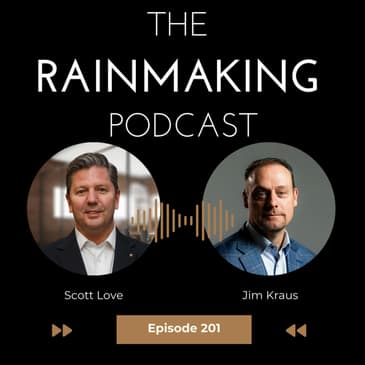
In this episode of The Rainmaking Podcast, host Scott Love speaks with Jim Kraus, President of the Buyer Persona Institute, about leveraging buyer personas to better influence buying decisions. Jim explains that understanding the buyer’s journey—from the moment a prospect recognizes a need to their final purchasing decision—is essential for professionals looking to differentiate themselves, build trust, and increase sales effectiveness. He highlights that trust, not just price, is the primary factor in winning business, and that by aligning messaging with the key triggers and concerns buyers experience, professionals can position themselves as the clear choice.
Key topics include the five critical elements of a buyer’s journey: 1) Triggers that spark a need for change, 2) Key success factors buyers seek, 3) Perceived barriers that create hesitation, 4) Decision criteria that guide the selection process, and 5) The buyer’s full decision-making journey. Jim shares how professionals can conduct interviews with recent buyers to uncover these insights and then map them to their firm’s strengths to craft a compelling, differentiated value proposition. He also discusses how professionals can refine their business development approach using buyer persona research, ensuring they engage prospects in a way that resonates with their needs and concerns. This episode provides practical strategies for professionals looking to improve sales effectiveness by deeply understanding what drives their clients' purchasing decisions.
Visit: https://therainmakingpodcast.com/
----------------------------------------
Jim is the President of Buyer Persona Institute (BPI) and a leading authority on buyer personas and buying insights.
BPI’s buyer persona research and workshop methodologies have become the gold standard for thousands of marketers in hundreds of companies worldwide that rely on these studies to reveal everything a prospective buyer needs to know and experience to have confidence in their solution. Marketers use these insights to develop strategies and messaging that drive more leads, improve conversion rates, and helps sales hit their numbers.
In addition to his work at BPI, Jim is an avid blogger, author of the Buyer Persona Buzz newsletter, and is currently working on a second edition of the book Buyer Personas with BPI’s founder, Adele Revella. He also frequently speaks at events and podcasts to advance the thinking around buyer personas and buying insights more broadly.
Outside of work, Jim enjoys travel, reading, sports, and spending time with his family.
----------------------------------------
This show is sponsored by Leopard Solutions Legal Intelligence Suite of products, Firmscape, and Leopard BI. Push ahead of the pack with the power of Leopard. For a free demo, visit this link:
https://www.leopardsolutions.com/index.php/request-a-demo/
Links:
Learn more about your ad choices. Visit megaphone.fm/adchoices
[00:00:01] You're listening to the Rainmaking Podcast, hosted by high-stakes headhunter, author and
[00:00:19] professional speaker, Scott Love.
[00:00:24] You're listening to The Rainmaking Podcast and my name is Scott Love.
[00:00:27] Thanks for joining me on the show.
[00:00:28] We've got a really exciting guest for you today with some concrete substance that I
[00:00:33] think is going to help you to be more effective in selling your services.
[00:00:37] My guest today is Jim Krause and he's with the Bayer Persona Institute.
[00:00:42] And the topic of our conversation is leveraging Bayer Personas to better influence buying decisions.
[00:00:49] Now Jim comes from the field of research and market intelligence, and he brings that perspective
[00:00:55] to our conversation today.
[00:00:57] What I like about this conversation is that there are real concrete action steps you
[00:01:01] can take to gain an edge in selling your services to your prospects.
[00:01:06] As always, this show is sponsored by Leopard Solutions Legal Intelligence Suite of Products,
[00:01:11] FirmScape and Leopard BI.
[00:01:13] Push ahead of the pack with the power of Leopard.
[00:01:16] And now here's my conversation with my guest, Jim Krause.
[00:01:20] Thanks for listening.
[00:01:22] Hey, this is Scott Love with The Rainmaking Podcast.
[00:01:25] Our special guest today is Jim Krause and we're talking about leveraging Bayer Personas
[00:01:30] to better influence buying decisions.
[00:01:33] Jim, thanks for being on my show today.
[00:01:36] Great to be here.
[00:01:37] Thanks, Scott.
[00:01:38] So I'm excited about this.
[00:01:39] I'm excited to learn from you.
[00:01:41] Let me start with this.
[00:01:42] The buyer's journey.
[00:01:44] What does that mean exactly?
[00:01:46] What is the buying journey and why should we understand that with the people that
[00:01:50] we're trying to sell our services to?
[00:01:52] Yeah, a great way to think about the buyer's journey is we try to think about all facets
[00:01:56] of a buyer's journey.
[00:01:58] So if you are marketing and selling a particular service, the great way to think about the
[00:02:02] buyer's journey is if you have two endpoints, the first endpoint would be at the beginning.
[00:02:08] And this is the point where prospective buyers wake up one day and figuratively speaking
[00:02:14] and they literally say, hey, we need to do something different.
[00:02:18] We're doing something a certain way or we have a certain new need or new opportunity.
[00:02:23] And as a result of that, we need to look for some type of help, some type of product
[00:02:28] or service, really that initial trigger that really starts.
[00:02:32] That's a great way to start looking at your buyer's journey.
[00:02:36] Then all the way through the steps that a prospective buyer would take as they figure
[00:02:40] out who are they going to consider if they're looking at different options?
[00:02:44] How are they going to winnow down those choices?
[00:02:46] And how are they ultimately going to arrive at a buying decision?
[00:02:49] And there's a lot of things to do with their mindset and the behaviors throughout
[00:02:53] that journey.
[00:02:54] But it's good to think about the buyer's journey holistically in all those steps
[00:02:58] because if you're marketing products and services, you're going to want to educate
[00:03:01] an influenced buyer along that entire spectrum that they're on.
[00:03:05] Wow. I mean, this is pretty deep.
[00:03:07] We can go pretty deep in pretty much everything that you said.
[00:03:10] Let me start with this.
[00:03:11] I like the fact that it's a simple answer, but the beginning and the end.
[00:03:16] And with the beginning, something happened, something changed
[00:03:20] that caused them to say we need to make a buying decision to buy this type of service.
[00:03:26] Does it make sense to kind of study what are the trends associated with why
[00:03:31] that first step happens and maybe to kind of predict the future
[00:03:35] and to put us at that intersection of when that action takes place
[00:03:40] and when people are ready to start looking for a service provider?
[00:03:43] What do you think about that?
[00:03:44] Yeah, no, it's absolutely critical.
[00:03:46] And one of the things I always I always tell people when I'm talking
[00:03:49] to marketers and sellers or any business development type of role
[00:03:53] in professional services is that you've got buyers that are
[00:03:59] have a particular need that they're trying to fulfill.
[00:04:02] Right? And they are going to have things that they want.
[00:04:04] Key outcomes that are really important to them, and they're going to have reservations.
[00:04:08] They're going to have fears and concerns about will this work?
[00:04:10] Am I going to quote unquote pick the right provider, etc., etc.
[00:04:14] So one of the things fundamentally that you're competing on price aside
[00:04:19] is trust, right?
[00:04:21] It's the the provider that usually comes out on top is a provider
[00:04:25] that instills the most trust in prospective buyers.
[00:04:28] And one great way to start to build that trust
[00:04:31] is that when buyers first start looking for options,
[00:04:35] if you know why they're there, you know, maybe there's five or six
[00:04:39] kind of key reasons that your prospective buyers tend to start searching for things.
[00:04:43] If you can write away when you're starting to interact and communicate with them,
[00:04:47] demonstrate right up front, like, hey, we get you.
[00:04:50] We kind of know why you're here type of thing that will make them trust you.
[00:04:54] But it will start that process.
[00:04:56] They'll start to say, hey, maybe I'm in the right place here.
[00:04:58] So it's a really a great place to start and establish
[00:05:01] that initial foothold in buyer trust.
[00:05:04] OK, that's great.
[00:05:04] So if we were to look at our steps in terms of, OK,
[00:05:10] I've made contact with this prospect.
[00:05:12] The next thing for me to do is to find out what their needs are.
[00:05:16] Is it to close them on the deal?
[00:05:18] Is it to earn trust?
[00:05:19] What do you think that next thing is that we need to do?
[00:05:21] Yeah, so the other things that you really want to understand in the buyer's journey
[00:05:25] is in terms of steps.
[00:05:27] Stepwise is the second one kind of at the top of the funnel type of thing.
[00:05:31] Just to think about it that way is we call it success factors.
[00:05:35] The way to think about this is or what are the outcomes
[00:05:37] that buyers are really trying to achieve?
[00:05:39] Right. So if you understand the triggers
[00:05:43] in terms of why they even start looking and you understand
[00:05:45] what are the key outcomes they're trying to achieve
[00:05:48] and you're able to articulate that in your marketing efforts,
[00:05:52] your messaging, what your sales teams and your business
[00:05:55] development teams are really talking about in case studies showing
[00:05:59] like hey, we can demonstrate how we've achieved this result
[00:06:01] and overcome this challenge for other providers.
[00:06:03] Interesting. That's a great way to start using those early insights
[00:06:07] when buyers first start looking.
[00:06:09] That's the first step getting that initial part right.
[00:06:12] Yeah, what are examples that you've seen with people that you've coached
[00:06:15] in this particular aspect of it?
[00:06:18] So triggers and it can come from a lot of different places.
[00:06:22] Oftentimes, it comes from it could be an organizational change.
[00:06:26] It could be new leadership that comes in or a new role
[00:06:30] that's appointed where they need to start looking for something
[00:06:33] or improve on something.
[00:06:34] It could be a challenge that's just become too painful.
[00:06:37] A lot of times it's associated with some type of growth
[00:06:40] or change in the market for that particular client
[00:06:42] where they're doing something and it's kind of worked OK.
[00:06:46] But now they've reached a point where there's been a significant
[00:06:49] enough change in their business or growth in their business
[00:06:52] where they need to do something a bit more efficient and more effective.
[00:06:56] Maybe quality is slipping because they're not doing it.
[00:06:58] Maybe the way they probably should do it.
[00:07:00] So those are all common things that we see, right?
[00:07:03] And it can vary, of course, by the product or service.
[00:07:05] But those are some common ones.
[00:07:07] OK, great. Great.
[00:07:08] So what are the other steps in the funnel?
[00:07:10] Is that what you call it, a funnel when you describe the buyer's journey?
[00:07:14] Yeah. So the buyer's journey really there's really five things
[00:07:17] that you really need to understand, right?
[00:07:19] Like if you're trying to really nail your marketing and sales,
[00:07:22] there's five fundamental things that you want to understand
[00:07:24] about the buying decision or the buyer's journey, however you want to look at.
[00:07:28] So we talked about the first two.
[00:07:31] We call triggers priority initiatives is what we call it
[00:07:34] and success factors are the outcomes they want.
[00:07:37] So those are the first two things you really want to understand.
[00:07:39] The third thing that you want to understand and this thing,
[00:07:41] this is one that's often overlooked and it's really powerful
[00:07:45] is what we call perceived barriers.
[00:07:47] And these are simply the reservations, the concerns, the fears
[00:07:51] that prospective buyers have making this buying decision, right?
[00:07:54] They don't want to mess up.
[00:07:56] They don't want to make a bad decision, right?
[00:07:58] They want to achieve the outcomes.
[00:07:59] So they're looking for a provider that they trust.
[00:08:02] So these are things that could potentially be concerns.
[00:08:05] Examples of a perceived barrier might be
[00:08:08] this provider, we're not sure they really understand our industry
[00:08:11] or we're not really sure that their particular serve,
[00:08:15] their culture really aligns with our culture.
[00:08:17] So we're a little worried about is that going to work out in the long run?
[00:08:20] Right? I'm just giving you examples.
[00:08:22] But the reason perceived barriers or concerns are so important
[00:08:26] is because if you are able to address those,
[00:08:29] you're able to check some of those boxes.
[00:08:31] That is really powerful differentiator in terms of your value proposition.
[00:08:36] The fourth key area, again, as we work our way down in terms of buyers or now,
[00:08:41] they're probably looking at some different alternatives.
[00:08:44] They're starting to really dig in and understand the service that they're looking for.
[00:08:48] They're getting more educated about it.
[00:08:50] The fourth thing we call as decision criteria.
[00:08:53] And this is simple.
[00:08:53] It's just what are the questions that your prospective buyers will be asking
[00:08:57] to evaluate their options?
[00:08:59] Right? And this is when they're getting a little smarter about what's out there,
[00:09:02] a little smarter about making comparisons to different alternatives they're looking at.
[00:09:06] You want to know what those questions are ahead of time, ideally, right?
[00:09:10] So you can address those proactively.
[00:09:12] And then the fifth and final thing that you want to understand is the buyer's journey itself.
[00:09:17] And all that is simply is in Europe, thinking about the service that you offer.
[00:09:21] What are the key steps that your prospective buyers typically take?
[00:09:25] What do they actually do?
[00:09:26] What are their behaviors?
[00:09:27] So they look online to figure out, you know, who's out there?
[00:09:30] Do they talk to their network?
[00:09:32] Do they talk to their internal colleagues to get recommendations, etc.
[00:09:35] So what are those steps?
[00:09:36] Then who are the influencers in the decision and then what information resources do they use?
[00:09:42] If you know those five things that I just articulated about your prospective buyers,
[00:09:47] you're way ahead of the game.
[00:09:49] Right? Because now you can really start tailoring your marketing and sales to those things.
[00:09:54] And when you said who are the influencers in the decision, what does that mean exactly?
[00:09:59] Yeah. So it means like within your prospective buyer's organization,
[00:10:03] what roles and individual types are actually involved in that decision.
[00:10:07] Right? So when it comes to professional services,
[00:10:09] it's often not just one person that's involved.
[00:10:11] It can be, of course, but it's often a buying committee or a buying center.
[00:10:15] Some people call it where you've got different roles and individuals
[00:10:18] that have coming from different opinions.
[00:10:20] They may have slightly different needs.
[00:10:23] They may have different concerns, for example, like, you know,
[00:10:26] the IT folks might be more concerned about security than, you know,
[00:10:30] the line of business people as an example.
[00:10:32] So it's you want to know what all those influencers are because it helps you think
[00:10:36] about who are all the people that we really need to educate and convince,
[00:10:40] right, that we are the right firm for the job.
[00:10:44] That's great.
[00:10:45] I like the fact that you've given a really good framework or playbook.
[00:10:49] This is exciting to me because I'm in sales just like everybody else listening
[00:10:54] and I'm trying to figure out, OK, what are the triggers for my clients?
[00:10:57] What are the success factors?
[00:10:59] What are perceived barriers?
[00:11:00] What are the decision criteria and what's the buyer's journey itself?
[00:11:03] So it sounds like there's a lot of planning we can do in terms of before
[00:11:08] we go to market, we can spend time in the war room and kind of plan all this out.
[00:11:13] Where do you think people should start where they're really trying
[00:11:16] to put a plan together based on this model?
[00:11:18] Yeah.
[00:11:18] So one of the important things that you really want to do is that a lot
[00:11:22] of services firms don't do enough of is interview your recent buyers.
[00:11:27] And what I mean by recent buyers is I'll put a definition on this
[00:11:31] because it's an important one is you want to go out and talk to people
[00:11:35] that have made the exact same buying decision that you're trying to influence,
[00:11:38] right? So let's say, for example, that you offer your law firm
[00:11:42] that offers legal services, you want to go out and talk to buyers
[00:11:45] that have recently purchased legal services.
[00:11:48] Ideally, these are not just your current customers.
[00:11:51] It's fine to talk to your current customers.
[00:11:53] They can tell you a lot, but you want to talk to buyers that potentially
[00:11:57] looked at you, but didn't select you.
[00:11:59] You want to look at buyers that never even considered you.
[00:12:02] The reason that's important is because now you've got a full market
[00:12:05] view of all the prospective buyers that you may run into.
[00:12:10] And talking to read by what I mean by recent is buyers
[00:12:13] that have made this type of buying decision in the last six to 12 months.
[00:12:17] And to talk to those folks, do in-depth interviews with those folks,
[00:12:21] 30, 40 minutes, really get in and understand everything,
[00:12:24] the mindset and behaviors and everything that went into that decision
[00:12:27] and what happened behind the scenes will basically give you all the five
[00:12:32] areas that I told you about.
[00:12:33] Right? I mean, there should be when you're
[00:12:36] developing marketing sales is hard enough, right?
[00:12:37] You don't want to be guessing at what's important to buyers.
[00:12:40] You want to be guessing on how they're evaluating you.
[00:12:43] You want to be guessing about what their fears and concerns are.
[00:12:45] If you talk to recent buyers, they'll tell you they're the experts.
[00:12:48] They just went through it.
[00:12:49] And I like the fact that you have a background in market intelligence,
[00:12:54] market research.
[00:12:56] You come from the research side.
[00:12:58] Is that right in your career?
[00:12:59] Yep. 30 years.
[00:13:01] Yeah. So that's interesting.
[00:13:02] And I like the fact that it all is towards selling the service,
[00:13:07] coming from a position of factual data and not just guesswork.
[00:13:12] So let me ask you this.
[00:13:12] When you've worked with organizations,
[00:13:15] what do you think are some of the pitfalls that they're trying to adopt this model?
[00:13:18] They're doing the work.
[00:13:19] Where do you think they run into trouble?
[00:13:22] I think one of the problems or one of the challenges that we see in it,
[00:13:25] problems, one of the challenges we see is there is a lot of time that's spent
[00:13:29] on when you say like buyer personas, for example, and that's what we do.
[00:13:33] A lot of people think about, OK, I'm going to figure out who are the
[00:13:37] different influencers in my perspective buyers organization.
[00:13:41] And I'm going to profile each one of those influencers.
[00:13:44] And I'm going to understand some of their demographics,
[00:13:48] their overall attitudes, some of their key priorities and challenges.
[00:13:52] And I'm going to have these different profiles, if you will,
[00:13:55] of different individuals.
[00:13:57] The challenge with that is it doesn't give you a lot of insight
[00:14:00] into what's going to actually move the needle
[00:14:03] when you're trying to influence them around a particular service that you're
[00:14:07] selling.
[00:14:08] Right?
[00:14:08] Because as an example, one of the examples I give a lot of people is that,
[00:14:12] let's say CIO, head of IT, somebody in the IT organization is one of your
[00:14:18] key influencers.
[00:14:20] What they're going to want and need and what their concerns are
[00:14:23] are going to be very different if they're buying a enterprise software solution
[00:14:27] like CRM versus if they're buying some servers for their data center.
[00:14:34] Their needs are going to be vastly different and what they're worried
[00:14:36] about and what they're trying to achieve and what that buyer's journey might look like.
[00:14:40] So one of the challenges that we see is when folks are really trying to understand
[00:14:43] their buyers, is they spend too much time understanding the roles and individuals
[00:14:48] rather than understanding the buying decision they're trying to influence
[00:14:52] because that's what you're trying to influence.
[00:14:53] You're trying to influence that specific buying decision.
[00:14:55] Got it.
[00:14:56] And so tell me a story then of somebody that you've worked with
[00:15:00] where you consulted to their company, you worked with them
[00:15:04] and you helped them go through all of these points.
[00:15:06] What were some of the major inflection points where they really started seeing
[00:15:12] things take off and what was the end result?
[00:15:15] Yeah, the funny thing is it's often in what we do, we develop buyer personas for organizations,
[00:15:22] the insights are great.
[00:15:23] They're really compelling.
[00:15:24] They take all the guesswork out of your marketing and sales.
[00:15:27] But a lot of times the actual actions are very simple and subtle.
[00:15:30] That's subtle but simple and they make big impact.
[00:15:33] So one example of a client is a client a few years ago, I'm just thinking of one example
[00:15:37] where they sold endpoint security solutions.
[00:15:41] So that's a security software you might put on your laptop or your tablet or a device
[00:15:46] just to help you from malware and things of that nature.
[00:15:50] And they were selling their soft.
[00:15:52] They have enterprise security software and they had a really great footprint
[00:15:56] with large enterprise at large global companies and they started to go
[00:16:00] down market the sell to mid small and they thought, hey, you know what?
[00:16:04] This is going to be great.
[00:16:05] The smaller companies are really going to want this enterprise grade security.
[00:16:10] So all their messaging on their website, on the actual box where they,
[00:16:15] you could buy the software really drummed up this enterprise security solution.
[00:16:20] And what they found by interviewing recent buyers of these smaller companies was,
[00:16:24] hey, that's terrific.
[00:16:25] But what we really care about is we don't want this security solution to slow us down.
[00:16:30] We're worried we're going to put this thing on our computers.
[00:16:33] It's going to eat up memory.
[00:16:35] It's going to slow all our processes down.
[00:16:37] It's going to slow transactions.
[00:16:38] We're going to get less revenue as a result.
[00:16:41] So they made a really simple change of their messaging where rather than just
[00:16:45] focusing on this enterprise level security, they talked about how you can get,
[00:16:49] you know, robust security without slowing you down, right?
[00:16:52] It was all about how and just that simple, simple change.
[00:16:56] I think they had like a 40% increase in sales over a year just making in that market,
[00:17:00] just by making that simple change.
[00:17:02] So how did they get that information?
[00:17:03] How do they know to make that change?
[00:17:05] Where did they get that data?
[00:17:06] So they talked to recent buyers.
[00:17:08] So what they did was they went out and they found the small mid-market firms
[00:17:12] that had recently bought this type of software for their organization.
[00:17:15] And they went through the interview them for about 30 to 40 minutes to understand
[00:17:20] their entire buyer's journey from that trigger, that initial trigger,
[00:17:24] all the way until when they made a final decision.
[00:17:26] And they found out all of the five things that we talked about earlier.
[00:17:29] There were prior initiatives, success factors, perceived barriers, decision criteria,
[00:17:33] and buyer's journey.
[00:17:34] And by understanding more of the key things that these small mid-sized firms
[00:17:39] made their decision on, now they felt, you know, really confident that,
[00:17:44] hey, this was a shift that they needed to make in their positioning and their messaging.
[00:17:48] Wow.
[00:17:49] Wow, that's great.
[00:17:50] So as we kind of bring things to a close here, Jim, if you could give our listeners
[00:17:55] three action steps so they can really get started taking action on making these changes,
[00:17:59] what would those three action steps be?
[00:18:01] Yeah.
[00:18:02] So, you know, really kind of just echoing what we talked about, right?
[00:18:05] One is talk to recent buyers, right?
[00:18:07] Talk to folks that have made the exact same buying decision that you're trying to influence.
[00:18:11] You can talk to your current customers, but you should talk to more than
[00:18:14] just your current customers.
[00:18:16] Two is when you interview them, talk to them.
[00:18:18] It shouldn't be like a survey where they're rating and ranking things or anything of that
[00:18:22] nature. What you want to understand is their entire buyer's journey from that initial trigger
[00:18:26] to the final decision.
[00:18:27] Talk to them like a journalist would, say, hey, look, we're just trying to understand
[00:18:31] how you made this decision three months ago.
[00:18:32] Can you tell me a little bit about what did you first do?
[00:18:35] How did you figure out you were even going to look at?
[00:18:37] Tell me, oh, I would say you looked at five people.
[00:18:39] Tell me a little bit about how you got information about each one
[00:18:43] and how you went down your choices, et cetera, et cetera.
[00:18:46] And then the third thing is once you talk to them and get these insights,
[00:18:51] if you can map them into those five buckets that we talked about earlier,
[00:18:54] another great thing to do is take all these buyer wants and needs that you found out,
[00:19:00] that you discovered, and map them to your organization's capabilities.
[00:19:05] So let's say you find out 30 things about your buyers, right?
[00:19:08] They want and need these things to feel confident in you.
[00:19:11] Go one by one and map them to what can your company do or not do well.
[00:19:17] Where can you differentiate yourself?
[00:19:19] And what will happen is at the intersection of those two things,
[00:19:23] you will find themes that you can really focus your value proposition,
[00:19:28] your messaging, what you're talking about in sales.
[00:19:31] Focus on those things because now you know they want it
[00:19:35] because you went out and did the work to talk to them.
[00:19:37] You've done the homework to figure out, hey, where can we really excel
[00:19:40] and deliver value?
[00:19:41] We have capabilities here.
[00:19:43] Now your business development teams will be really confident
[00:19:45] because they know that buyers care about this stuff
[00:19:48] and that you can deliver on it.
[00:19:49] So those are three really great things to firm up
[00:19:53] just how you're positioning yourself in the marketplace.
[00:19:55] Well, Jim, this is great.
[00:19:57] You've done such a great job in explaining an important concept
[00:20:00] in a simple way and a concept that's going to make a big change
[00:20:04] to how people sell their services.
[00:20:06] So I've learned a lot.
[00:20:08] So tell us about your offerings that your company has.
[00:20:11] What do you do?
[00:20:12] What would be the things that you offer
[00:20:13] that you'd like our listeners to know about?
[00:20:15] Yeah, so if anybody has any interest
[00:20:17] in what we've been talking about and this approach,
[00:20:20] if you will, makes sense.
[00:20:21] It's very pragmatic.
[00:20:22] It's very doable.
[00:20:24] If you want to learn more about it,
[00:20:25] you can go to our or buyer persona institute.
[00:20:28] You can go to our website.
[00:20:29] It's buyerpersonas.com.
[00:20:32] So pretty easy to remember that.
[00:20:33] We have a lot of information out there
[00:20:35] in terms of articles that we put out there,
[00:20:38] buyer persona templates, et cetera.
[00:20:41] The other thing that you can do is we have
[00:20:44] buyer personas.
[00:20:45] A second edition of our book is coming out
[00:20:47] at the end of July, July 30th.
[00:20:49] It's buyer personas revised and expanded
[00:20:52] and it's available on Amazon right now
[00:20:54] in Barnes & Noble presale.
[00:20:57] Myself Jim Kraus and Adele Rivella,
[00:20:59] who is the founder of buyer persona institute
[00:21:01] or the co-authors.
[00:21:02] And in that book, it describes everything
[00:21:04] that we talked about today in a lot of detail
[00:21:06] in terms of exactly how to do this.
[00:21:09] Right?
[00:21:09] So we made this book a step by step.
[00:21:11] We put a ton of examples in there
[00:21:13] so you can see like here's how you actually
[00:21:15] can do this and construct this
[00:21:17] and you can actually see what the output looks like.
[00:21:19] So if anybody has an interest, that's a great,
[00:21:21] that's another great resource
[00:21:22] that we're pretty excited about.
[00:21:23] That's great.
[00:21:24] We'll definitely put your company
[00:21:26] and even your LinkedIn link on the show notes.
[00:21:28] So for everybody listening,
[00:21:30] if you want to get in contact with Jim
[00:21:31] or learn more,
[00:21:32] just go to the show notes
[00:21:34] wherever you listen to your podcast.
[00:21:37] Jim, great job today.
[00:21:38] Thanks so much for sharing some great insights
[00:21:41] and I'd love to have you back on the show in the future.
[00:21:43] Great, Scott. I appreciate it.