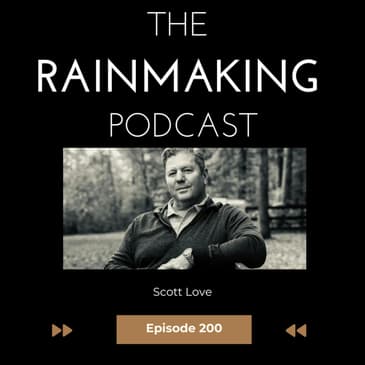
In this special 200th episode of The Rainmaking Podcast, host Scott Love reflects on three key trends that have shaped business development and rainmaking success over the past few years. He shares lessons learned from interviewing top industry experts and discusses how professionals can apply these insights to stand out in an increasingly competitive market. Scott also introduces game theory concepts to help professionals predict business outcomes and optimize their client development strategies.
Key topics include the three major trends in rainmaking success: 1) Empathy, the ability to understand and connect with clients on a deeper level; 2) Active Listening, which helps professionals uncover pain points and build trust; and 3) Distinction, the importance of identifying and leveraging unique personal or professional traits to differentiate from competitors. Scott also discusses how to gamify business development using a point-based system to track key performance activities, inspired by principles from blackjack and MIT-style card counting strategies. He shares how professionals can measure and refine their business development approach, ensuring they focus on high-value activities that yield the greatest ROI. This episode provides a roadmap for professionals looking to enhance their sales effectiveness, build stronger client relationships, and create a sustainable rainmaking process.
Visit: https://therainmakingpodcast.com/
----------------------------------------
Scott Love is a legal recruiter who recruits private equity attorneys for global law firms and facilitates law firm mergers. He also is an author and speaker on client development.
----------------------------------------
This show is sponsored by Leopard Solutions Legal Intelligence Suite of products, Firmscape, and Leopard BI. Push ahead of the pack with the power of Leopard. For a free demo, visit this link:
https://www.leopardsolutions.com/index.php/request-a-demo/
Learn more about your ad choices. Visit megaphone.fm/adchoices
[00:00:01] You're listening to The Rainmaking Podcast, hosted by high stakes headhunter, author and
[00:00:19] professional speaker, Scott Love.
[00:00:22] Hey, this is Scott Love with The Rainmaking Podcast.
[00:00:27] Our guest today is me again.
[00:00:28] Now, I know I did what's called a solo cast a few weeks ago, but this is our 200th episode.
[00:00:34] So I wanted to take the time to thank you and to all of our guests for making this
[00:00:38] show a huge success.
[00:00:40] We're a top 2% show on the podcast rankings.
[00:00:44] And I think part of it is because we have high quality guests on the show.
[00:00:48] We have a clear topic of rainmaking and topics related to rainmaking.
[00:00:52] And even though the show is industry agnostic, it really does lean towards those people
[00:00:57] in professional services who are responsible for getting clients to say yes.
[00:01:02] And that means everybody in a law firm, everybody in a recruiting firm or a staffing
[00:01:05] company and accounting firms, management consulting firms, investment banking firms
[00:01:10] and you name it. And those are our listeners.
[00:01:12] So thank you for making this a fantastic show.
[00:01:15] I'm really honored and I cherish that trust that you've placed in me.
[00:01:19] Now, our topic today is a summary of what I've learned.
[00:01:23] I'd say there are three main points that I've seen as a trend since I launched this
[00:01:27] show three and a half, almost four years ago.
[00:01:30] And then secondly, game theory and how you can use that to help your practice
[00:01:35] to predict what the future is going to be in terms of outcomes.
[00:01:39] So I would say that when I launched this after Covid, I had done other podcasting
[00:01:43] before. I'd actually been podcasting since 2007.
[00:01:47] But when we had guests on the show, that was when Covid had just happened.
[00:01:51] That was back in the day when you would reach out to a stranger and you would
[00:01:55] say, are you safe? How are you?
[00:01:58] And I think our entire society bonded together because we all went through a
[00:02:02] pretty severe situation at the same time.
[00:02:04] And that served as a bonding agent.
[00:02:05] So at that time, it was relatively easier to reach out to people because you had
[00:02:11] experienced an event together and you could talk about that.
[00:02:15] I think Covid helped us to quickly bring walls down when we're talking with
[00:02:20] strangers. And I think even I saw a trend on social media posts of
[00:02:25] vulnerability, especially on LinkedIn.
[00:02:28] Now, I'm not talking the type of vulnerability where you say my girlfriend
[00:02:31] dumped me and nobody wants to go out with me.
[00:02:34] I'm talking about I struggled with this, but this was the solution that I found
[00:02:37] and this is how I'd improve my practice.
[00:02:39] That's the kind of vulnerability I'm talking about.
[00:02:42] But there are three overarching trends that I saw took place over the last few
[00:02:46] years. And this is the common theme I've seen in the guests that I've had on
[00:02:50] the show. Number one is empathy.
[00:02:53] Being able to empathize and understand where somebody is, that serves as a
[00:02:58] bonding agent.
[00:03:00] Second was listening.
[00:03:02] If you understand how to communicate to people and how to be a good listener,
[00:03:08] then you can guide them forward and get intelligence that tells you what their
[00:03:11] pain points are and how you can move them forward to solve their problems by
[00:03:15] them working with you.
[00:03:17] Recently, I was the guest of the toughest audience I've ever spoken at,
[00:03:22] fifth graders, at the Binsley Elementary School Career Day.
[00:03:27] I did three different sessions of about 25 to 30 fifth graders talking about
[00:03:31] what is it like to pursue a career in business development or sales.
[00:03:35] And I talked about the key to success is to use your ears and your mouth and
[00:03:39] the proportion that you have them.
[00:03:41] How many years do you have?
[00:03:42] Two, they said.
[00:03:43] How many mouths do you have?
[00:03:44] One. You should use it in that relationship and that ratio.
[00:03:47] Listen, twice as much than what you say.
[00:03:50] I even was telling a group of people I was training on client development an
[00:03:54] example of how I use this to kind of get to know somebody.
[00:03:58] I was at a party and I met a professional there and he and his wife,
[00:04:02] they were talking with my wife and I.
[00:04:04] And the husband and I, we kind of walked off to the side so we could kind
[00:04:06] of get to know each other a little bit better.
[00:04:08] And he was a physician.
[00:04:09] He worked in plastic surgery.
[00:04:11] And sometimes I'll kind of play a game when I make a new friend and
[00:04:14] I'm going to ask them questions not to be intrusive but just to get to
[00:04:17] know them and see how long does it take for them to ask a question about me.
[00:04:21] And I think that if you're in sales or business development,
[00:04:24] you know that this is a good skill to develop.
[00:04:26] Getting to know people.
[00:04:27] Where do you live? How long you live there?
[00:04:29] How many kids do you have?
[00:04:30] How old are your kids? What schools are they in?
[00:04:32] How did you get into your profession?
[00:04:33] What are some of the things that you've seen are different now since
[00:04:36] COVID? Has that helped you?
[00:04:37] What's kind of your niche within your profession?
[00:04:40] And 20 minutes later he had to go.
[00:04:42] He didn't ask a single question and he shook my hand.
[00:04:45] He said, I've really enjoyed getting to know you.
[00:04:47] And that's how listening is.
[00:04:48] They can serve as a bonding agent.
[00:04:50] And when you listen and you empathize,
[00:04:53] that helps us to move the relationship forward.
[00:04:56] The third thing I've seen that's been a big change is that information
[00:05:00] is everywhere and business is hyper competitive.
[00:05:04] I spoke at a conference recently in the staffing industry and
[00:05:08] I was kind of working the room during my presentation.
[00:05:10] Tell me about business.
[00:05:11] It's tough. It's so tough.
[00:05:14] I said, well, I thought there was an increase in demand for talent.
[00:05:16] Absolutely. It's off the chart.
[00:05:17] People are looking for people.
[00:05:19] I said, well, isn't that what you want?
[00:05:21] They said, no, it's harder.
[00:05:23] Why is that? Because there's increased competition.
[00:05:25] And this lends me to the third point of distinction.
[00:05:29] So number one, empathy.
[00:05:30] Number two, listening.
[00:05:31] Number three, distinction.
[00:05:33] How can you show distinction in what you are all about?
[00:05:38] How does that distinction help you to become successful in selling your
[00:05:42] services?
[00:05:44] Recently I was talking with someone that was in the recruiting industry.
[00:05:48] He was struggling to find his way to get new clients because it's hyper
[00:05:53] competitive.
[00:05:54] And I said, well, what's unique about you?
[00:05:55] What's the first thing you can think of that's different about you?
[00:05:58] I used to be a professional tennis player.
[00:06:00] Tell me about that.
[00:06:01] I said there is a line of opportunity associated with that because you used
[00:06:06] to be a professional athlete.
[00:06:07] You perform at a high level, which means that you know how to focus,
[00:06:10] you know how to achieve results and you know how to deliver.
[00:06:13] I said you can use that distinction as a reason to help people see that
[00:06:17] you are the one they should work with.
[00:06:20] The question I have for you is what's distinct about you?
[00:06:23] What can you say about yourself that nobody else can say about themselves?
[00:06:26] And I'd be willing to bet that there is a line of a narrative that we can
[00:06:31] develop from that, which we can pull forward and use that as a way to
[00:06:36] bond with people.
[00:06:37] And I'll tell you this.
[00:06:38] People like people who are interesting and a little bit different.
[00:06:42] If everybody's all the same, it's just not interesting.
[00:06:45] Oh, wow, that's different.
[00:06:46] You're a professional athlete.
[00:06:47] Tell me about that.
[00:06:48] It's a way that you can bring the walls down and kind of break the ice,
[00:06:52] so to speak.
[00:06:53] And when I was at Binsley Elementary, I told them this is how you sell.
[00:06:57] You ask questions.
[00:06:58] I gave them examples of that.
[00:07:00] And one of the things we talked about was breaking the ice.
[00:07:03] How do you make a friend?
[00:07:05] And I even had one of the kids come up to the front of the class.
[00:07:07] We had kind of a role play about breaking the ice.
[00:07:09] How do you make friends with the stranger?
[00:07:11] Talk about the weather.
[00:07:13] Talk about current events.
[00:07:14] Oh, it sure is hot today.
[00:07:15] Did you see the ball game last night?
[00:07:17] And I talked about how in sales and client development,
[00:07:20] it's about developing effective people skills.
[00:07:23] And by the way, this school has a lot of kids whose parents
[00:07:27] came from someplace else based on where it's geographically situated.
[00:07:31] And our parish has that school as an outreach project.
[00:07:34] So it's exciting to get a chance to do that and be involved in that.
[00:07:37] It's very meaningful to me personally.
[00:07:39] And I even told them how many of my friends
[00:07:42] came from other countries with not a lot of resources.
[00:07:45] And they built something in this country.
[00:07:46] And that this is the land of opportunity.
[00:07:49] And it was really exciting to see that these kids understand that
[00:07:52] and that they understand that they could pursue a career
[00:07:55] in client development even later on in life.
[00:07:58] If they become an electrician, they might become a business
[00:08:00] developer for that electrical contractor at some point.
[00:08:03] But anyways, the school itself took the time
[00:08:07] to teach the kids the seven habits of highly effective people.
[00:08:11] Now, this was actually a program that they got the license to.
[00:08:13] But when I walked up to the school on the sidewalk leading to it,
[00:08:17] they had painted on there the seven habits.
[00:08:20] And we talked about that.
[00:08:22] And I asked them, tell me what some of them are.
[00:08:23] And I heard some of these fifth graders tell me things like,
[00:08:26] begin with the end in mind.
[00:08:28] Seek first to understand.
[00:08:30] It was so exciting to see that.
[00:08:32] But these are children that apparently the school had decided
[00:08:35] to teach them life skills.
[00:08:37] And those are the things that I think make someone successful
[00:08:40] in anything that they do.
[00:08:42] So getting back to client development, the three things
[00:08:45] that I've seen are the changes and the trends
[00:08:49] in being able to develop empathy with people,
[00:08:51] the need to listen more.
[00:08:53] And if you're in a competitive industry,
[00:08:56] what can you say that nobody else in the industry can say?
[00:08:59] What is that distinction?
[00:09:00] This is something I've even brought
[00:09:01] to my legal search practice.
[00:09:03] Sometimes when I meet with a law firm leader,
[00:09:05] I'll start with that.
[00:09:06] Tell me things that your firm can say about itself
[00:09:09] that nobody else can say about themselves.
[00:09:10] And you can't use the word culture
[00:09:12] because everybody's got great culture.
[00:09:13] That's table stakes now, everybody has it.
[00:09:16] And sometimes you would think that I've asked
[00:09:18] for a moment of silence when I asked that,
[00:09:20] but it forces them and me to get creative,
[00:09:23] to find that narrative that is truly distinct.
[00:09:27] That is something that's going
[00:09:28] to get the attention of people.
[00:09:29] By the way, read the book,
[00:09:31] Pitch Anything by Oram Clough.
[00:09:33] He talks about how you have to have something shiny,
[00:09:36] something new, something different
[00:09:38] to get people's attention.
[00:09:39] And that's a good way to start with that.
[00:09:41] So that's one trend that I've seen,
[00:09:43] empathy, listening and distinction,
[00:09:45] or three trends actually.
[00:09:47] Now let me switch gears for a little bit
[00:09:49] and talk about the recent concept
[00:09:50] that I developed for another recruiting firm.
[00:09:53] Now my core business is to recruit partners
[00:09:55] for law firms, especially corporate
[00:09:56] and private equity for big firms and major markets.
[00:09:59] But I also like speaking to groups
[00:10:01] on business development, especially recruiting groups.
[00:10:04] And some of the recruiting firms are just amazing
[00:10:06] with how they invest resources within their people.
[00:10:09] There's one group I helped to develop a concept
[00:10:12] of measuring key performance indicators.
[00:10:15] Those are the variables that lead
[00:10:17] to the outcomes we want.
[00:10:20] And it's important to gamify it.
[00:10:23] Now, I used to be a card counting blackjack player
[00:10:25] mentored by alumni of the MIT blackjack team years ago.
[00:10:28] But what that taught me, and I don't gamble anymore,
[00:10:30] but that taught me was that business is a game.
[00:10:33] And if we can make it a game,
[00:10:35] we're going to be more effective in our decision making.
[00:10:37] We're going to be more effective in our execution.
[00:10:40] And it's going to take the sting out of disappointment.
[00:10:42] Those are the three things that we get
[00:10:44] when we think of business as a game.
[00:10:46] So what I did was, because their whole focus
[00:10:49] was to increase business development effectiveness
[00:10:53] among their people.
[00:10:54] And some of them had never been
[00:10:55] in any sort of client development role before.
[00:10:58] So we looked at what are the key actions
[00:11:01] that lead up to getting a new client?
[00:11:03] Then I created a point system for it.
[00:11:05] Now, I got this idea years ago from Tony Bruno,
[00:11:08] a trainer married to Bar Bruno in the recruiting industry.
[00:11:11] He had what he called the 140 point system.
[00:11:13] And I use that every day.
[00:11:15] And that helped me to become successful.
[00:11:17] So I give a nod and recognition to Tony for his work.
[00:11:21] This is something that that inspired me over the years
[00:11:24] to come up with different variations of that
[00:11:25] for my own performance.
[00:11:27] But I did that for this other group
[00:11:29] where the goal is to make 100 points a day.
[00:11:31] And we're going to have different actions
[00:11:33] that lead up to the end result.
[00:11:35] For example, getting a signed agreement back from a client,
[00:11:40] that's worth 30 points.
[00:11:42] But getting a referral is worth 15 points.
[00:11:45] Wait a minute, why is getting a single referral
[00:11:47] worth half the price of getting an agreement back
[00:11:52] or half the value?
[00:11:53] Well, that's because each referral is so valuable
[00:11:55] because that could lead you to new opportunities.
[00:11:58] So if you set a goal to get a certain number of points,
[00:12:00] let's say 100 points every day,
[00:12:02] what are the actions that you can take to lead up to that?
[00:12:06] I'd recommend writing out all the inputs
[00:12:09] that lead up to it, assigning a point value
[00:12:12] and then track it and see what sort of success
[00:12:15] it leads to in terms of your business development efforts.
[00:12:19] Now in some professional services firms,
[00:12:21] this isn't going to be effective.
[00:12:23] In others, boy, you could create
[00:12:25] a whole system like this.
[00:12:26] And in fact, if you're interested in getting an example
[00:12:29] of what I've created, something that I've created
[00:12:31] for my own use, feel free to email me
[00:12:34] scottatattorneysearchgroup.com
[00:12:37] and mention the 100 point tool
[00:12:38] and I'll send that to you.
[00:12:40] No charge, just a gift, I wanted to help you with that.
[00:12:43] So think of the actions that lead up to the end result.
[00:12:47] How can you gamify that?
[00:12:49] One thing it'll help you do,
[00:12:50] like I mentioned in game theory,
[00:12:52] it helps you to make effective decisions.
[00:12:54] Well, if I spend more time in getting referrals,
[00:12:57] instead of other activities
[00:12:59] that don't have much results,
[00:13:00] so for example, sending an email to a cold client,
[00:13:02] that might be worth one point,
[00:13:04] but each referral by name is worth 15 points each.
[00:13:09] If you get three referrals from someone,
[00:13:11] that's 45 points, you're halfway to your goal for the day
[00:13:14] just by getting three referrals
[00:13:16] because that's how valuable that is.
[00:13:18] So you want to spend time in areas
[00:13:21] that add the most value.
[00:13:23] And by using a tool like this,
[00:13:25] it's going to teach you
[00:13:26] how to make effective decisions
[00:13:28] in terms of utilizing your time.
[00:13:30] Also, the more you spend time in areas
[00:13:33] that contribute the most to your success,
[00:13:35] you're going to increase your skills.
[00:13:37] It's going to increase effectiveness.
[00:13:40] And then third, like I said,
[00:13:42] it's going to take the sting out of disappointment
[00:13:44] when it's a game.
[00:13:45] We never lose as long as we learn things
[00:13:48] and I'd be willing to bet
[00:13:49] if you said I'm gonna use this every day
[00:13:51] for three weeks and if you measured it,
[00:13:53] keep an Excel spreadsheet at the end of the day,
[00:13:55] type in your points and see the trend,
[00:13:57] you're going to start getting better.
[00:13:59] Remember this, anything that can be measured
[00:14:01] improves over time.
[00:14:02] I was fortunate when I was 24
[00:14:04] to be a management consultant in the US Navy
[00:14:06] teaching Denning management methods,
[00:14:08] statistical charts and graphs,
[00:14:10] knowing that anything that contributes to the end goal,
[00:14:14] if we focus on improving the process,
[00:14:16] we will improve the results.
[00:14:18] Even client development is a process.
[00:14:20] It's not a one-time thing, it's an ongoing process.
[00:14:24] So let me know if that's a tool that can help you.
[00:14:26] And thank you again for taking the time to listen.
[00:14:29] We've got some exciting episodes coming up
[00:14:31] with some amazing guests,
[00:14:33] people that you may have already heard of
[00:14:35] here in the next few months.
[00:14:36] If you also have any suggestions of any coaches
[00:14:39] or authors or speakers on client development
[00:14:41] that you've come across,
[00:14:43] maybe they spoke at your partner retreat,
[00:14:45] maybe you saw them speak at a legal conference,
[00:14:47] please send me a note,
[00:14:49] scott at attorneysearchgroup.com
[00:14:51] and let me know about them,
[00:14:52] connect them with me on LinkedIn,
[00:14:53] I'm easy to find and I'd love to have them on the show.
[00:14:56] Thanks again for listening.
[00:14:57] And as always, this show is sponsored
[00:14:58] by Leopard Solutions Legal Intelligence Suite of Products,
[00:15:02] FirmScape and Leopard BI.
[00:15:04] Push ahead of the pack with the power of Leopard.
[00:15:10] Thank you for listening to the Rain Making Podcast.
[00:15:13] For more information about our recruiting services
[00:15:16] for international law firms,
[00:15:18] visit our website at attorneysearchgroup.com.
[00:15:22] To inquire about having Scott speak
[00:15:24] at your next convention,
[00:15:25] conference, sales meeting or executive retreat,
[00:15:29] visit therainmakingpodcast.com.