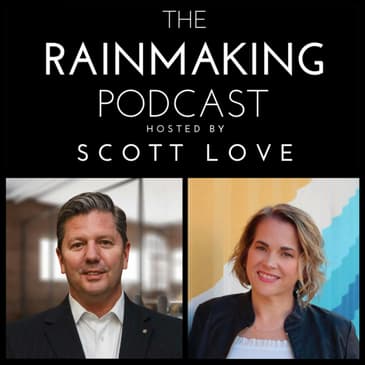
In this episode of The Rainmaking Podcast, host Scott Love speaks with Jill Huse, co-founder and Chief Strategy Officer of Society 54, about women in leadership roles within professional services firms. Jill shares insights on the challenges women face in leadership, including limited access to key opportunities, bias in leadership selection, and a lack of allies to support their growth. She discusses how firms sometimes promote women into leadership roles without giving them real authority, which can undermine firm culture and professional development.
Key topics include coaching strategies for leadership success, how women can advocate for themselves in equity and compensation discussions, and the importance of developing confidence in self-promotion. Visit: https://therainmakingpodcast.com/
----------------------------------------
Society 54 Co-Founder and Chief Strategy Officer Jill Huse is renowned as a trusted professional services advisor. Jill, a certified Business Coach, is highly regarded for her progressive ingenuity, research-based strategy and, most importantly, her ability to deliver results for clients. In addition to her work with Society 54, Jill is also co-founder and CSO of Society Tech, a technology company that utilizes the proprietary software INform54 to help law firms track and analyze their firm performance initiatives to support strategic growth.
Jill’s strengths lie in ideation on high-level strategy, leadership development, and coaching attorneys and business professionals on career growth and relationship selling. She has worked in professional services marketing (legal and accounting) for over twenty years. She has an innate ability to identify, encourage, and develop her clients’ unique and differentiating professional strengths, and to help clients leverage these strengths to meet and exceed bottom-line goals.
Prior to launching Society 54, Jill led the marketing and business development department at one of the most reputable AmLaw firms in the southeast. While there, she structured and guided her team in developing, implementing, and managing award-winning communication, business development, and marketing initiatives. Further, Jill is a tenured member of the Legal Marketing Association (LMA), serving as the 2020 President of the International Board of Directors where she led the efforts to expand LMA to Europe; additionally, she also served as the president of the Southeastern Chapter. Jill is also one of the founding members of Law 2.5, a roundtable think tank focused on the future of the legal industry and how to implement and lead change, and was co-founder and Principal at The Chiral Project which focused on Leadership Development for Women in Professional Services.
Jill was inducted into the Legal Marketing Association’s Hall of Fame in 2024 for her leadership and contributions to the association and its membership. In 2023, Jill and Heather earned a spot in the Charlotte Business Journal’s Fast 50, ranking Society 54 as the 8th fastest-growing private company in the Charlotte region. In 2021, she was inducted as a Fellow into the College of Law Practice Management. And, in 2016, Jill was personally selected as one of the “50 Most Influential Women in Charlotte” by The Mecklenburg Times.
----------------------------------------
This show is sponsored by Leopard Solutions Legal Intelligence Suite of products, Firmscape, and Leopard BI. Push ahead of the pack with the power of Leopard. For a free demo, visit this link:
https://www.leopardsolutions.com/index.php/request-a-demo/
Links:
https://www.linkedin.com/in/jillhuse/
Learn more about your ad choices. Visit megaphone.fm/adchoices
[00:00:01] You're listening to the Rainmaking Podcast, hosted by high-stakes headhunter, author and
[00:00:19] professional speaker, Scott Love.
[00:00:24] You're listening to The Rainmaking Podcast and my name is Scott Love.
[00:00:27] Thank you for joining me on the show.
[00:00:28] I'm excited about our episode today because it's one that's very different than what we've
[00:00:33] had in the past.
[00:00:34] Let me tell you about our topic and then who our guest is.
[00:00:37] Our topic for today is women in leadership roles and professional services firms.
[00:00:42] We've never talked about that yet, that's an important topic.
[00:00:44] And our guest is my friend Jill Hughes.
[00:00:47] Now you may recognize that name because Jill came on the show in the first year that I
[00:00:51] produced it.
[00:00:53] She is the co-founder and chief strategy officer for Society 54 which is a consulting
[00:00:59] and training firm that helps professional services firms, especially law firms, improve
[00:01:03] their skills in terms of business development.
[00:01:06] Now even if you're not in the legal industry, this conversation with Jill will impact you
[00:01:11] in significant ways.
[00:01:13] Of course all of the concepts are malleable to those who are rainmakers and other types
[00:01:17] of professional services firms.
[00:01:19] So make sure you pay attention and listen to what she has to say.
[00:01:22] As always, this show is sponsored by Leopard Solutions, legal intelligence suite of
[00:01:27] products, FirmScape and Leopard BI.
[00:01:30] Push ahead of the pack with the power of Leopard.
[00:01:32] And now here's my conversation with my friend Jill Hughes.
[00:01:35] Thanks for listening.
[00:01:36] Hey, this is Scott Love with the Rain Making Podcast.
[00:01:41] I've got a repeat guest today.
[00:01:43] Jill Hughes is joining us and today we're talking about women in leadership roles
[00:01:47] and professional services firms.
[00:01:49] Jill, thanks for joining me again on the podcast.
[00:01:52] Scott, thanks for having me.
[00:01:53] I'm excited.
[00:01:54] Yeah, me too.
[00:01:55] Me too.
[00:01:56] And so I like this topic because I think it is very much a big part of the way I
[00:02:01] know for a fact law firms are thinking of in terms of putting women in leadership
[00:02:05] roles.
[00:02:06] And I think that's a common trend also in professional services firms across the
[00:02:10] board.
[00:02:11] So let me ask you this, what are some of the common challenges that you think
[00:02:15] women are facing in leadership roles?
[00:02:17] Yeah, so I think that there's quite a few, but I think predominantly the
[00:02:21] biggest challenge is that there are a lot of men in leadership who are
[00:02:28] sometimes good old boy network where they're giving advantages to other men that
[00:02:34] are coming up the ranks and the women aren't getting the same opportunities.
[00:02:38] A lot of that is pointed back to black and white of these are the numbers
[00:02:42] and this is what the numbers looks like, but unfortunately because they're not
[00:02:46] getting those same advantages it doesn't show up in the numbers.
[00:02:49] So there's not a lot of allies out there right now for women
[00:02:53] involving to those leadership roles.
[00:02:56] The other thing that I see is when firms are putting women into place,
[00:02:59] sometimes they're putting them into place for name only and not giving them
[00:03:03] the autonomy or the authority to actually lead, which is a big problem.
[00:03:08] It kind of chips away at the whole culture of the law firm when they're
[00:03:11] doing it for reasons that aren't authentic to the firm and the message
[00:03:16] behind why they're actually putting somebody in place.
[00:03:19] And that's the other large issue that I see as it relates to the challenges.
[00:03:24] And so have you worked with clients where that's the case within their
[00:03:27] organization before where somebody is being put into a role and there's no
[00:03:30] real authority behind her?
[00:03:32] Yeah, I mean it happens every day and it's not just with women.
[00:03:34] I see this happening with men too, but I think sometimes people are
[00:03:40] putting people into place and leadership is putting people into place
[00:03:43] because for the wrong reasons maybe they're putting them into place
[00:03:47] because they have a large book of business and they feel like they
[00:03:49] need to put them into place to satisfy the ego that might be driving
[00:03:55] around that decision.
[00:03:57] They're not putting the best people into place sometimes in the leadership
[00:04:00] capacity, so they're not really thinking about why would they be a good leader?
[00:04:05] What can they add to this?
[00:04:06] Do they have the management skills to be effective and make an impact
[00:04:10] in a leadership capacity?
[00:04:12] So I think that those are some of those challenges that I've seen
[00:04:16] personally and that we work with firms every day as it relates to
[00:04:21] coaching individuals and helping them get to that next level.
[00:04:25] And so where do you think most people can make improvements,
[00:04:29] whether it's a man or even a woman that's in a leadership role?
[00:04:32] And let's say you're coaching somebody.
[00:04:34] How do you coach them to become more effective in their leadership skills?
[00:04:39] Well, what's really interesting is I don't know if you've ever read
[00:04:42] the book, Confidence Code, which is by Claire Shipman and I can't
[00:04:47] remember the other person that co-writes it.
[00:04:49] But it's a really good book and it goes into the science of men
[00:04:52] versus women and kind of what happens in the psyche around just
[00:04:57] the belief system around whether they can do something or not.
[00:05:01] And what it shows is that for men, if they're going for a job,
[00:05:06] let's say, they feel like they have to be qualified at 60% of the
[00:05:10] job to apply for it.
[00:05:12] Women feel like they have to be competent in 100% of the job to apply for it.
[00:05:16] Oh, wow.
[00:05:17] So it really goes to the whole psyche around can I do this?
[00:05:20] Would I be effective at it?
[00:05:22] So when I'm coaching people, whether it's a man or a woman and
[00:05:25] they're feeling like they're maybe not ready for it or they're worried
[00:05:29] about kind of stepping into that role, it's really about getting them
[00:05:33] to understand their power and controlling the narrative that they set
[00:05:37] for themselves and understand what they want from a career trajectory
[00:05:40] and making sure that they're putting those building blocks in place
[00:05:44] to kind of get to where they want to be.
[00:05:46] And that looks different for everybody, but it's really kind of
[00:05:49] doing that self-analysis, understanding where their strengths are,
[00:05:53] where their weaknesses are, where they may come off as
[00:05:57] unintentionally disturbing relationships in a way that they hadn't intended to.
[00:06:03] Just kind of understanding more about themselves.
[00:06:05] I think that's the first step that we all have to do, just as a reality check
[00:06:09] of self-evaluation and then figuring out where can they apply those strengths
[00:06:15] and not just strengths but areas that they want to improve and they want to focus on
[00:06:19] into their career path to kind of really define where they want to be
[00:06:24] in three to five years.
[00:06:25] Right.
[00:06:26] And then we start building up how can we get there?
[00:06:29] And it starts with kind of understanding and controlling their narrative.
[00:06:32] Yeah, that's really interesting.
[00:06:33] I'm sure that your clients tell you these are what I think my weak spots are.
[00:06:39] How can I ameliorate that deficit?
[00:06:41] So let me ask you this, how do we become aware of where those pitfalls are?
[00:06:47] Because as you're saying this, I'm thinking about myself and how do I really know?
[00:06:52] You know, how do I really know where that weak spot is?
[00:06:54] What do you recommend for somebody who really see where they're at?
[00:06:56] That's really interesting.
[00:06:57] And it's hard for people to understand where their weak spots are, quite frankly.
[00:07:02] So we do a lot of different things.
[00:07:03] One of the things that we do is we work with leadership to kind of get an analysis
[00:07:08] from them of the partners that we're working with to understand where they
[00:07:12] think their strengths and weaknesses are.
[00:07:15] Then we do another evaluation with those particular people to kind of evaluate,
[00:07:20] like are we seeing eye to eye on this?
[00:07:22] Are they matching up where they think their strengths and weaknesses are?
[00:07:26] The other thing that we always do for everybody that we do coaching with
[00:07:29] is a disc analysis.
[00:07:30] And there's several different types of analysis out there.
[00:07:34] I like discs because it not only shows your strengths, but it also shows
[00:07:38] where your weaknesses could be and where you may be unintentionally,
[00:07:42] you know, disturbing relationships were things that you hadn't thought of before.
[00:07:46] And you're seeing it in black and white.
[00:07:48] So it's a behavioral test.
[00:07:50] You can't game the test.
[00:07:52] I've taken it several times.
[00:07:53] I've tried to game it, but I always end up in the same place.
[00:07:56] And as I read my results, I'm like, yep, that's me.
[00:08:00] That's me.
[00:08:01] You know, so it's good for self-improvisation and evaluation.
[00:08:05] So I like those kind of tests.
[00:08:06] And there's other ones out there like there's Gallop's Strength Finder,
[00:08:11] which is also very good, but it points out your strengths and not
[00:08:14] necessarily your weaknesses.
[00:08:15] Myers-Briggs is also a personality test.
[00:08:18] But I think disc is really good because it is based in science
[00:08:21] and you kind of get both sides of your personality.
[00:08:25] Tell me about then.
[00:08:26] I actually took that several years ago.
[00:08:28] I found it very insightful and it did show me where my week spots were,
[00:08:32] which I kind of knew, you know, attention to detail.
[00:08:34] It's just not a big thing.
[00:08:35] I mean, well, of course it is at work.
[00:08:37] It's a very big thing to those listening on the show.
[00:08:40] I never dropped the ball on that, but it gave me some insight into
[00:08:43] where I really need to spend time into really shoring up weak areas.
[00:08:46] So kind of describe that.
[00:08:48] What does the DISC mean?
[00:08:49] How does that?
[00:08:50] Yeah.
[00:08:50] So it's a four-part quadrants of circles and wherever you land on the
[00:08:56] spectrum is kind of where your personality sits.
[00:09:00] D is dominance, so it's direct personality.
[00:09:04] You're very focused, targeted, results oriented.
[00:09:08] There's then the I, which is all about influence, very social people,
[00:09:12] kind of the extroverts that we typically think of.
[00:09:15] The Ss are steady and conscientious, very focused
[00:09:19] and more of the worker bees.
[00:09:21] And then we have the Cs that are conscientious and they're very focused on accuracy.
[00:09:27] A lot of the attorneys that we coach fall in the C category,
[00:09:30] but what's really interesting is that what we find is when we work with law firms
[00:09:36] for many years and work with different practice groups,
[00:09:40] a lot of times we'll find the same type of people that we get over and over.
[00:09:45] So if they have a lot of Cs, we'll end up seeing a lot of Cs.
[00:09:47] So you attract the people that you feel most comfortable with.
[00:09:52] And I think that that's really interesting.
[00:09:54] But what I like about Disk is I'm a D.
[00:09:58] So I am somebody who's very results oriented and very direct.
[00:10:03] How this can be applied, especially in a sales capacity,
[00:10:06] is I know that I am from a business development context.
[00:10:10] I am very driven on just getting a sale done.
[00:10:14] Like, and I kind of get I want to get to that yes or no quickly.
[00:10:18] If I'm working with somebody who is a C, they're all about the numbers.
[00:10:22] Like they want to understand like how does this actually relate?
[00:10:25] Like what is the business case for this?
[00:10:27] So I have to approach my business development sales in a different way.
[00:10:32] So it's good to kind of understand where I am,
[00:10:34] but also ask questions of the person that I'm talking to
[00:10:38] to understand where they are so I can deliver my message
[00:10:41] in a way that's going to resonate best.
[00:10:43] Yeah, that's great.
[00:10:44] My business partner is an I.
[00:10:46] So she is big picture, very social, and we mesh really well
[00:10:51] because we have different personalities and different strengths
[00:10:55] that we bring to our partnership.
[00:10:57] And we have people that are on our team that balance us out,
[00:11:00] that are on the C and the S as well.
[00:11:02] So I like looking at it from a lens of how can we all work together
[00:11:09] productively and find those people that help balance us out as teams.
[00:11:14] And that's good to look at not just from your internal team,
[00:11:16] but also your client perspective as well.
[00:11:18] That's great.
[00:11:20] So let me ask you this about leadership.
[00:11:22] I know that empathy and listening is a very big part of it.
[00:11:26] And what's interesting in my life,
[00:11:27] my wife who used to be a social worker then was at home.
[00:11:31] She actually volunteers.
[00:11:32] She's on the vestry of our Episcopal Parish.
[00:11:34] So she in her first time is in a leadership role.
[00:11:37] And I'm sure you know people in volunteer modes,
[00:11:40] you have to use real leadership because they can bail on you
[00:11:43] at any time.
[00:11:44] And there's no consequence for quitting the committee, right?
[00:11:48] And I saw that I think that she's built a lot of trust
[00:11:52] in the organization because she listens to people
[00:11:54] and she has a lot of empathy.
[00:11:56] How do you think people can bring those skills
[00:11:59] to the workplace?
[00:12:00] And do you think women have an advantage over men
[00:12:02] in that area?
[00:12:03] So there's been some studies on this too
[00:12:05] from an empathy perspective.
[00:12:07] Attorneys actually rate very low on empathy scores,
[00:12:10] like really, really low.
[00:12:12] I am lower on an empathy score and that's partly due
[00:12:15] to my disk behavioral style.
[00:12:18] And I know that about myself.
[00:12:19] So I actually have to practice empathy.
[00:12:22] When I go into situations, I have to ask more questions.
[00:12:26] I have to be concerned in a different way.
[00:12:27] I learned a lot of these skills when I was managing
[00:12:30] internally at the last place that I worked
[00:12:33] where I was managing a team very hands-on
[00:12:36] and some of them just communicated a little bit
[00:12:39] differently.
[00:12:39] They wanted to have a conversation about what
[00:12:41] we did on the weekends where I was like, it's Monday morning.
[00:12:44] Let's get to work.
[00:12:45] Let's get to work, right?
[00:12:46] I need to step back and actually get to know my people
[00:12:49] and understand what makes them tick, how they're going
[00:12:53] to be motivated.
[00:12:54] And that is all part of empathy.
[00:12:57] I do think women are better at empathy,
[00:12:59] but I think that it's not a gender thing.
[00:13:02] I think it really is kind of based on your personality.
[00:13:05] But it's something that you can train yourself
[00:13:08] to be more empathetic and be aware of it.
[00:13:11] That's great.
[00:13:11] That's great.
[00:13:12] So tell me a time where you coached a female executive
[00:13:15] or female attorney, female leader, somebody
[00:13:17] that's new in the leadership role.
[00:13:19] What were some of the challenges she was facing?
[00:13:22] Would any of those challenges be unique because of her gender?
[00:13:25] And how do you think she overcame those challenges
[00:13:28] to become successful in that role?
[00:13:30] Yeah.
[00:13:30] So I think for a lot of women that I coach,
[00:13:33] one of the things that's a trend that I kind of see
[00:13:36] is that they are very, number one,
[00:13:40] they're very shy about bragging about themselves.
[00:13:43] And self-promotion is really, really difficult for them to do.
[00:13:49] So it's hard sometimes to authentically describe
[00:13:54] a win that you've had or something
[00:13:56] that you're involved in because you don't want to look
[00:13:58] like you are self-promoting.
[00:14:00] And that's something that I see men doing a little bit more
[00:14:03] comfortably than women.
[00:14:05] I also see, and this is more specific to the law firm model,
[00:14:09] but I see that a lot of the women I coach
[00:14:12] are having trouble with equity conversations,
[00:14:15] both from getting to that equity level as well as compensation
[00:14:20] around origination sharing.
[00:14:22] That is something that's really, really hot right now.
[00:14:25] And it's beholden upon the person in most firms
[00:14:29] to ask for equity.
[00:14:31] Partners aren't giving away equity.
[00:14:33] Most of the time on cases and they're getting women involved.
[00:14:36] And a lot of times the women are shy about asking for that
[00:14:40] and they just kind of go about doing their work
[00:14:43] even when the client is connecting with them directly
[00:14:46] and not even involving their relationship partner.
[00:14:49] So it's really kind of getting the women
[00:14:51] to start asking for things and start promoting themselves
[00:14:55] and advocating for themselves.
[00:14:57] I think that that's really important.
[00:14:59] And it's something that is missed on us a lot
[00:15:02] because we're always as a gender kind of waiting
[00:15:05] for people to appreciate us versus kind of being
[00:15:08] on the forefront of asking for forgiveness instead
[00:15:12] of permission.
[00:15:13] Right.
[00:15:13] So what advice would you give to someone where tomorrow
[00:15:17] they have a meeting and they need to bring this up?
[00:15:20] And this might be a conflict in terms of causing conflict,
[00:15:25] not a legal conflict, but it might be a stressful
[00:15:28] conversation.
[00:15:29] Let's just put it that way.
[00:15:31] How would you coach that female executive or female attorney
[00:15:34] to really steer that conversation?
[00:15:36] It's all about being prepared for it.
[00:15:38] So having some practice around what I actually
[00:15:42] want to get across, what are those key points that I want
[00:15:45] to deliver, how might I respond thinking
[00:15:49] through the different scenarios and practicing your words.
[00:15:52] I know it sounds strange, but having a conversation
[00:15:55] with a friend or your partner around this
[00:15:59] is how this might go.
[00:16:00] Can I just practice on you?
[00:16:01] Can I do some role playing?
[00:16:03] It really does help with just making sure
[00:16:06] that the words that you're saying are authentic to you.
[00:16:08] So it just kind of flows with the conversation.
[00:16:11] And you're prepared for any kind of comeback
[00:16:14] that the other person might have.
[00:16:16] So you're not based in a motion,
[00:16:18] and you can be very factual with how
[00:16:20] you're delivering your message.
[00:16:22] Yeah, that's great advice.
[00:16:24] What's interesting, I think, especially
[00:16:26] in the legal environment, is that you do see firms
[00:16:28] putting women in position of leadership.
[00:16:30] And I've seen it where they've done it,
[00:16:32] and they actually give them the authority.
[00:16:34] I made a placement last year.
[00:16:35] It was a female attorney.
[00:16:37] She joined a big firm where the Washington Managing
[00:16:40] Partner was a female attorney.
[00:16:41] The US Global Managing Partner was a female attorney.
[00:16:44] And the firm's Global Managing Partner
[00:16:47] was a female attorney.
[00:16:48] But I thought what was interesting,
[00:16:50] nobody ever brought that up.
[00:16:51] But I thought that's unique, and that's something
[00:16:53] that I would bring up, especially to female candidates
[00:16:56] that I'm talking to now when I'm working with this firm still.
[00:16:59] But I thought it really was a really good story,
[00:17:03] a really good narrative.
[00:17:05] How do you think organizations can really pick and choose
[00:17:08] and find the successful female attorneys or leaders that
[00:17:12] have good leadership skills?
[00:17:13] What do you think their criteria should be,
[00:17:16] and who's going to get put into that leadership role?
[00:17:18] That's an interesting question.
[00:17:20] I think in your particular case,
[00:17:22] I think what's really interesting with the story
[00:17:24] that you just told is it was part of the culture
[00:17:27] and the fabric of their firm.
[00:17:29] So they weren't doing it just to be
[00:17:32] on the forefront of their clients' minds,
[00:17:36] having this non-gender bias leader.
[00:17:39] And I think that that's important because they weren't
[00:17:41] all about the self-promotion side of it,
[00:17:44] or the firm promotion side of it.
[00:17:46] It was just part of the culture.
[00:17:47] But it really is very important for top down
[00:17:51] when you're talking about your associate development.
[00:17:54] Because I think law school has just flipped
[00:17:56] and now there's more women in law school again
[00:17:59] than there is men coming through.
[00:18:02] So it's interesting that we have all these women
[00:18:04] that are interested in professional services and legal,
[00:18:07] but they're not rising to the top all of this time.
[00:18:10] And I think that it really is, to your question,
[00:18:14] it's finding those people,
[00:18:16] and those are different skill sets of what a leader is
[00:18:19] versus what a good business developer is,
[00:18:21] versus what a manager is, versus what a worker be is.
[00:18:24] And finding those people
[00:18:26] and really investing in those people.
[00:18:28] And this is a really big challenge for a lot of law firms
[00:18:31] and professional service firms
[00:18:33] because they don't wanna play favorites on things.
[00:18:37] But sometimes you have to play favorites.
[00:18:38] If there is somebody who is excelling in one area,
[00:18:42] you need to invest in them.
[00:18:43] You need to really show that you are interested
[00:18:47] in helping their career path.
[00:18:49] So whether that's giving them a mentor
[00:18:51] or giving them opportunities to succeed
[00:18:53] in that particular lane, that's really important.
[00:18:56] And it's also important for those other people
[00:18:59] that you're guiding to find what their lane is.
[00:19:02] Maybe it's not leadership.
[00:19:04] Maybe they're a great recruiter
[00:19:07] and they be a great hiring partner one day.
[00:19:10] So it's really finding where is that career development lies
[00:19:14] and really fostering that for everybody.
[00:19:17] So it's almost making sure
[00:19:18] that everybody has a career plan in place
[00:19:21] and really trying to feed and guide them.
[00:19:24] Let me ask you this question.
[00:19:25] What do you think men can do to be better allies?
[00:19:28] Cause I think the day my daughter was born,
[00:19:31] I had a stake in the future of how the women
[00:19:33] are treated in the world of work.
[00:19:35] And I found that my perspective changed.
[00:19:38] And before it's absolutely important
[00:19:40] that it's fair and equitable for women in the workplace.
[00:19:44] But when my daughter was born,
[00:19:46] then I really want the world to change.
[00:19:48] What do you think men can do to be better allies
[00:19:50] of women in the workplace?
[00:19:52] Well, I've heard that story several times.
[00:19:53] So I think men need to have daughters
[00:19:55] because that really does kind of change
[00:19:57] your mindset on things.
[00:19:59] I think that a lot of times it's more of a talk
[00:20:04] and you're talking the talk instead of walking the walk.
[00:20:07] I hear a lot of people saying their advocates
[00:20:10] and trying to bolster women.
[00:20:13] But one of my friends is really good
[00:20:16] into like the data analytics and everything.
[00:20:19] And we were doing a survey with ALM.
[00:20:21] I don't know if you are familiar with ALM,
[00:20:23] but we were doing a survey with them
[00:20:25] about a year and a half ago.
[00:20:26] And we started talking about the social analytics
[00:20:30] around everything.
[00:20:30] So when somebody is putting out there like,
[00:20:34] please congratulate my fellow colleague, Sarah,
[00:20:38] for making partner, right?
[00:20:40] That's great that they're putting that out there.
[00:20:42] What are they also doing on their other social media posts?
[00:20:46] Are they engaging with other women on,
[00:20:50] like what does the behavior look like behind the curtain?
[00:20:53] Is it just promotion for this one time?
[00:20:57] Are they actually walking the walk
[00:20:59] with other things that they're doing?
[00:21:01] And social media is a great place
[00:21:02] that you can kind of dive in and look at that.
[00:21:04] What their social media preferences are,
[00:21:07] how they're actually engaging and promoting.
[00:21:09] And it's really fascinating to kind of dive into that.
[00:21:12] It's something that I hadn't looked at before,
[00:21:16] but that's just one case.
[00:21:17] And that's a very visible case because it's out there.
[00:21:21] And I don't think people are kind of understanding that.
[00:21:23] So I'm very conscious of that when I am out there promoting
[00:21:27] on social media, I wanna make sure that I am balanced
[00:21:29] in whatever I'm talking about
[00:21:31] because you do kind of leave a footprint
[00:21:33] of everything that you're putting out there for yourself.
[00:21:35] Absolutely right, absolutely right.
[00:21:37] So let me ask you this as we bring things
[00:21:39] to a close, Jylyth.
[00:21:40] You could give three action steps.
[00:21:42] What can somebody or a female in a leadership role,
[00:21:45] what action steps can they take
[00:21:47] to become more effective in that role?
[00:21:50] Yeah, so I think to your point about the allies,
[00:21:53] I think the first one is finding an advocate and an ally.
[00:21:56] And that is really important.
[00:21:58] I think finding who your circle of influence is,
[00:22:03] who that network is for you.
[00:22:05] I think of it as a board of advisors.
[00:22:07] I actually have a board of advisors for myself.
[00:22:09] And I think that that's really powerful
[00:22:11] to be able to have people, men and women
[00:22:14] that you can connect with
[00:22:15] and can be sounding boards for different things.
[00:22:19] I call on them for the last 20 years.
[00:22:22] They've just been kind of my stable people
[00:22:24] that I can go to.
[00:22:25] So I think that that's first and foremost
[00:22:28] the most important thing that you can do is
[00:22:30] surrounding yourself with the right people.
[00:22:32] That's great.
[00:22:33] The second thing I think is really important
[00:22:35] is owning your narrative, like controlling your narrative,
[00:22:38] what you want that to be,
[00:22:39] what you want that to look like
[00:22:41] and thinking through how is my perception out there?
[00:22:45] And one thing that I always kind of go back to
[00:22:48] is there was a lawyer that I used to work with
[00:22:51] at the firm that I was at most recently.
[00:22:54] And it was about 10 years ago
[00:22:56] and he had a black and white picture where he had hair.
[00:23:00] And he was no longer with hair.
[00:23:04] It was about 30 years later
[00:23:06] and we wanted to change his picture.
[00:23:08] And he was hell bent on not doing that.
[00:23:11] And it's the perception that's out there.
[00:23:15] Yeah, right, right.
[00:23:16] So when he went to meet people,
[00:23:17] I actually had a client that came to me
[00:23:19] and said that they were shocked when they met him
[00:23:22] because he looked nothing like his picture.
[00:23:24] And that's telling and it goes, it erodes trust.
[00:23:28] You don't think about that, but it really does.
[00:23:31] So making sure that whatever's out there
[00:23:33] is reflective of who you are
[00:23:36] and what you want people to know about you.
[00:23:39] So controlling that narrative.
[00:23:41] And I think the third thing would just be,
[00:23:45] really kind of thinking about
[00:23:46] what you want from your career.
[00:23:48] And one of the things that we start with
[00:23:50] whenever we start coaching
[00:23:51] is getting people to think about why they went to law school.
[00:23:56] What made you decide you wanna be an attorney?
[00:23:58] Or what made you decide you wanted to be an accountant
[00:24:01] or a financial advisor?
[00:24:02] Like, what was it that brought you there?
[00:24:04] Because a lot of times they go in,
[00:24:07] my son's in college right now
[00:24:08] and he's going to try to find what he wants to do
[00:24:12] and he's gonna land in something.
[00:24:14] And it may not be what he wants to land in.
[00:24:17] It may be where the job is pushing him.
[00:24:19] And a lot of times within professional services,
[00:24:22] especially within legal, you go into a firm
[00:24:26] and you're kind of put where the need is, right?
[00:24:28] And that's kind of your path.
[00:24:31] And you kind of go towards that path
[00:24:34] thinking that you wanna make partner
[00:24:36] and you don't take a step back to think about
[00:24:38] is this what's making me happy?
[00:24:39] So a lot of people get to that partnership stage
[00:24:44] and they're like, I'm not happy.
[00:24:46] Why am I not happy?
[00:24:47] Where was the disconnect?
[00:24:49] It's because you didn't take stock
[00:24:51] in where you really wanted to be
[00:24:53] at the start of your career
[00:24:54] and check in occasionally to make sure
[00:24:57] that am I on the right path?
[00:24:59] Is this still what I want for my life?
[00:25:01] Because I've seen attorneys that go to law school,
[00:25:04] spend hundreds of thousand dollars at Harvard,
[00:25:07] get to that stage where they're at an equity level
[00:25:10] and they're like, this is not what I thought
[00:25:12] it was gonna be.
[00:25:13] I'm gonna go be a baker now.
[00:25:15] I'm gonna go be an artist or they wanna tap into
[00:25:18] a different side of their career
[00:25:20] their passions that they've kind of pushed down for so long
[00:25:25] because they haven't been authentic to themselves.
[00:25:28] That's all great advice, Jill
[00:25:29] and thank you for sharing that
[00:25:30] and thanks for being on the show.
[00:25:31] But before we go, tell us about your company,
[00:25:34] what are the offerings?
[00:25:35] What do you have?
[00:25:35] What do you do that you'd like our listeners to know about?
[00:25:38] And we'll certainly put any links
[00:25:39] that you have on the show notes.
[00:25:41] So for everybody listening here
[00:25:42] if you wanna connect with Jill
[00:25:43] go to the show notes wherever you hear this podcast
[00:25:46] and we'll have all her information there.
[00:25:48] Well, thank you so much Scott.
[00:25:49] So my business is founded in coaching and training
[00:25:53] and that's something that we do
[00:25:54] for both business development, communications
[00:25:57] as well as leadership focus.
[00:25:59] I am right now getting my certification
[00:26:01] to certify others in the leadership capacity
[00:26:03] so I'm pretty excited about that.
[00:26:05] That's great.
[00:26:06] The other thing that we are focused on
[00:26:08] is being an extension of services
[00:26:11] for marketing BD departments.
[00:26:12] We have talent resources that can step in
[00:26:16] with the moments noticed to help support
[00:26:18] marketing BD teams.
[00:26:19] And a third thing that I'm most excited about
[00:26:22] is we've built our own technology.
[00:26:24] So we are tech pernures now, not just entrepreneurs
[00:26:27] and we have a technology that we've invested in
[00:26:30] to be built and it has two sides.
[00:26:33] One is really focused on professionals
[00:26:35] whether it be attorneys or accountants
[00:26:39] or financial that focus on business development efforts.
[00:26:43] And then the other side
[00:26:44] is a project management system
[00:26:45] for marketing BD departments
[00:26:47] that is there to quantify the ROI
[00:26:51] around marketing BD support.
[00:26:53] So I am really excited about that
[00:26:55] and it's all gamified, which is great
[00:26:57] because everybody loves the fun competition side of things
[00:27:00] and I'm just excited to bring that to market as well.
[00:27:03] That's great.
[00:27:04] We'll put that link on the show notes as well Jill.
[00:27:06] Thank you.
[00:27:07] Yeah, thanks for being here.
[00:27:08] Thanks for being back on the show.
[00:27:09] Great job.
[00:27:10] I'd love to have you back on the show
[00:27:11] again in the future, Jill.
[00:27:12] Thanks for being here.
[00:27:13] Love that.
[00:27:14] Thanks, Scott.
[00:27:18] Thank you for listening to the Rain Making Podcast.
[00:27:22] For more information about our recruiting services
[00:27:24] for international law firms,
[00:27:26] visit our website at attorneyssearchgroup.com
[00:27:31] To inquire about having Scott speak
[00:27:33] at your next convention, conference, sales meeting
[00:27:36] or executive retreat, visit therainmakingpodcast.com.