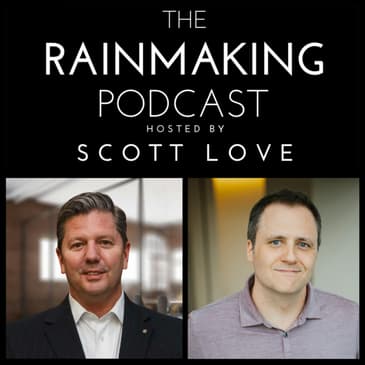
In this episode of The Rainmaking Podcast, host Scott Love speaks with Robert Ingalls, former attorney and founder of LawPods, about how professionals can use podcasting as a powerful business development tool. Robert shares his insights on leveraging podcasts to build relationships, establish thought leadership, and attract new clients. He emphasizes that podcasting isn’t just about producing content—it’s about strategically using it to nurture leads, educate referral sources, and expand professional networks. By consistently creating content that speaks directly to client pain points, professionals can establish trust and credibility in a way that written content or traditional marketing cannot.
Key topics include the three primary ways professionals use podcasting for business growth—nurturing leads by addressing common client concerns, educating referral sources to build long-term partnerships, and networking through strategic guest interviews. Robert also discusses the importance of consistency in podcasting, outlining best practices for content planning, ideal episode length, and the role of authenticity in making a podcast relatable. He highlights common pitfalls, such as failing to define an audience, inconsistent publishing schedules, and not repurposing content for multiple platforms. Additionally, Robert explains how law firms and other professionals can use podcasts as a "Trojan horse strategy" to initiate conversations with high-value prospects who would otherwise be difficult to engage. This episode provides practical, actionable insights for professionals looking to harness podcasting as a business development asset.
Visit: https://therainmakingpodcast.com/
----------------------------------------
Robert Ingalls is a recovering attorney, speaker, and the founder of LawPods, one of the first podcast marketing agencies for law firms.
After the challenges of practicing law threatened to derail his career and mental health, he traded in his suit and tie for a shot at entrepreneurship. Struggling to generate interest from law firms in the early days, Robert spent two years in a corporate banking gig. Grinding nights and weekends, he turned his spare bedroom podcasting hobby into a marketing agency servicing the biggest brands in law.
He lives in Raleigh, North Carolina, with his delightful wife, darling daughters, and a proliferating collection of longboard skateboards.
----------------------------------------
This show is sponsored by Leopard Solutions Legal Intelligence Suite of products, Firmscape, and Leopard BI. Push ahead of the pack with the power of Leopard. For a free demo, visit this link:
https://www.leopardsolutions.com/index.php/request-a-demo/
Links:
https://www.linkedin.com/in/robertingalls/
Learn more about your ad choices. Visit megaphone.fm/adchoices
[00:00:00] You're listening to the Rainmaking Podcast, hosted by high-stakes headhunter, author,
[00:00:19] and professional speaker, Scott Love.
[00:00:24] You're listening to The Rainmaking Podcast, and my name is Scott Love.
[00:00:27] Thanks for joining me on the show.
[00:00:28] We've got an exciting and an interesting episode for you today.
[00:00:32] Robert Ingalls is my guest.
[00:00:34] Now, Robert is a former attorney, but he's also the founder of Law Pods.
[00:00:38] That's a consulting firm that helps attorneys start up and get involved with podcasting.
[00:00:44] Now the things that he's talking about today don't apply just to the legal industry.
[00:00:47] In fact, if you're in professional services, if you're in the business of getting business,
[00:00:52] you're going to learn some unique innovative ways that you can use podcasts to help
[00:00:57] you build relationships with high-health prospects.
[00:01:00] Guess what?
[00:01:01] I've been podcasting since 2009.
[00:01:03] I've done this not for living, but to build my brand and various businesses I've been
[00:01:08] involved in.
[00:01:09] And I can tell you, this is untapped territory.
[00:01:12] And despite of how many podcasts are out there, there's always opportunities to
[00:01:16] get involved in this that will generate business for you.
[00:01:20] So I hope you get some great ideas from my interview with Robert today.
[00:01:24] All of his information is on the show notes wherever you listen to the podcast go there.
[00:01:29] You'll be able to connect with him directly.
[00:01:31] And as always, this show is sponsored by Leopard Solutions, legal intelligence suite of products,
[00:01:36] FirmScape and Leopard BI.
[00:01:38] Push ahead of the pack with the power of Leopard.
[00:01:41] And now here's my conversation with Robert Ingalls.
[00:01:43] I hope you get some great ideas from our discussion today.
[00:01:47] Thanks for listening.
[00:01:48] Hey, this is Scott Love with the Rain Making Podcast.
[00:01:52] Our special guest today is Rob Ingalls.
[00:01:55] And our topic title is Generating Business Using Podcasts.
[00:01:58] Rob, thanks for joining me on the show.
[00:02:00] Hey, it's such a pleasure to be here.
[00:02:02] I really appreciate that invite.
[00:02:04] Yeah, absolutely.
[00:02:05] And I love the expertise you have and related to podcasts.
[00:02:09] So let's just dig into it.
[00:02:10] I'm here for you.
[00:02:11] And so your business, we're going to get to this later, but you help professionals
[00:02:15] in legal get business using podcasts.
[00:02:19] And it's not necessarily somebody doing a show and somebody happens to call them because
[00:02:25] they heard them, but there's other strategies that they can use to get business kind of on
[00:02:30] the front end, not just the back end.
[00:02:33] So kind of dig in.
[00:02:34] What are some of the ideas that you have related to this?
[00:02:36] Where should we start unpacking this topic?
[00:02:38] I mean, my clients are falling into just a couple of different buckets the way they
[00:02:42] use the podcast.
[00:02:43] One of the big ones, and I see this a lot with like a personal injury attorney
[00:02:48] or a family law attorney.
[00:02:49] Like that is they're speaking directly to prospects.
[00:02:52] They're creating content that speaks to a pain point that their customer has in their buying
[00:02:57] journey and they're answering a question because that's really how that buying journey happens
[00:03:02] now.
[00:03:03] That's where you are in the funnel.
[00:03:04] They show up, they have a problem and you know exactly what that problem is because
[00:03:07] you have had a thousand consults where everybody has the same question.
[00:03:12] And that's the content you're making.
[00:03:14] Do I, you know, should I call an attorney before I go to the chiropractor?
[00:03:17] Should I take, can I take half the money in the bank account before I leave them?
[00:03:20] Whatever that stuff is you're making episodes specifically speaking to that pain point, to
[00:03:25] those pain points.
[00:03:26] And so when your clients are doing their research or your prospects are they're finding that
[00:03:30] they're getting to know you like you trust you and you're building that relationship
[00:03:37] during the buying journey in a way that is hard to do with the written word.
[00:03:43] It's even hard to do with video.
[00:03:44] Video is hard.
[00:03:45] What do you think that is?
[00:03:46] Compared to the written word of video?
[00:03:48] Hey, people don't like reading.
[00:03:50] We scan.
[00:03:51] I mean even people like me who spent a good portion of our life in school and reading
[00:03:57] became part of, you know, a central part of your career.
[00:04:00] I'm still, I mean it's bullet points.
[00:04:01] It's moving quick and you're not really, it's hard to feel that person.
[00:04:06] And then the videos are similar.
[00:04:08] Videos are great.
[00:04:09] I love them.
[00:04:10] But the kind of video I like is this kind where we're just riffing.
[00:04:14] But when you bring in that $20,000 crew and you sit there and some people are pretty good
[00:04:19] at it, but then you bring your associate in and they're immediately aware of their hands
[00:04:25] and their eyebrows.
[00:04:27] And they're very stiff and that's hard.
[00:04:30] But with the podcast, it gives you that ability to sit and just have a conversation.
[00:04:34] And after a couple episodes, you kind of forget you're even talking to someone else
[00:04:38] who isn't in the room.
[00:04:40] That's right.
[00:04:41] That's right.
[00:04:42] You let your personality out.
[00:04:43] You leave in some stories.
[00:04:44] You're relatable.
[00:04:45] That's the thing.
[00:04:47] Relatability is what the podcast does because people like doing business with people they
[00:04:51] like.
[00:04:52] That's who we are.
[00:04:53] And when somebody hears your voice and this, I mean, anybody who listens to podcasts understands
[00:04:58] this feeling of you just get that trust with someone.
[00:05:01] Yeah, that's right.
[00:05:02] That's right.
[00:05:03] And I've heard podcasters talk about this.
[00:05:05] They'll get in trouble if you will.
[00:05:08] They'll, some will come up on Twitter from 20 years ago or whatever, you know?
[00:05:12] You'll see they don't really lose their following.
[00:05:14] And I heard one podcaster say, these people know me.
[00:05:18] They've listened to me for a thousand hours and you can't hide in there.
[00:05:22] They know who I am and they know where my heart is.
[00:05:25] And that's one of the things that you can do is people hear your voice and they get
[00:05:28] to understand you and they go, that is someone I want to talk to.
[00:05:32] So let me ask you this.
[00:05:33] Let's see if we can kind of segment this into different categories.
[00:05:36] You talked about different buckets in their buying journey.
[00:05:40] What would this bucket be called?
[00:05:42] Do you have any sort of descriptive name for this bucket, so to speak?
[00:05:46] Yeah, I mean, it's I don't know that I have it written down essentially.
[00:05:49] But when I'm doing this and I'm talking to people about why are we doing your
[00:05:52] podcast because people show up and they're like, I want one, but they don't know why.
[00:05:57] And this is why are we trying to do this?
[00:05:59] And this is talking, you know, developing prospects is we're nurturing
[00:06:03] leads really is what I'll call it.
[00:06:04] I'll say that's the nurturing leads bucket, right?
[00:06:08] OK, good.
[00:06:09] And that's great.
[00:06:10] You know, you want to move to the next bucket?
[00:06:12] Yeah. And let me kind of talk about this for a little bit.
[00:06:14] What I found with my show is that it's kind of like that.
[00:06:18] What am I on? Like episode 190 plus.
[00:06:21] And I found that people when I reach out to them, if they call me or I call
[00:06:25] them, they feel like they know me because I think that relationships
[00:06:29] are built on frequency of contact.
[00:06:30] Absolutely. And, you know, it can be short connections with people.
[00:06:35] But if you can stack those or compress those in a period of time,
[00:06:38] then I think just the frequency increases that feeling of connection.
[00:06:43] What do you think about that? Oh, 100 percent.
[00:06:45] I mean, there's a reason that Doritos shows up on the Super Bowl every year.
[00:06:50] Even if they're not in front of you the rest of the year,
[00:06:52] they're not going to let that game go by without you knowing, oh, no,
[00:06:56] we're still here. We're still doing our thing.
[00:06:59] Top of mind.
[00:07:00] You need to be kind of staying top of mind in front of the people,
[00:07:03] in front of those those prospects that you want to continue to do business
[00:07:07] with, because especially in the age that we're in now where I mean,
[00:07:11] how many LinkedIn messages do you get every day?
[00:07:14] Yeah. Connect with me on LinkedIn so I can sell you something.
[00:07:17] Yeah. And I mean, that's it.
[00:07:19] We could do 30 minutes on that alone.
[00:07:21] But it's so many names come across every single day.
[00:07:26] The world is open to us now.
[00:07:28] We can do business on, you know, every major continent.
[00:07:31] And if you're not top of mind, you are bottom of mind.
[00:07:35] You are gone.
[00:07:36] Right. So what are we calling this one?
[00:07:39] The top of mind approach or top of mind bucket?
[00:07:42] Well, I don't know that I probably niche down a little bit further.
[00:07:46] I'm thinking of who am I trying to stay top of mind with, right?
[00:07:50] And then how do I do that?
[00:07:51] And so the next one, I call it educating referral sources.
[00:07:55] OK, good. Good. Wow.
[00:07:56] And tell me about that. What does that mean?
[00:07:57] So I'll give an example.
[00:07:59] We do a podcast with Michael Cowan in San Antonio,
[00:08:02] a trial or nation's name of the podcast.
[00:08:04] And in that podcast, they talk about being a good trial lawyer.
[00:08:08] They break down some of the most amazing cases
[00:08:11] from some of the greatest trial lawyers, bloodier strategies.
[00:08:14] What did you do here?
[00:08:15] What happened when this happened?
[00:08:16] And they talk about running a law office.
[00:08:18] It's all about being a better trial lawyer,
[00:08:21] managing your office better, just all of that.
[00:08:23] And that isn't talking to prospects at all,
[00:08:26] because prospects don't care.
[00:08:28] Somebody who got re-rended and got hurt doesn't care about any of that.
[00:08:32] Yeah.
[00:08:33] This is for other lawyers.
[00:08:35] This is a way to get other people in the legal community
[00:08:39] to know you like you trust you, you've established your expertise.
[00:08:42] You're staying top of mind because every two weeks
[00:08:45] you're pumping out a new episode that is valuable for them.
[00:08:48] They're starting to like you.
[00:08:50] You know, we do business with people we like.
[00:08:51] So now you are educating and ingratiating yourself
[00:08:55] with people who can send you business.
[00:08:57] That's great.
[00:08:58] So the first bucket we talked about is building relationship,
[00:09:00] I guess, with prospects directly.
[00:09:02] The second one is educating referral sources, right?
[00:09:04] Yes.
[00:09:05] The next big one is networking.
[00:09:08] And this one is, you know, I'll say when I started this business,
[00:09:11] this one wasn't even really on my radar.
[00:09:14] I just didn't, I don't know how I missed it,
[00:09:17] but I didn't see the power of the podcast from a networking perspective.
[00:09:22] I kind of saw it as a nice addition.
[00:09:25] And now I have people that are doing podcasts
[00:09:28] where the listener is very secondary to the podcast's existence.
[00:09:33] It's great.
[00:09:34] They don't, you know, they're building some listeners,
[00:09:36] but that is not their KPI.
[00:09:38] That is not really what they care about.
[00:09:40] They care about being able to have this platform
[00:09:43] so they can reach out and say, hey, Mike,
[00:09:46] I have a podcast where we interview the most successful CFOs.
[00:09:50] I'd love to have you on.
[00:09:52] Here's a couple of episodes from people that you probably know.
[00:09:55] Now you're on a call with Mike
[00:09:57] and you're 30, 40 minutes on the mic getting to know each other.
[00:09:59] He gets to say, oh, he likes you.
[00:10:00] Then you clip it up and you send him these clips of him looking awesome.
[00:10:03] And he has, he feels nice about you now.
[00:10:06] Now, what are the odds that you can have that conversation,
[00:10:09] develop that relationship and get him to feel about you that way?
[00:10:11] If you just call him up and say, Mike,
[00:10:13] you don't know me, but I'd love to talk.
[00:10:15] Yeah, I've heard Henry DeVries call this the Trojan Horse Strategy
[00:10:19] where you're not cold calling.
[00:10:21] They never take that call.
[00:10:23] You're reaching out because I'd like to interview you on my show.
[00:10:26] Right. That's fantastic platform.
[00:10:28] And that one has been huge.
[00:10:31] I love it.
[00:10:32] And then if you can take the first two and weave the other one in,
[00:10:37] now you're in business.
[00:10:39] If you can serve a listener and use it as a valuable networking tool,
[00:10:43] that that's where the business is.
[00:10:45] So have you had clients that have used pretty much all three of these
[00:10:47] buckets as strategy, so to speak?
[00:10:49] Absolutely.
[00:10:50] You know, I have a lot of clients in the first bucket doing nurturing leads.
[00:10:54] And then I have a lot of big law that is in a semi different bucket.
[00:10:59] They're nurturing leads, but they're also they're interested
[00:11:03] in being the first person talking about the thing.
[00:11:05] It's thought leadership.
[00:11:08] New legislation happens.
[00:11:09] They are the first person talking about it.
[00:11:10] And you just start to get to a point where this is where I go to get that
[00:11:14] information.
[00:11:15] And then it is more of a long term play because you don't necessarily
[00:11:19] know if you're speaking to a prospect at the moment.
[00:11:21] But you are getting to a situation where you are seen as the authority.
[00:11:25] And when and if somebody does need, there they go.
[00:11:28] Right? This is great.
[00:11:29] This is great.
[00:11:30] My mind is spinning already with ideas on how attorneys and other
[00:11:34] professionals can use these the way you're talking about.
[00:11:37] Let me kind of go before I ask you this next question,
[00:11:40] are there any other buckets besides nurturing leads,
[00:11:43] referral sources and networking?
[00:11:44] These are the big ones that we do.
[00:11:46] I mean, you can get down into into a strong niche all over.
[00:11:50] But these are the major ways that we're doing it.
[00:11:53] OK, good, good.
[00:11:53] So what are the common pitfalls that when you've worked with
[00:11:57] professionals and they've hired you to help them build their show
[00:12:01] and their strategy and all that, what are some of the bigger pitfalls
[00:12:04] that they need to avoid?
[00:12:06] Consistency, not showing up and doing it is I mean, that's hard.
[00:12:12] You can have this content marketing plan where I mean,
[00:12:16] I feel like anyone in any marketing business has run into this
[00:12:20] where you put out you put out this strategic plan
[00:12:22] where you're going to write all these blog posts and then nobody writes them.
[00:12:25] Yeah, I mean, you go three.
[00:12:26] Then you go to 2017 and that's their last episode and it's still out there.
[00:12:30] And if you really are trying to execute this plan,
[00:12:33] you have to budget this time out.
[00:12:36] And one of the ways we do that is just standing meetings.
[00:12:38] Every third Friday of the month, you are spending an hour here
[00:12:44] and doing it.
[00:12:44] And but that's the nice part of working with an agency
[00:12:47] is now you've got somebody holding you accountable.
[00:12:49] You've got somebody whose job it is to set all this up
[00:12:53] and then you show up and you do the talking.
[00:12:55] But that is something when people are doing it themselves,
[00:12:57] is consistency is huge.
[00:12:59] And then when they're doing it themselves, too,
[00:13:02] too often they're not thinking about the big questions
[00:13:06] before they ever hit record.
[00:13:08] Why am I doing it?
[00:13:10] That's huge because I want to have a podcast.
[00:13:12] Somebody told me I should podcast or all the rage right now.
[00:13:15] And I just start a podcast.
[00:13:17] OK, why?
[00:13:18] Where is this going to turn into money one day?
[00:13:20] Like, what why are we doing it?
[00:13:22] And then once we know why we're doing it, who are we doing it for?
[00:13:25] And so is that avatar, right?
[00:13:27] Yeah. OK, so let me let me come to this also.
[00:13:30] Let me go back to this consistency.
[00:13:33] What would you recommend would be the frequency
[00:13:35] and the length for most shows?
[00:13:36] What have you seen that works well for professionals?
[00:13:39] You know, I'm going to I'm going to lawyer you with this answer.
[00:13:41] It depends. But then I will go further.
[00:13:44] Right. It really does depend because it's it comes to your avatar.
[00:13:48] You think about Joe Rogan's avatar.
[00:13:50] They will listen to a five hour show.
[00:13:52] Yeah, they did just do.
[00:13:54] They're there. A lot of it's for entertainment
[00:13:56] and they're willing to just listen to it over
[00:13:59] three different commutes if they have to.
[00:14:00] They don't mind.
[00:14:01] They're not going to see that episode and think, oh, too long.
[00:14:03] But if this is really dense academic content
[00:14:07] and somebody just needs an answer, your leash is infinitely shorter.
[00:14:11] And so I'm thinking about my avatar.
[00:14:13] What do they want to know?
[00:14:14] What pain point are they struggling with?
[00:14:16] How am I uniquely qualified to address that pain point?
[00:14:19] Because if I'm talking to somebody, if it's personal injury, let's say
[00:14:23] they got in a car accident, they just want an answer.
[00:14:26] They don't want a bunch of fluff.
[00:14:28] And so if you can answer that question in 10 minutes,
[00:14:31] then the length is 10 minutes.
[00:14:32] Do you think people should be afraid of putting out content
[00:14:35] like I'm giving away all my secrets on the podcast
[00:14:37] or not going to call me? What do you think about that?
[00:14:38] I think that's crazy.
[00:14:40] You know, I'll be the first person to say,
[00:14:41] I don't think I have the corner
[00:14:43] on marketing information and knowledge.
[00:14:45] I'm always happy to learn more and change.
[00:14:46] But from my perspective, I think that's insane.
[00:14:49] I've heard it a lot.
[00:14:50] I don't want to say too much.
[00:14:52] I got lawyers that don't want to present CLEs
[00:14:53] because they don't want to give the competition the tricks.
[00:14:55] And from my perspective, you know, I had a mentor years ago
[00:14:59] love this guy to death.
[00:15:00] He said there's always room in the market
[00:15:02] to be better than everyone else.
[00:15:04] And the knowledge is almost never what makes you better.
[00:15:08] Knowledge is everywhere.
[00:15:10] Like almost everything is everywhere.
[00:15:12] There are very few secrets left.
[00:15:14] And so the knowledge isn't really the differentiator anymore.
[00:15:18] It's much larger.
[00:15:19] It's your ability to drive service.
[00:15:21] It's your ability for people to be happy
[00:15:23] and do good work consistently.
[00:15:25] So I think your job is to go out there
[00:15:28] and provide this information to your prospects
[00:15:31] in a way that will make them get just enough
[00:15:33] that they're like, OK, that answers my question.
[00:15:35] I like this.
[00:15:36] And then they say, oh, well, what if I give them all this
[00:15:38] and then they go do it themselves?
[00:15:39] Right. Then that's not a client you wanted in the first place.
[00:15:43] We don't want the DIYers.
[00:15:44] That's a good point. That's a really good point.
[00:15:47] And that goes back to the question that you brought up before.
[00:15:49] Who who is it that you want?
[00:15:51] Who's that avatar?
[00:15:52] And I am speaking to somebody
[00:15:53] who is trying to only spend a thousand dollars a month
[00:15:56] on something and your minimum buy is 10,000.
[00:16:00] Then that's not who you're talking to.
[00:16:02] You should find a way not even have that conversation if you can,
[00:16:04] you know, unless, you know, depending on what your strategy is.
[00:16:07] But you know what I mean.
[00:16:09] So tell me of someone that you've worked with
[00:16:11] and you can't you don't have to mention their name.
[00:16:13] Sure. But you worked with them,
[00:16:14] maybe it was somebody in a big law or solo,
[00:16:18] somebody that's an attorney and they say, I want to do a podcast.
[00:16:22] What are some of the challenges that they faced?
[00:16:24] What were the things that they did that they did well?
[00:16:27] And what were the results that they had to show for their efforts
[00:16:29] and working with you?
[00:16:31] Yeah, I mean, I'll speak to some big law.
[00:16:32] We work with some of the biggest firms in the world
[00:16:35] and a number of our clients in that space
[00:16:38] had started these initiatives themselves.
[00:16:40] And because it really, I mean, you've been
[00:16:43] it sounded like for off the mic, it's not like you've been podcasting
[00:16:45] a hell of a lot longer than me.
[00:16:47] So you know better than anybody what it takes to pull this off.
[00:16:51] And when you start doing it, it doesn't seem that complicated.
[00:16:55] You get a mic and you hit record
[00:16:57] and then you've got the episode great.
[00:17:00] Now what do you do with it?
[00:17:01] And that's where it starts to get complicated.
[00:17:04] Then Apple changes their algorithm.
[00:17:06] So that's where people end up trying to do it themselves.
[00:17:10] And they kind of struggle with it and then they show up.
[00:17:12] And for moment one, the experience is what we've talked about.
[00:17:18] We really want to define everything.
[00:17:21] Why are we doing it? Who are we doing it for?
[00:17:23] How like what's our consistent content plan?
[00:17:25] Because you might have an idea, but then you start talking about that idea
[00:17:28] and you're like, well, OK, that's five episodes.
[00:17:30] What's after that?
[00:17:31] And coming up with a strategy that you can build on over a period of time
[00:17:37] that isn't, you know, is this something that we will run out of?
[00:17:41] Frequently, that's never the case.
[00:17:43] But if it's a super niche issue, it might be.
[00:17:45] And so where is this going?
[00:17:47] Thinking about that next year, because I don't want to talk
[00:17:49] about a podcast that's going to go on for a long time
[00:17:51] without at least knowing where we're going to be in 52 weeks.
[00:17:54] Right, right. So then, you know, to the consistency is mapping out early.
[00:18:00] This is when we're going to do it.
[00:18:02] This is how often we're going to do it, those kind of things.
[00:18:05] And then not letting yourself get tripped up and going, oh, my God,
[00:18:08] we're supposed to have a new episode tomorrow. Yeah.
[00:18:10] So was this an example of one firm that you worked with?
[00:18:14] Well, no, that was I was kind of weaving in different stories here.
[00:18:16] But, you know, I'll give you an example
[00:18:17] of one of the bigger firms I've worked with that had that same similar story.
[00:18:20] They tried it. Sure. Sure.
[00:18:21] And we started working on something and it took the buildup was a while.
[00:18:25] I don't know what you know about working with big firms.
[00:18:27] I think you do.
[00:18:28] But there's a lot of cooks in the kitchen.
[00:18:30] So getting the finally bringing this thing to life took a good bit of time.
[00:18:34] But when it hit, it was exactly what we were looking for, exactly what we wanted.
[00:18:38] We knew exactly who our avatar was.
[00:18:41] And within months, the podcast listenership had grown.
[00:18:46] I mean, especially for a niche podcast like this, not only had it grown.
[00:18:51] It stayed consistent from episode to episode that, you know,
[00:18:54] you want to see those unique listeners, you want to see new listeners,
[00:18:56] but you don't want to ever see that go back down
[00:18:59] where people find it, find it, find it.
[00:19:00] And they go, every episode is really not for me back down.
[00:19:04] So we found that consistency.
[00:19:06] But then we started seeing conversions.
[00:19:08] And that is what turned this client into a major client for us.
[00:19:12] And when I say major client,
[00:19:13] that means it expanded across the across the firm.
[00:19:16] How did those conversions take place?
[00:19:18] If I could ask you that, I'm curious.
[00:19:19] So these they're talking about issues on this podcast
[00:19:23] that if you don't have a company that has, you know, eight or nine figures,
[00:19:27] you wouldn't even understand what this problem is.
[00:19:29] And so those are the listeners and these people turned into clients
[00:19:33] several over the first year became clients because they found them
[00:19:37] through the podcast and they liked the information
[00:19:41] they were learning about it and they started working.
[00:19:43] And I mean, that as a major, major client, you know, like,
[00:19:48] I'm never I'm never going to raise somebody's prices
[00:19:50] because the value is too high.
[00:19:52] But I'm also, you know, at the same time,
[00:19:54] I understand that this is great.
[00:19:57] I'm delivering value here for this client.
[00:20:00] And so when we do have to have those conversations in the future,
[00:20:02] inevitably, you know, where your leverage is a little
[00:20:05] because you understand you always as long as you're delivering value,
[00:20:08] you should never feel bad about charging for it. Right?
[00:20:11] Yeah, that's right. That's a great story.
[00:20:13] So one thing that you mentioned and I want to come back to this,
[00:20:15] you talked about consistency.
[00:20:17] One thing that you said is the avatar might be saying,
[00:20:21] I don't think every episode is for me.
[00:20:23] I don't think I'm going to tune in anymore.
[00:20:25] What do you think are elements of consistency we should look at,
[00:20:30] such as frequency, length of time?
[00:20:33] What do you think what are elements of consistency that should be considered?
[00:20:36] I think that you need to be considering how to create a habit
[00:20:41] because that is what makes your content work well
[00:20:45] is people know if you're weekly, every Monday morning on their drive
[00:20:48] to work, you're there every Monday.
[00:20:51] If you come out on the 15th and the last day of the month,
[00:20:54] they know when they look at their calendar that your show is going to be there
[00:20:58] for them the morning of the 15th and they look forward to it.
[00:21:01] And that's a habit.
[00:21:02] And when we can create habits in our consumer,
[00:21:06] then we're in really, really good shape.
[00:21:08] But the danger there is when you miss your episodes
[00:21:13] and people are expecting it.
[00:21:15] Now, you know, most sane, rational people aren't going to get like mad
[00:21:19] at you or anything, but now you're breaking your relationship down with them a little.
[00:21:23] They're going to then move to something else that morning.
[00:21:26] Yeah, you know, what do you do?
[00:21:27] And then that happens here and there again, and you're breaking the habit.
[00:21:32] And so they're going to go there.
[00:21:33] I like they're not going to say I'm going to stop listening.
[00:21:35] But what's going to happen is they're going to say, well,
[00:21:37] I'll wait until a few more come out and then I'll come back.
[00:21:40] That's not a habit.
[00:21:41] And I have so many of those shows.
[00:21:44] And sometimes it's not even because they didn't release on time.
[00:21:47] It's because I just got overwhelmed with content.
[00:21:49] And then I realize I come back next year and I'm like, oh, man,
[00:21:53] I haven't listened to this podcast in so long.
[00:21:56] But that is that's a really good way if you're thinking every episode,
[00:22:00] every episode, every decision you make with the podcast,
[00:22:04] you're thinking who's the avatar?
[00:22:06] What do they want?
[00:22:07] And that's a way to ensure that every episode is for them
[00:22:11] because I'm thinking about the decisions I'm making,
[00:22:14] what I'm going to be discussing because I don't want my avatar
[00:22:17] to start believing that sometimes this stuff's not for me.
[00:22:21] That's great.
[00:22:21] And I think the theme that I've heard you talk about is coming back
[00:22:25] to who is the avatar?
[00:22:27] What do they want?
[00:22:28] So I think, yeah, I think, I mean, that's what all business
[00:22:30] should be about anyways.
[00:22:31] But the fact that we're thinking about that with our constituents,
[00:22:34] our listeners, who are they?
[00:22:36] What do they want?
[00:22:37] If we thought about that every episode?
[00:22:39] So I think I think that's really, really good advice.
[00:22:41] So one final question that I want to kind of bring things home
[00:22:45] in terms of connecting with people, seeing who listened to our show,
[00:22:49] how many people listen to our show, where they come from.
[00:22:51] Are there any resources that you know are out there
[00:22:54] that podcasters can go to to really find statistics
[00:22:57] that can be helpful and meaningful to them?
[00:22:59] Like for their show?
[00:23:00] That's right.
[00:23:01] Or yeah, for their show.
[00:23:02] Yeah.
[00:23:02] So if you have a podcast, the first place
[00:23:04] stories your hosting provider is looking in the analytics
[00:23:07] on your hosting provider.
[00:23:08] Some have better analytics than others.
[00:23:11] You know, I captivate it's one of my favorites
[00:23:12] that's very accessible for everyday users as well as professionals.
[00:23:17] But you can go in and you can get a really good sense
[00:23:20] of how many downloads are you getting per episode?
[00:23:22] How many unique listeners are you getting per episode?
[00:23:25] You can compare episodes against each other.
[00:23:27] But you can also get down and drill down geographically.
[00:23:30] What countries is it coming from?
[00:23:31] What states, even what cities are you getting a lot
[00:23:34] of your listeners from?
[00:23:36] And so those are good analytics.
[00:23:38] But then you can also do third party analytics.
[00:23:41] You can use there's a bunch of different stuff out there.
[00:23:44] Chartable is a more notable one.
[00:23:46] I think Spotify acquired them over the last few years.
[00:23:49] That's one that we use and you can add that to your RSS feed
[00:23:53] and it'll track and it gives you a little bit better analytics.
[00:23:56] You can get into some IP address tracking.
[00:24:00] You can get maybe an understanding of what companies people are
[00:24:04] that might be listening.
[00:24:05] You know, podcasting hasn't gotten as to the place
[00:24:10] that other forms of marketing are where you can really track
[00:24:13] your lead conversions the same way.
[00:24:15] I'm sure that it's coming.
[00:24:16] It's where the money is.
[00:24:17] I'm positive that there are people working diligently on this.
[00:24:21] But it's not quite there yet, but you can get some pretty solid
[00:24:25] understanding of where things are.
[00:24:27] And then I always tell people if you ask,
[00:24:31] that's a big way to figure out what's going on out there.
[00:24:33] Just ask your listeners to take an action.
[00:24:36] If you have something valuable for them, create a download
[00:24:38] and capture email addresses.
[00:24:40] And I mean, lead generation in your podcast, depending on what
[00:24:43] you're using it for is a very valuable have a CTA in there
[00:24:48] that allows people to jump into your funnel instead of just
[00:24:51] being a listener that shows up as a number on a sheet.
[00:24:54] What does CTA stand for?
[00:24:55] Call to action.
[00:24:57] Oh, good. See, OK.
[00:24:58] Yeah, I'll get out there using all kinds of acronyms.
[00:25:01] That's great.
[00:25:02] So let me ask you then, Rob, if you could kind of bring this
[00:25:05] home for us in terms of three action steps that people can take
[00:25:08] to really get started on this.
[00:25:10] What would those three action steps be?
[00:25:12] You know, I think too many people will get into buying
[00:25:14] mics and all that stuff.
[00:25:16] And I think the action steps are plan.
[00:25:18] The plan is the 100 percent most important thing.
[00:25:20] Why? Why am I doing it?
[00:25:22] Am I doing this to drive referrals?
[00:25:24] Am I doing it because I have questions that I can nurture
[00:25:28] my leads through?
[00:25:30] Can I network this way?
[00:25:32] Lawyers, this is a big one for lawyers.
[00:25:33] They can't call.
[00:25:34] So you can't call someone who you want to work with as a client
[00:25:38] and say, I'd like to work with you as a client.
[00:25:40] And almost every jurisdiction, I think that's a thing you can't do.
[00:25:44] What you can do is hop on a podcast episode and talk to them.
[00:25:46] And then they get, you know, I like to cut of that guy's
[00:25:48] jib, right? Yeah.
[00:25:50] Why are you doing it?
[00:25:51] Who are you doing it for?
[00:25:54] Like, who is that person?
[00:25:55] What do they want to know?
[00:25:55] What are the things that matter to them?
[00:25:57] And then establish what your KPIs are.
[00:26:00] Understand how you are going to measure success with this
[00:26:03] because too many people think download, download, download,
[00:26:06] download. Got it.
[00:26:07] And then they think that, oh, well, this person,
[00:26:10] this show has 5,000 downloads.
[00:26:11] Why am I only getting 500?
[00:26:13] What's the size of your market?
[00:26:14] 500 very well could be amazing.
[00:26:17] I have podcasts that are getting around 200 downloads.
[00:26:22] And this firm will do this podcast till the end of time.
[00:26:26] If they can keep 200 people listening
[00:26:28] because 200 people that would listen to a podcast like this
[00:26:30] are valuable. Absolutely right.
[00:26:33] So number one is plan number two, establish KPIs.
[00:26:36] Is that right?
[00:26:37] Well, I was saying, you know, well, yeah, plan, I guess,
[00:26:39] I mean, I was kind of making that into three, like what is the why?
[00:26:42] OK, got it. Who is the avatar?
[00:26:44] And then establish your KPIs. Got it.
[00:26:46] OK, good, good, good.
[00:26:47] I think that's great.
[00:26:48] I think that's really good.
[00:26:50] That's no you want to roll it out and make sure
[00:26:51] your rollout strategy hits a lot of boxes,
[00:26:54] but there is a lot of boxes in there to fit inside three.
[00:26:57] Yeah, that's right. Wow.
[00:26:58] What a project. But that's worth it.
[00:26:59] And I know you know that from working with your clients.
[00:27:01] I'm seeing what happens to them.
[00:27:03] And so tell us about your services.
[00:27:05] What do you do?
[00:27:06] What do you have that you'd like our listeners to know about?
[00:27:08] You're Robin, we'll certainly put all of your links on our show notes.
[00:27:11] Yeah. So I mean, really, you do the talking, we do the rest.
[00:27:14] That is something that we really try to stick to.
[00:27:16] It's like we work on the strategy.
[00:27:18] We set up the recording environment.
[00:27:19] People show up. They add their guests show up.
[00:27:21] They have a conversation that we record for them professionally.
[00:27:25] We record that video as well in high res.
[00:27:28] Everyone's on a separate track, gives us a lot of editing capability.
[00:27:31] And they hang up and they're done.
[00:27:34] You know, we we engineer the audio.
[00:27:36] We cut the video.
[00:27:37] We cut it into video clips, image quotes, transcripts, show notes,
[00:27:41] publish the video to YouTube, put it on the website,
[00:27:43] make sure it's on every podcast player,
[00:27:44] put those clips out all over social media.
[00:27:47] I mean, showing up 30 minutes and having a conversation
[00:27:50] can be the cornerstone of a content marketing strategy
[00:27:52] when you're doing it like this.
[00:27:53] Absolutely right. And it's nice.
[00:27:54] They can just delegate that to you and go back to practicing
[00:27:58] and not have to worry about that, knowing that your team is doing all this.
[00:28:01] I think that's a brilliant business model.
[00:28:03] Yeah. I mean, I learned that as a lawyer,
[00:28:04] do the thing that you do well and pay people to do the things they do.
[00:28:07] Yeah, absolutely right.
[00:28:08] Well, this is great. I appreciate you being on the show.
[00:28:11] We're going to put like I mentioned the links on your show notes.
[00:28:13] So anybody listening right now, go to wherever you hear this podcast
[00:28:17] and you'll be able to connect with Rob directly.
[00:28:19] And I'd love to have you back on.
[00:28:20] I know there's a lot more that we can talk about.
[00:28:22] So thanks for being a great guest today and sharing all this info with this Rob.
[00:28:25] It's pleasure.
[00:28:26] Really was mine.
[00:28:30] Thank you for listening to the Rain Making podcast
[00:28:33] for more information about our recruiting services for international law firms.
[00:28:37] Visit our website at attorneysearchgroup.com
[00:28:42] to inquire about having Scott speak at your next convention,
[00:28:45] conference, sales meeting or executive retreat.
[00:28:48] Visit the Rain Making podcast.com.