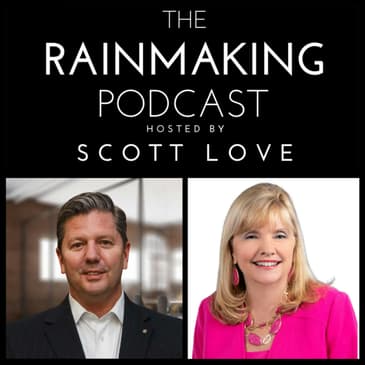
In this episode of The Rainmaking Podcast, host Scott Love speaks with Suzette Welling, management consultant and expert in professional services firm operations, about how to take action on strategic plans to drive real business results. Suzette shares insights from her experience working with law firms, explaining that many firms invest significant time and money into strategic planning retreats but fail to execute on their plans once they return to their daily operations. She emphasizes that intentionality, accountability, and structured systems are the key factors in ensuring that strategic initiatives don’t get lost in the shuffle of daily business demands.
Key topics include how to break long-term plans into manageable quarterly and weekly goals, the importance of assigning clear responsibility for action items, and how to implement the Entrepreneurial Operating System (EOS) to create structured accountability. Suzette also shares strategies for effective team communication, weekly progress tracking, and building a culture of execution so that firm leadership follows through on commitments. She highlights common pitfalls such as lack of follow-through, unclear delegation, and failure to track progress, offering actionable steps to overcome these challenges. This episode provides professionals with a clear roadmap to ensure that strategic planning translates into measurable business growth.
Visit: https://therainmakingpodcast.com/
----------------------------------------
Suzette Welling, holding the distinguished Certified Legal Manager (CLM)® designation, is the founder and President of Law Practice Edge. With a career spanning over two and a half decades in upper-tier law firm management, Suzette brings a wealth of expertise to the table. Her comprehensive understanding of law firm administrative functions encompasses a broad spectrum, including strategic planning, finance, human resources, communications, client relations, professional development, recruitment, and facilities management.
Suzette’s financial acumen and leadership capabilities were recognized in 2009 when she was honored with the Tampa Bay Business Journal CFO of the Year Award. Her pursuit of excellence led her to attain the CLM® designation in 2018, affirming her deep-rooted knowledge and proficiency in various aspects of law firm management. This accreditation, demanding rigorous education and testing, underscores Suzette’s mastery in the legal management domain. Further expanding her skill set, Suzette acquired a certification in Legal Lean Sigma in 2022, enhancing her ability to offer top-tier process improvement and project management solutions.
Suzette caters to law firms of all sizes, but she has identified a niche in smaller law firms, which require expert guidance but might not have the resources for a full-time position of this caliber. In response, she founded Law Practice Edge, aiming to level the playing field and provide competitive advantages to firms irrespective of their size. Larger firms also benefit from her services, particularly when they face challenges in managing complex projects due to limited resources. Suzette is available for consultation and can be reached at suzette@lawpracticeedge.com
----------------------------------------
This show is sponsored by Leopard Solutions Legal Intelligence Suite of products, Firmscape, and Leopard BI. Push ahead of the pack with the power of Leopard. For a free demo, visit this link:
https://www.leopardsolutions.com/index.php/request-a-demo/
Links:
www.legalmanagementexchange.org
https://www.linkedin.com/in/suzettewelling/
Learn more about your ad choices. Visit megaphone.fm/adchoices
[00:00:00] You're listening to The Rainmaking Podcast.
[00:00:07] You're listening to The Rainmaking Podcast.
[00:00:10] You're listening to The Rainmaking Podcast.
[00:00:16] Posted by High Stinks Head Hunter, author and professional speaker, Scott Love.
[00:00:23] You're listening to The Rainmaking Podcast.
[00:00:25] And my name is Scott Love.
[00:00:27] Thanks for joining me on the show.
[00:00:28] I'm excited that you're here.
[00:00:30] We've got an exciting episode for you.
[00:00:32] Are you someone that manages a team of people?
[00:00:35] And you're not necessarily the best manager in the world, but you know that
[00:00:38] that should be something you need to be good at.
[00:00:41] We know that you're a really good professional service provider,
[00:00:44] but you gotta get better at managing that team.
[00:00:47] You're going to learn some action steps and strategies related to taking action on your plan
[00:00:54] and our guest talking about that today is Susette Welling.
[00:00:58] Susette is a management consultant that specializes in helping professional services firms,
[00:01:03] especially law firms increase their performance in dealing with things like
[00:01:08] client development, marketing, recruiting, facilities management.
[00:01:12] All those things that professionals really don't want to have to take care of,
[00:01:16] but they need to have somebody take care of it.
[00:01:18] Well, those are the things that she's really good at.
[00:01:21] Susette is going to share recommendations and action steps on how you can be more effective
[00:01:26] at managing your team and making sure that they perform in the way that they need to.
[00:01:30] All of Susette's contact information is on the show notes,
[00:01:34] so wherever you hear this podcast, make sure you visit that and connect with her directly on LinkedIn.
[00:01:39] As always, this show is sponsored by FirmScape and LepardBI.
[00:01:43] Push ahead of the pack with the power of Lepard.
[00:01:46] And one other final note, if you're in the recruiting industry,
[00:01:49] make sure you check out the placement club dot com.
[00:01:52] It's a free learning community with resources that can help you become more effective at recruiting,
[00:01:58] the placement club dot com.
[00:02:00] And now here's my conversation with my friend Susette Welling.
[00:02:03] Thanks for listening.
[00:02:06] Hey, this is Scott Love with the Rainmaking Podcast.
[00:02:08] Our special guest today is Susette Welling,
[00:02:11] and we're talking about taking action on the plan.
[00:02:14] Susette, thanks for joining me on the show.
[00:02:17] Thanks, Scott. It's great to be here.
[00:02:20] Absolutely. And I like the fact that you're very niched within the legal industry even though these concepts that we're talking about today can apply to any organization
[00:02:28] because it's all about taking action on the plan.
[00:02:31] And let's kind of set the scenario.
[00:02:33] Let's say that there is an organization.
[00:02:35] Let's say it's a law firm.
[00:02:36] They have their strategic planning retreat.
[00:02:38] Maybe it's a partner's retreat.
[00:02:40] They have the golf.
[00:02:41] They have the meeting.
[00:02:42] They have some meetings meetings meetings and then they talk about the strategic plan.
[00:02:46] And then everybody gets back to their offices on Monday.
[00:02:49] And what have you seen usually happens?
[00:02:51] Those great plans going to draw.
[00:02:53] Yeah, everyone is want.
[00:02:56] And it never gets addressed.
[00:02:59] So I think that the intentions are really good.
[00:03:03] Obviously because they took the time to make those plans.
[00:03:06] They took the time to maybe go away from their families for a weekend to focus on the business.
[00:03:12] And when they get back to the office, they're so swamped working in the business that they just never are able to take those great plans and help them come to fruition.
[00:03:24] That's right.
[00:03:25] And that's a waste.
[00:03:26] And that 300, 400, 500,000 or more that they spent on that meeting is gone because nothing changes.
[00:03:32] So where do you think we should start with this?
[00:03:34] Where do you think those that want to take action on their plans?
[00:03:38] Where do you think they should kind of start?
[00:03:40] And making changes to where things actually get done?
[00:03:43] Well, I think you have to have assigned responsibility for tasks.
[00:03:48] In my organization, we use the EOS model and I know a lot of people are familiar with traction by a genome equipment.
[00:03:56] And I think that it is a great resource for developing how you do make sure that things happen.
[00:04:05] So you have your long term goals, let's say 10 years and then you kind of back up from there right?
[00:04:11] You're looking at where do I need to be in five years to make it to 10?
[00:04:14] Where do I need to be in three years to make it to five?
[00:04:17] And you know, you continue to back up until you get to quarterly goals.
[00:04:21] And I think that having regularly scheduled meetings, having people that are responsible for each one of those items is what will help to make sure that it happens.
[00:04:33] And then the great thing about the EOS model is that there is a formula in place for how we conduct those meetings because we've all been in meetings that are death by meeting and nobody wants to do that.
[00:04:46] And attorney time is especially valuable because that's what they're selling is their time.
[00:04:52] Yeah, right.
[00:04:53] So make sure that those meetings are productive and that they don't go on and on.
[00:04:59] And so there are systems in place to make sure that that doesn't happen.
[00:05:03] Okay, good.
[00:05:04] So kind of help us unpack that a little bit.
[00:05:06] What are the big rocks on the bucket, so to speak in terms of these systems that somebody that even if they've got a small business, they really need to focus on to take action on the plan.
[00:05:16] So if you have specific goals that you want to meet in a quarterly fashion, you would have those defined let's say it's add this many new clients, this quarter or create a new practice area that we're going to include in our offerings or cross selling.
[00:05:37] And so a lot of firms have multiple different areas that they practice and they may especially if they have corporate clients, you know, they can have corporate clients that don't have any idea the other areas that they could support them in if intentional things are not put in place to make that note.
[00:05:57] And I've heard partners talk about that a lot where they're at lunch with the client and a client talks about an issue they're having in the partner says, well, we can do that for you.
[00:06:07] Oh, you do that.
[00:06:09] So should I should have known that right?
[00:06:12] I get that.
[00:06:13] So let me kind of ask you this question then, why do you think it's so hard for people to really take action on their plan? What do you think are some of the blockers that most people and professionals face.
[00:06:26] I think that they are so busy that it's really difficult to just add one more thing to their plate.
[00:06:34] Again, I think they have good intentions. I think that they can have really and so a lot of times with the partner retreats, they may have their firm administrator or their executive director at the retreat with them.
[00:06:48] I think that that's ideal because someone again has to take responsibility for those items, but even that internal executive director, they have so many things on their play.
[00:06:59] And if it isn't intentional, how we're going to make these things happen then it just falls by the wayside.
[00:07:06] That's right.
[00:07:08] Yeah, that is human nature, I think.
[00:07:11] So do you think the people like the firm administrator or the executive director, do you think they ever face hesitation to push back on the partners to actually take action on some of these things? Do you think that can be problematic to professional services firms?
[00:07:27] Absolutely, I think it really depends on the firm culture.
[00:07:30] Yeah.
[00:07:31] I think you know, I've been in law firms since 1982 so I've seen a lot of change in our cultures in that time.
[00:07:38] You know, we come a long way from the partner that comes back with the from the three martini lunch and chain smoky cigarettes in his office.
[00:07:47] I think many firms have a much healthier culture today where the executive director or firm administrator is comfortable.
[00:07:55] But it really, it's, it's the responsibility of the partners to make that manager feel comfortable to know that it's safe to have those conversations with them to because the whole point is for them.
[00:08:13] It's like help me help you, right?
[00:08:15] Right. Right.
[00:08:16] So what do you think are some of the pitfalls as people have started to take action when they see I've got to break this down 10 year, five or three year, when you're quarterly.
[00:08:26] What are some of the things that really keep them from executing well on this that you've seen?
[00:08:31] I think a lot of it is that it's just not intuitive.
[00:08:34] It's not intuitive to them how they should break this down.
[00:08:39] I have one client where it is very intuitive to him and it's amazing.
[00:08:44] It almost makes me feel like I'm not needed because it's so good at it.
[00:08:48] But in general, I don't think it's intuitive.
[00:08:51] And so I think having someone to guide you can make a tremendous difference.
[00:08:58] So what's some of the structure then that you think has been effective in how they tell their team like this is division.
[00:09:06] Where do we go from here?
[00:09:08] What have you seen in terms of a format that they've followed to actually get people on board and take action on these things?
[00:09:15] I think communication is really important.
[00:09:18] I think sharing the excitement of your vision is really important.
[00:09:23] I also think that if you're in a firm where people have seen these things happen in the past where we have these big plans, but then they never happen.
[00:09:34] It can create a perception that all this is just another one of their ideas and you know we can ignore it because in a couple weeks they'll forget about it.
[00:09:43] So I think it's really important to put your money where you're mouth is and show that you're going to actually act on what you say.
[00:09:52] And then I think having something whether it's the EOS model or another model, there are other ideas out there, but some kind of structure where you're really keeping track of these things.
[00:10:03] So with EOS, we have you know, you have your 90 day goals and then you have your weekly goals that lead up to those 90 day goals.
[00:10:12] And by having a quick meeting every week to review the status of those items, you'd be amazed at how much accountability that creates.
[00:10:22] I managed to firm that operating on the EOS model and I can tell you that the day before the weekly partner meeting, I was looking at that list and making sure that my things were done because I didn't want to sit in the middle of the table.
[00:10:32] Because I didn't want to sit in that partner meeting and say that I had failed to meet one of my objectives.
[00:10:38] Yeah, it creates a lot of accountability.
[00:10:42] So I want to dig deep into that but let me kind of back up then on the vision.
[00:10:46] One of the first, the first thing you said when I talked about what should they keep in mind and take action on you mentioned sharing the excitement of your vision.
[00:10:54] Tell me a time where you've seen that done well in an organization, what did the leader do? What did he or she say?
[00:11:00] What was the response and then where did they go from here in terms of really taking that vision and making it part of their firm story.
[00:11:07] So I would say at this particular firm that I managed where we operated on the EOS model.
[00:11:14] And we put in place and it was a firm where there had been things in the past that had been attempted that had never come to fruition.
[00:11:24] And I think what made it different was having this structure in place people could see that that structure was being put in place and they could see that we were having weekly partner meetings that we were taking this really seriously for the partners to commit to those meetings.
[00:11:39] I think sent a very strong message of how committed they were. We also had weekly what they called all hands meetings where everyone in the firm participated and it was just a short 30 minutes, but it was just enough to keep everybody on board to you know to make everyone feel like they're part of it.
[00:12:00] Yeah, so you know it's not just the people appear will say that are have these pie in the sky ideas and it means nothing to the receptionist.
[00:12:10] It's everyone in the firm is important without any one of those pieces we wouldn't be as successful right otherwise we wouldn't have those positions in the firm.
[00:12:20] So including everyone in those weekly meetings where everyone is shown that they bring value to the team. I think makes a huge difference.
[00:12:29] Yeah, that's right. And I think people want to know that their work contributes to the role vision of that organization.
[00:12:36] And I've seen this in organizations even the receptionist someone tells that receptionist you're the director of first impressions and you're the final memory maker.
[00:12:43] And because if your work here, this is what our clients think about us so you help us reach our vision, you know things like that.
[00:12:49] Exactly.
[00:12:50] So let me go down then you talked about there was structure in place people participated at that point in time.
[00:12:57] What did that leader do to set the structure? What were the different roles that were assigned and who received those roles and kind of what were their responsibilities to executing on that vision.
[00:13:12] So a lot of it fell on me as the chief administrative officer in the firm at the time, but there were also some items that were assigned to partners.
[00:13:22] So again, every single item had someone assigned as the responsible person. If more than one person is responsible, no one's responsible because it's just too easy to say I assumed so and so was doing it.
[00:13:35] And so not that other people aren't contributing but someone has to be accountable for making sure that the plan is happening that things are moving forward.
[00:13:44] And with software today, you know in my organization we use Monday.com and we actually have a whole EOS board that we set up so that we keep track of these things and you use that to run the meeting.
[00:13:57] So you're going through here are the two do's that everyone has to do and you know this is your assignment. Are you on task?
[00:14:04] Yes, this is your assignment. Are you on task?
[00:14:06] And if there are issues that are getting in the way, then we discuss those issues so that we can help the person find a solution.
[00:14:13] So you can't hide I mean people are going to be people they can't just say well I'm kind of busy. I can't make that meeting.
[00:14:19] No, so that kind of I'd say in a way it puts social pressure on people to produce right what do you think?
[00:14:26] Absolutely it absolutely does like I said I was making sure before every weekly meeting that my tasks were done.
[00:14:32] Yeah, yeah you don't want to show up and look like you're the one that's not holding the bag. You know you're the one that's not doing the job so exactly.
[00:14:39] That's really interesting. So do you think that's and I think I already was going to ask you a question but I already know the answer.
[00:14:47] Let's talk about trust in an organization without trust I can see this is not being an effective use of time.
[00:14:54] What do you think about that? How important is it for trust to be there and how can a leader build that trust in your organization?
[00:15:00] It's extremely important and I think that part of the process does create an intentionality of the leader communicating that it is safe that they want you to be completely honest.
[00:15:17] So when we're in these meetings and if someone is struggling with meeting one of their goals.
[00:15:23] Well we put that on the issues list and we talk about it together we help you find a solution so even though you're the one responsible for making sure that thing happens.
[00:15:33] You're not alone we're all a team and we're here to help you.
[00:15:37] Yeah, that's right that's right okay interesting so let me let me ask you this then let's look at an organization that you work with as a consultant and what I want to find out more about what you do with that in just a second.
[00:15:47] What has been what were the problems that they had before and what was kind of the arc how did you initially set them up to build these systems.
[00:15:56] What were some of the challenges that you faced and then what were some of the successes that they realized by working with you on that?
[00:16:02] So there's one firm that I work with they're a fairly new firm. They practice defense work so the firm was created by two women who were very well known.
[00:16:16] They were very well known in their industry in large firms they decided they wanted to go out on their own.
[00:16:23] When out on their own we all know that there's a lot more to it than what anyone knows until they get there very busy very fast because of their reputations.
[00:16:35] And so there are a lot of things that a lot of challenges that are faced with that when you grow so fast like there's not an opportunity to get those systems and structures in place.
[00:16:47] Right, so that as you grow at your scaling and things are already there.
[00:16:52] So putting plans in place where these are the things that we need to make happen this is how we need to make them happen has been significant.
[00:17:02] So another issue is communication so when you have so much growth so fast, you can't hire people fast enough.
[00:17:12] You know that's another thing we're helping them with is recruiting and there's just a lot of frustration.
[00:17:18] And so part of what this whole system just automatically creates is a way to communicate.
[00:17:24] So when we have these systems in place and then we have these weekly meetings, then everyone now is starting to feel heard.
[00:17:32] So you can see the stress levels coming down and it creates also a way to communicate that you may think you're communicating with your team but they may not be always hearing what you think you're sharing.
[00:17:46] And so by having these meetings, they can see oh they're working really hard to try to get us help through doing everything they can to bring more people in here.
[00:17:55] We need more paralegals but we can see that they're doing it.
[00:17:58] We can see they're investing in a consultant to help us get systems in place so that our lives can be better.
[00:18:04] They've asked her to help facilitate these meetings for us because they really care about what we think they're asking her to invest time in spending time with each of us individually to hear about what our experience is.
[00:18:15] And I think a lot of it really comes down to communication but having these systems in place kind of creates that way of having communication happen almost automatically.
[00:18:28] Right, that's really interesting. So when you say the system gives a way to communicate what's an example of that?
[00:18:35] I want to see is it a tangible system? Is it email verbal or what do you mean by that exactly?
[00:18:40] So the whole EOS system when you have your goals, your quarterly goals and your weekly goals.
[00:18:46] And then you have a meeting to review them.
[00:18:49] And then if you're having an issue accomplishing one of those goals.
[00:18:53] The whole format of the meeting is let's put that on the issues list.
[00:18:58] Let's help find a solution.
[00:19:00] So nobody feels isolated and alone they have a team that's in partnership with them to help things move forward.
[00:19:08] So I think you know, I see this a lot in paralegals where a good paralegal they feel a great sense of responsibility.
[00:19:17] And if there's something that they need to be accomplishing and they're they find that you know they're just hitting a wall and it's not happening.
[00:19:26] They tend to wear it on their own shoulders as opposed to seeking help because they feel the sense of responsibility.
[00:19:32] But when you're in this meeting where we're talking about is the soundtrack and if not, what's the issue and how can we help?
[00:19:39] Yeah.
[00:19:40] Then it creates just creates this relief for them.
[00:19:43] Yeah. Yeah.
[00:19:44] That's right.
[00:19:45] Where they don't have to feel like a failure.
[00:19:46] Right.
[00:19:47] We're all here to help.
[00:19:48] This is great.
[00:19:49] And I appreciate these insights who said let me ask you this as we kind of bring our conversation to a close.
[00:19:55] If you could say there are three action steps people can take to get started on building these types of systems.
[00:20:01] So that they're taking action on the plan.
[00:20:04] What do you think the first step would be?
[00:20:06] I highly recommend reading the book traction if they haven't already.
[00:20:11] I know I shared that with you earlier, I just I can't say enough about it.
[00:20:15] Now there are a lot of really great business books out there that talk about these ideas.
[00:20:21] But I think what traction does is it goes a step beyond telling you what you should be doing and it tells you how to do it.
[00:20:29] And I think that's what makes it different.
[00:20:31] That's great.
[00:20:32] That's great.
[00:20:33] That's good.
[00:20:34] That's step number one.
[00:20:35] And what do you think step number two is?
[00:20:36] Actually put the system in place.
[00:20:38] So, you know, create and whether it's the EOS model through traction or another model that you've read about or heard about or have experienced in the past.
[00:20:48] So, you know, there's a lot of things that are going to happen.
[00:20:51] And then what do you think is the kind of type of actual system in place where you're tracking your goals and you're having regular meetings to discuss those goals so that it creates accountability and those things actually happen.
[00:21:01] That's great. Good.
[00:21:02] And then what's our final step here? Step three.
[00:21:04] I would say, you know, there are a lot of fractional services out there today that can help when a lot of times I think firms of all sizes.
[00:21:14] The small firm just doesn't have someone capable maybe of handling the higher level management and a middle size or even larger firm.
[00:21:22] They've got all kinds of people on their team, but they have so many things on their plates that they can't always manage one more thing.
[00:21:30] And so I think it just really gives the opportunity to get a little extra help only when you need it.
[00:21:38] So it can be a win-win because you don't have that extra expense all the time. It's only when you need that.
[00:21:46] That's great.
[00:21:47] And tell us more about what you do.
[00:21:49] How do you help these organizations execute and really take action on the plan?
[00:21:53] Tell us about your offerings and services that you'd like everybody to know about.
[00:21:56] Who's that?
[00:21:57] So we support firms in a lot of different ways, whether it's fractional CFO marketing strategic planning.
[00:22:07] I would say as it relates to our conversation today, strategic planning so we actually use the EOS model with our clients.
[00:22:16] And we work with them in a way that we meet with them weekly.
[00:22:20] And we identify the issues that need to be addressed and work with their internal team to make those things happen.
[00:22:28] And again, a lot of times we see clients who they just don't know what they don't know.
[00:22:34] You know, smaller firms and firms that, you know, we have clients who have been in business 10 years or less who they're discovering today, things that they didn't know.
[00:22:44] They didn't know.
[00:22:45] I can see that you really feel that gap.
[00:22:47] You bring that wisdom and insight.
[00:22:48] You've seen this movie before so you can tell them where the pitfalls are.
[00:22:52] So I really appreciate that perspective, Susette.
[00:22:54] And for everybody listening, we're going to put Susette's contact info and also LinkedIn link on the show notes.
[00:23:00] So wherever you're listening to this podcast, go there and you'll be able to connect with Susette directly.
[00:23:06] So that thanks for sharing your wisdom here and your insight.
[00:23:08] I'd love to have you back on the show.
[00:23:10] Thank you so much again for being a guest on the Rainmaking podcast today.
[00:23:13] Thank you, Scott. It was a pleasure.
[00:23:18] Thank you for listening to the Rainmaking podcast.
[00:23:22] For more information about our recruiting services for international law firms, visit our website at attorney-searchgroup.com
[00:23:31] To inquire about having Scott speak at your next convention, conference, sales meeting or executive retreat, visit the rainmakingpodcast.com
[00:23:43] and visit our website at attorney-searchgroup.com