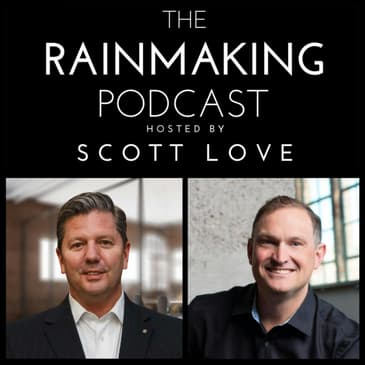
In this episode of The Rainmaking Podcast, host Scott Love speaks with Jonathan Porter-Whistman, author of The Sales Boss, about what it takes to become a top 1% sales leader. Jonathan shares insights from his book, explaining that being a true “Sales Boss” is about more than managing a team—it’s about building a high-performance culture, taking full ownership of results, and leading with a clear, strategic vision. He emphasizes that top-performing sales leaders recognize that success starts with them, and they take responsibility for every aspect of their team’s performance, from hiring to training to execution.
Key topics include Jonathan’s Sales Boss framework, which outlines the essential traits and actions of elite sales leaders, and his four-stage hiring process for identifying and onboarding high-potential sales professionals. He discusses the importance of avoiding micromanagement while staying actively engaged, setting high expectations, and leading by example. Jonathan also shares his “BOSS” acronym, a leadership mindset that helps managers create an environment where top performers thrive. He introduces advanced hiring techniques, including the pressure interview, performance interview, and the “bumbling idiot” test, designed to reveal a candidate’s true potential. This episode provides practical strategies for professionals looking to elevate their leadership skills, build stronger teams, and achieve elite-level success in sales and business development.
Visit: https://therainmakingpodcast.com/
----------------------------------------
Jonathan Porter-Whistman, who is the CEO of PerceptionPredict.ai and WhoHire.com, Jonathan has a deep knowledge of building and scaling businesses. His best-selling book, 'The Sales Boss', stands as a clear indicator of his expertise. Jonathan specializes in aiding clients in constructing efficient teams, tailored to their business’s unique requirements. His targeted approach mitigates the anguish and disappointment that often result from recruiting incompatible talent.
----------------------------------------
This show is sponsored by Leopard Solutions Legal Intelligence Suite of products, Firmscape, and Leopard BI. Push ahead of the pack with the power of Leopard. For a free demo, visit this link:
https://www.leopardsolutions.com/index.php/request-a-demo/
Links:
https://www.amazon.com/Sales-Boss-Secret-Training-Managing/dp/1119286646
https://www.linkedin.com/in/jonathanwhistman/
Learn more about your ad choices. Visit megaphone.fm/adchoices
[00:00:00] Your listening to The Rainmaking Podcast.
[00:00:07] You're listening to The Rainmaking Podcast.
[00:00:14] Posted by High Stinks Head Hunter, author and professional speaker, Scott Love.
[00:00:22] You're listening to The Rainmaking Podcast and my name is Scott Love. Thanks for joining me on the show.
[00:00:28] Today we have a sales boss with us today talking about how you can become a sales boss.
[00:00:34] What does that mean somebody that's in the top 1% of client development?
[00:00:38] His name is Jonathan Porter-Whisman. He's the author of the book The Sales Boss.
[00:00:43] I'd highly recommend checking that book out.
[00:00:45] I put the link for you to order it on Amazon on the show notes.
[00:00:48] So wherever you listen to this podcast, go to where you can see the show notes and you'll be able to order it directly.
[00:00:54] I also put Jonathan's bio link and also his LinkedIn link on the show notes.
[00:00:59] And Jonathan Porter-Whisman is an author, a professional speaker, and also CEO of a company that gets involved in predicting who's going to work out when you hire them.
[00:01:10] His company's called PerceptionPredict and you can visit their website at whohire.com as well.
[00:01:17] I hope you get some great ideas out of this show, as always. This show is sponsored by Leopard Solutions Legal Intelligence, Sweet of Products, Firmscape and LeopardBI.
[00:01:26] Push ahead of the pack with the power of Leopard. Thanks for listening and I hope you get some great ideas from my conversation with Jonathan today.
[00:01:35] Hey, this is Scott Love with the Rainmaking Podcast. Our special guest today is Jonathan Porter-Whisman who is the author of The Sales Boss.
[00:01:43] And we're talking about The Sales Boss, as all of us are in sales or client development. We're leading teams of people.
[00:01:49] So Jonathan, thanks for being on the show today.
[00:01:51] Yeah, absolutely. Nice to be visiting with you Scott looking forward to the show.
[00:01:55] Absolutely right. So let me kind of dig into it. This is your book The Sales Boss. I've read it. It's a good book. I'd highly recommend that.
[00:02:01] And you talk about the management code. About don't be a micromanager, be actively engaged, be honest always be authentic, be the thermostat, not the thermometer.
[00:02:12] Trust and expect the best but verify believe bigger and believe the fault is yours.
[00:02:18] And that's a really good simple code that you articulate here that kind of sets us up for how we can be effective at leading our team.
[00:02:27] Let me ask you this question out of all those, where do you think people kind of stumble the most? What are kind of the most obvious pitfalls among that code that you find people really struggling with?
[00:02:37] Yeah, one of the management when I isolate that directly to the management code. I think the one that people fail the most in is the fault is yours.
[00:02:46] Oh yeah, tell me about that. What does that mean?
[00:02:48] And what do I mean by that when I call somebody the sales boss? Let me define that to start with. So a sales boss, I define that as a sales leader that's operating at the top 1% of their industry.
[00:02:59] Yeah. And I use the term boss for a couple things. One is I don't like to hear somebody say, Oh, I'm managing. I like it when people say I'm doing it like a boss.
[00:03:07] Yeah, that's right. That's right. And then it's it's also an acronym BOS SS. It's an acronym and we could talk about that but that they can use to get performance out of their team.
[00:03:16] So the reason I say the fault is always there is because a top 1% leader recognizes that their job is not excuses. If the problem is in marketing, then they need to help figure out what's going on in marketing.
[00:03:29] If the problem is they have a competitor that they are not well positioned again, they need to figure that out right whatever it is.
[00:03:35] That standing in the way of their team being able to produce results, they have to do that. And if they've hired people on their team and those people need training and development, they have to recognize that it's them at the end of the day. They picked them. They got to live with them.
[00:03:49] Yeah, you know, that's a leadership attribute. I think that is timeless and parallels. I mean really transcends all industries. Don't you think so?
[00:03:56] Yeah, absolutely. Yeah. That's something when I went to the Naval Academy we learned you have to accept full responsibility for your actions.
[00:04:02] In fact, when you're a plea, your first year there, you can only give five responses to an upper classmen and one of those is no excuse. No excuse sir. You can't give an excuse. You have to accept responsibility.
[00:04:12] How do you think people can get to that point where they can accept full responsibility and they take that total ownership on?
[00:04:20] You know, I think in some ways that that is something that's intrinsically built into people. Yes, people get better at it, but it is sort of a worldview and I have a sort of a shorthand.
[00:04:33] When you ask people to rate things on a scale of one to 10, I think you end up with something in the middle because people don't want to be too critical.
[00:04:40] So they say, well, he's a four or he's a six or I like a three point scale.
[00:04:46] So one means is they're terrible. They suck. They should never be doing this and three is they are so great at it. So talented.
[00:04:54] They should write the book there. They're masterful and then you got a two in the middle. And if you think about who you're going to hire, we don't hire twos.
[00:05:03] We only hire three is a perfect fit for what we want what I what happens is in the pressure of finding the right person for that role. People settle for a two two and a half, two point six because they don't believe they can get a three.
[00:05:17] So that's not related to sales leader. I don't think everyone is equipped to be a sales boss, the top one percent leader that level of transparency and harshness with oneself about holding one self accountable for results is a pretty rare thing.
[00:05:32] But when you find it, that's when you have success. It's probably like, you know, in your background, when you have an attorney that is a rainmaker, they have that special.
[00:05:42] It doesn't it thing. It doesn't mean they don't train. It doesn't mean they don't pay attention to how they do what they do that they're not an expert, but they also have that special thing allows them to pull all that together.
[00:05:54] Absolutely right. That's really interesting. I love the depth that you have in your book here where you talk about what do you do in your first 30 days as a new boss?
[00:06:04] The truth about humans, the DNA of a sales boss talking about the market for hiring and then even the step by step process to hiring a sales superstar.
[00:06:14] And I wanted to talk about that a little bit better because all of us that are listening were rain makers. We're busy, but most of us have people that support us.
[00:06:22] And it's really hard to be truly solo. You want to hire somebody that's going to support your efforts in serving your clients and getting business, kind of give us an overview what would be the major areas that a sales boss needs to keep top of mind as they start hiring people to do the work.
[00:06:40] Yeah, maybe do one click deeper on that question. Make sure I understand what you're asking for them.
[00:06:45] So let's say somebody listening to this has to hire an associate and they want to train that associate to do the work that they're doing and also be a rain maker. Where should they start?
[00:06:55] And where do they go from a starting point?
[00:06:58] Yeah, so I think the starting point is being crystal clear on what is it that you need that person to do.
[00:07:05] And secondly, what is rain maker status for that role for that thing you want to do?
[00:07:13] Like that's the only way you're really going to be able to find it is if you're crystal clear about what you want.
[00:07:18] But what I see happen is people hire somebody and then they sort of get a rolling start around, okay, well they're good at this. Let me have them do more.
[00:07:26] Let me have them do more. Let me have them do that so the very first thing is being crystal clear about what it is that you want, but then in the actual hiring process from the way you write the ad, you don't want to talk about the role.
[00:07:39] You want to talk about the person, okay, right? If you need somebody that can stand in front of the room and hold the attention of the room with great respect, that better be described right in the front of the advertisement.
[00:07:52] If you need somebody that has great relationships and are you you're describing that sort of person, not actually the job.
[00:08:00] So when people read it, they go, oh, that's me. And you're getting them to apply in that.
[00:08:05] And the second thing is I use this and this comes out of sort of the Sandler world way back if some of your readers are familiar with the Sandler sales process.
[00:08:14] But David Sandler used to say that sales is a stage play put on by a psychologist.
[00:08:21] And I think of the hiring process the same way you get to decide what the setting and the lights and the music as you're bringing people into your organization.
[00:08:30] And everything from that first hello on a phone call or an email all the way through how do you onboard them into your company is setting a standard for what greatness is within your organization.
[00:08:41] Yeah, yeah. Right. And an A player, especially an A player wants to be surrounded by other A players.
[00:08:48] They want to feel like they earned their way onto your team. If it's easy for them to get on your team, they don't feel like an A player.
[00:08:56] They feel like you let everyone on the team. Yeah.
[00:08:59] And I also like to create this or even with an A player that they say, well, it might be an A player.
[00:09:05] But I'm going to have to step it up if I'm going to fit on Scottstein. Yeah.
[00:09:09] Yeah.
[00:09:10] Because that's how you really get the extra level.
[00:09:13] And so let me ask you this then you talk about the different stages and I like the things that you mentioned about setting those expectations being clear about that.
[00:09:22] But what's the four stage process you talk about the 10 minute phone screening.
[00:09:27] And then you talk about a pressure interview performance interview and a romance interview these are things I've never heard before.
[00:09:33] Can I kind of go a little bit deeper? Yeah, so you could take these four pieces and in some hiring processes it just wouldn't necessarily apply like let's say you're you're recruiting somebody trying to get them away from another law firm your approach might be slightly different.
[00:09:50] So I structured that from you know the entirety. So on the left hand a phone screen is if you have a lot of applicants coming in, you just need to screen through them.
[00:10:00] I call it a 10 minute phone screen and right at the beginning, especially in sales roles, my job is really just to understand based on their tonality and the way they talk and the way they think.
[00:10:11] Do I want to spend another hour with them? Yeah.
[00:10:14] And frankly, I don't want to spend time with people if they can't light me up in that first 10 minutes. Yeah.
[00:10:19] And just I'm and I'm going to I'm not going to be rude but I'm going to be fast and short.
[00:10:25] And because a great salesperson who has that in their DNA even by the end of the 10 minutes, even if I'm trying to hold to a 10 minute and cut them off.
[00:10:35] I'm going to find myself enjoying the conversation and be at 20 minutes. Yeah, right. And they're going to have that same you know influence on their prospects that they're selling to you.
[00:10:45] So that's the 10 minute interview. They performance interview or the pressure, the pressure interview is really that I tell business owners if you're going to hire someone I want you to think about that the minute they walk out of that room, you have to cut them a half a million dollar check when you say yes.
[00:11:02] Because that's the seriousness. Right. And oftentimes it costs an organization far more than that if they make a bad hire. Absolutely right.
[00:11:10] They don't take it serious at that first point of contact. And so they may go, oh gosh Joe's coming. Where's his resume? Let me look it over again or you know they're just like they're not giving it the seriousness that it deserves.
[00:11:23] So in a pressure interview, when you're bringing somebody in oftentimes what I find business owners doing is they're sort of courting the person. Oh, you'd love to work with us because we do this we do this and they're like bragging about themselves.
[00:11:36] But they should be their mindset should be my job is to keep Scott or this applicant off the team. Right. Unless they convinced me they should be on the team. That doesn't mean I'm rude to them, but I'm asking the tough questions. I'm challenging and I'm not I'm not really just allowing for sort of the you know the answers you get on every job interview. That's right. I've never heard of it like this before. I'm going to probe three or four levels deep. And I'm also going to say.
[00:12:04] Scott, let me tell you why most people struggle in this job and when they burn out and fail at it. Why? Let me hear your response to that. So I'm not painting a pretty picture and all of the beauty that it is to be in our organization.
[00:12:19] There's a time and place for that but it's not now. Yeah. So that's what I call a pressure interview. Then the performance interview is I'm going to give them an opportunity to actually come in and do the job in some way that I can
[00:12:33] observe. So as an example, you know I was hiring some people to be investor advisors for a real estate organization. So these are people that are you know talking to high net worth individuals and getting multi million dollars investment.
[00:12:47] They didn't necessarily have to have a background as an investor advisor. But in that performance interview, I had given them all of the industry terminology. I didn't give them the definitions.
[00:13:00] I gave them the definitions. I gave them a basic script that we follow our sales process and I gave them a video of two or three typical calls that we would consider a plus calls.
[00:13:11] And when they came in, we actually did it as a group interview in this case. And each one of them went through performing that process. And people will study hard when they want the job. And I always pay people for that. So I say look, this is going to require some preparation.
[00:13:28] Regardless of how you do, I'm going to give you a stipend for having shown up and put in the work. But I want people to show up. And I'm not actually looking for them to be excellent in that.
[00:13:39] But I want to see how well their mental flexibility, how well can they absorb and make it their own and still feel authentic. And at some point in that performance interview, I'm going to say, Scott, you did really great. But there's a few things I noticed you're missing. Are you okay if I share that with you?
[00:13:54] Yeah, that's great. That's a good way to phrase that too. And then you're going to say, uh, sure, and I'll say great. Well, I like how you did this. And I'm just even if I have to make something up.
[00:14:03] I'm going to say the one thing that I think you're really going to run in trouble with is XYZ. Like you did went here and I just think your instinct was off on this question.
[00:14:12] Two things I'm looking for. I challenged them. Hey, that's my AI balloons there. Zoom is doing that sort of thing. But the two things that happened there is one, the person you're interviewing, do they ask to follow up question? Do they go, Scott, I appreciate you sharing that with me. Tell me more.
[00:14:28] Because that's what you want them to do in a sales role. Yeah, right. That's right. Exactly.
[00:14:31] The only way to get a challenge is not to take offense, but to dig deeper. So if they do that one, I'm happier. Second, I'm going to ask them, do you want another shot at it? Yeah. And you would be surprised at how many people go, no, I think I got your point, but let's move on. But your A player go, heck yeah, let's go again. Yeah, right. Right.
[00:14:49] Not only will they be able to do another at bat without, you know, being nervous. But they'll also naturally incorporate the feedback that you gave them. And that's really what you're looking for. You're looking for somebody who's can naturally take feedback.
[00:15:04] And not all of a sudden make them awkward because those are the people that are going to learn quickly and bring their own talent to it. Does that make sense? I would read that in the interview, because I really don't care where they came from or what school they had. I really care can they do the job at a high level.
[00:15:18] This is interesting. I think, I mean, I know there's a lot of deep psychology to this. And when you take something away, it's much more attractive to people. It's not too easy, right.
[00:15:26] It has all that in there. And you're actually engaging them and seeing how do they respond to you? What you said, can they take feedback? Yeah.
[00:15:34] You can see some people they might get that no, I'm out of here. I'm done. Well, you just saved yourself a lot of money.
[00:15:40] You save yourself half a year.
[00:15:43] Yeah. And sometimes people are so desperate to find that person in Philip because let's face it.
[00:15:48] You're like going through having an open spot on your team is not fun. Like it requires bandwidth, you don't have it requires time. You don't have that's why people hire recruiters.
[00:15:57] However, to fill that role with a two rather than a three means you only have the illusion that you filled the job.
[00:16:06] Yeah. Because you're not going to be happy with the results. You're going to be managing them out of the organization. You'll be right back looking for your superstar.
[00:16:13] Absolutely right. So I say hang in get the superstar. The last one of those is the romance interview and that's the one most people start with, right.
[00:16:21] You would love working with XYZ company because we've been around for multi-family generations and we got a great pay package.
[00:16:27] And no, you're going to love our customers and we're the best, right? That's the romance like why should you but I don't need to have that romance with someone until they have agreed, right, that they want this job and they're working hard for it.
[00:16:40] And I feel like, hey, this is the right person. This is my A player, right? Right.
[00:16:44] So let me ask you this are these all interviews is this like four separate times you're meeting with them or do you have I structured it completely differently depending on the industry what I want to make sure is the components of all of that exist in some form or fashion.
[00:17:01] So some people get that out of the way, you know, more rapidly other people take a smaller pace. I have a sixth interview that I put in there that's not in the book. This is like the bonus section.
[00:17:13] Okay, tell me about that.
[00:17:14] And I the bonus section is the bumbling idiot interview.
[00:17:21] And what I mean by that Scott, let's say you interviewed me and you love me right and we've had great meetings and you decide you're going to hire me right.
[00:17:28] Then I want you to find somebody completely outside of your organization, you say and you would say to me Jonathan love what we've done but I have this guy always trust Jonathan.
[00:17:39] I just like you to go to lunch with them or have a chat with him before we seal us up.
[00:17:44] So I go to lunch with that person. I sit down with the candidate and I say, you know Scott, I don't even know why they asked me to meet with you.
[00:17:51] They've already decided they wanted to hire you and you're obviously a rock star.
[00:17:55] So why don't we just have a great meal and chit chat and like I'll tell my love of you you tell him it was great meeting me and well, be good fair.
[00:18:04] And 95% of people will say great and they forget now that they're on an interview.
[00:18:11] Oh wow.
[00:18:12] And so they'll start talking about the real reason they left that last job and that they had a boss that and so all of the stuff that they were unwilling to bring out in an interview gets popped onto that table
[00:18:24] because you've already played that I'm on your side, I'm going to say I love you.
[00:18:31] You're going to say you love me and Scott's going to hire you, but there is a human need for them to pay you back for that generosity and leeway you gave them when they sat down at the table now what you have to be prepared for
[00:18:44] is the backlash. So if I come to you and I say, Scott, you shouldn't hire this guy.
[00:18:48] The real reason he lost the job is this the my right and you can put the pieces together.
[00:18:52] Guarantee that person is going to call Scott and say, Scott, I don't know why you ever hired this guy Jonathan to chat with people he was just a complete ass.
[00:19:00] He didn't know what he was talking about because they're going to know that that bumbling idiots the one that sunk the ship right so you just have to be ready for that interesting.
[00:19:09] That's the power move right there in interviewing.
[00:19:12] I want to have you back on my show because there is a lot more that I want to pull out of out of this book that you wrote because this is like almost like an entire course.
[00:19:22] But it can be read pretty quickly and published by Wiley also, which is really interesting good for you.
[00:19:27] Awesome. Well, let's do that and get another opportunity to be together.
[00:19:31] This is the thing I love. You know, nothing happens until somebody sells something and it's a noble profession.
[00:19:37] The lifeblood of a company's business is their ability to bring somebody in bring them up to speed and keep them long term.
[00:19:44] Yeah, absolutely.
[00:19:45] I get specialists in.
[00:19:46] And so, so let me ask you this if there were three action steps people can take to becoming a better sales boss.
[00:19:52] And I know we talked about hiring. We talked a little bit about philosophy of terms of the code that they should have.
[00:19:58] What would be three action steps people can take to become better at being a good sales boss?
[00:20:04] Well, one by my book.
[00:20:06] Second, become a student of the craft.
[00:20:10] Like quit believing that the best there is is some version of the best you've ever seen.
[00:20:17] Like some people just don't realize how great great sales leadership is.
[00:20:24] Yeah, it's almost magical and so they have to open their mind to that.
[00:20:28] So I would say those two things really important is just get serious about this is a brand new skill.
[00:20:36] You studied hard for whatever industry or in you really have to get around greatness and see what it is.
[00:20:42] Yeah, right.
[00:20:43] And what's a good third action step people should take?
[00:20:45] Oh gosh.
[00:20:47] You know, I'm all about knowledge so finding people that can impart that sort of knowledge and give you great feedback.
[00:20:56] If people want to interact with me and intersect with me in my world, I'm sure in the show notes will put ways for people to do that.
[00:21:02] They could always reach out to me and happy to do that.
[00:21:04] I would recommend though an audit as maybe that third step.
[00:21:09] And what I mean by an audit is everything that happens in your organization is the result of a human thinking something first, feeling something as a result of that thought and then taking an action.
[00:21:23] And because they take an action, people around them have a thought have a feeling have an action.
[00:21:28] And so I want you to go into your business like right from the front door and say, what do people think when they see this?
[00:21:34] So your front glass windows dirty.
[00:21:36] There's a thought there's an action they walk in.
[00:21:38] There's a magazine on the table that's three months out of date.
[00:21:41] What's their thinking?
[00:21:42] What's their feeling?
[00:21:43] What's their action?
[00:21:44] A great sales boss realizes they are putting on a stage play.
[00:21:49] They are this psychologist.
[00:21:51] What's the stage lighting?
[00:21:52] What's the chair look like?
[00:21:54] Every single interaction is creating a thought more importantly creating a feeling and that feeling is turning into an action.
[00:22:03] And if you can master that cycle, you can influence anyone's behavior.
[00:22:10] And more importantly, once you start influencing people's behavior, you can actually start influencing their belief about what's possible which to go back to where we started the management code is believe bigger always.
[00:22:23] Well, Jonathan, I definitely now I want to have you back on the third time because I know we can go even deeper than that.
[00:22:30] So let me just give you a chance to tell us what do you do?
[00:22:33] What services do you have that you'd like our listeners to know about and by the way everybody listening, we're going to put Jonathan's link to his company name, his LinkedIn profile also the link for his book that you can order directly will put that on the show notes wherever you're listening to the podcast.
[00:22:46] But tell us about your your services and your offerings, Jonathan.
[00:22:49] Absolutely. I do sales boss consulting so I go into organizations help them get that, you know the sales process and the magic happening right whether that comes to how do I hire an onboard people and get them to a high level performance.
[00:23:03] So that's under the sales boss at this point I only take clients by referral in that business so you know if you know somebody that knows me and I'm interested in the project, I do that because my primary thing that I'm spending my time and energy and is in a product called who hire.com is also another corporate version out there perception predict which I'm sure you'll put in the show notes.
[00:23:25] But we're building AI data models to help predict prior to hire how somebody's likely to do and we're using massive amount of data. I know AI is sort of the you know the new cool word but we've been doing this for seven years.
[00:23:38] Yeah, and we're creating models for organizations as an example where the an incoming candidate answers a questionnaire and we're able to say this person will produce 275,000 dollars a quarter in new revenue or they'll grow your account based by X
[00:23:53] and because it's such a massive data play we're getting to within 15% between what we predict pre higher and what we have post higher so super powerful in terms of you know getting that done it's a huge data place.
[00:24:07] So we don't have it across every industry I think prior to the show we were talking about would be interesting if you could get enough groups of lawyers to say let's create a profile that could predict somebody's rain making capacity as an attorney.
[00:24:19] Absolutely right or even in any industry in terms of industry that's interesting Jonathan well definitely we're going to have you back on the show and now definitely want to hear about more about that.
[00:24:28] And like we said we'll put all the links on the show notes so just feel free to go wherever you hear the podcast everybody and connect with Jonathan that way.
[00:24:36] Thanks for being a great guest thanks for sharing your wisdom and like I said we'll be talking again soon Jonathan yeah great talking to you Scott.
[00:24:43] Thank you for listening to the rain making podcast for more information about our recruiting services for international law firms visit our website at attorney search group dot com to inquire about having Scott speak at your next convention conference sales meeting or executive retreat visit the rain making podcast dot com.
[00:25:13] you