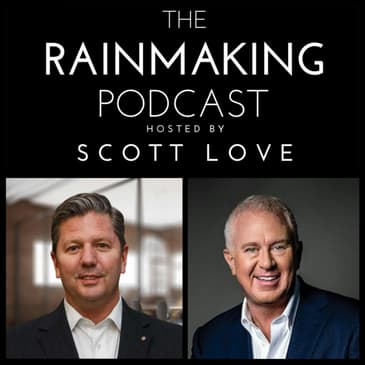
In this episode of The Rainmaking Podcast, host Scott Love speaks with Ian Campbell, author of The Value Sale, about how professionals can integrate value-based selling into every stage of the sales funnel. Ian explains that many sales professionals make the mistake of presenting value only at the end of the sales process when building a business case, which often leads to stalled deals. Instead, he advocates for a dual-sided sales funnel, where value is introduced early, reinforced with examples, and solidified by a clear ROI before the close. By taking this approach, professionals can create more compelling sales conversations and improve their ability to close deals.
Key topics include the three-stage value messaging framework—starting with general value discussion, progressing to case studies that demonstrate tangible results, and finally tailoring value to the specific prospect’s needs. Ian also discusses how to identify the one or two core benefits that truly drive a deal, avoiding the common pitfall of overwhelming prospects with excessive value points. He shares techniques for making business cases simple and compelling, focusing on clear ROI calculations and presenting payback periods rather than just ROI percentages to ease decision-making. This episode provides a structured approach for professionals looking to refine their sales process and increase their close rates by leading with value.
Visit: https://therainmakingpodcast.com/
----------------------------------------
Ian Campbell is CEO of Nucleus Research, where he is responsible for the company’s investigative research approach, product set, and overall corporate direction. A recognized expert on ROI and TCO analysis of technology, Campbell is a frequent speaker at industry and business events. He has been featured in the New York Times, the Wall Street Journal, the Economist, and the Financial Times.
Campbell teaches an executive course at Babson College in Massachusetts and is a frequent guest lecturer at Stanford University; the University of California, Berkeley; Massachusetts Institute of Technology; Harvard University; and Boston College.
----------------------------------------
This show is sponsored by Leopard Solutions Legal Intelligence Suite of products, Firmscape, and Leopard BI. Push ahead of the pack with the power of Leopard. For a free demo, visit this link:
https://www.leopardsolutions.com/index.php/request-a-demo/
Links:
https://www.amazon.com/Value-Sale-Prove-More-Deals-ebook/dp/B0C67GSKKD
https://www.linkedin.com/in/iancampbellnucleusresearch/
Learn more about your ad choices. Visit megaphone.fm/adchoices
[00:00:00] You're listening to the Rainmaking Podcast.
[00:00:16] Hosted by high stakes headhunter, author, and professional speaker, Scott Love.
[00:00:24] You're listening to the Rainmaking Podcast and my name is Scott Love.
[00:00:27] Thank you for joining information on the show notes, as well as Ian's links where you can connect with him directly.
[00:01:40] What's interesting is that he comes from professional services,
[00:01:44] client development from a timer in sales. And the first question I have for you is you talk about value. And we don't want to save it for the end. By the way, Mr. Prospect, here's our value. You talk about keeping that value throughout the sales funnel. What do you mean by that, exactly? And why did you come to that idea to really kind of start
[00:03:02] your book with, with that particular perspective of value?
[00:03:05] Absolutely.
[00:03:06] So we see when we work with salespeople, you qualify that lead, you align your proposition, and then you close the deal. There might be four stages or eight stages. Whatever is funneled is right for you. You already know what those stages are. But think about the funnel having another side. It has two sides. The other side is building the value message. So like anything, just go through both sides. The value message has three steps.
[00:04:21] At the top of the funnel,
[00:04:22] when you bring a lead in,
[00:04:23] start talking about value.
[00:04:25] Here are all the different ways
[00:04:27] we deliver value for the customer. the business case, but why do you want to do that? When you get to the business case, you've already built the message about value. They already know what the value points are. So you're not just bringing this ROI equation at the end saying, okay, I'm going to build a business case, let me do this. That's a disconnection. I've done a sale, I've got to the bottom and said, well, here's the contract and here's a business case,
[00:05:40] I had somebody build for us. It's not going to work.
[00:05:42] So think about the fundless having those two sides.
[00:05:45] As long as you go through both sides,
[00:05:47] you'll be fine when you get you talking to me? Well, you don't understand we do all this better integration. We have AI capabilities. What you're doing is selling them something they probably are some solution for.
[00:07:00] So they don't necessarily perceive pain as much as they see
[00:07:02] it as it's old and I should look at what's new,
[00:07:05] which is not necessarily pain.
[00:07:07] What you should be saying is folks that have deployed are deployed by other pharmaceutical companies. And here's the value that they got. They hear the kind of benefits they had, mostly around productivity gains and on better accuracy in contract negotiation because you could standardize the contract. Of course there are a lot of other benefits, but those are the two big ones. And it gets to another point we can talk about. So now they said, okay, I knew there are five benefits.
[00:08:22] I've keyed into all five of them.
[00:08:23] I like all five.
[00:08:24] There are two that are likely to drive the deal, drive the business case forward, then I'm gonna win. So now I've narrowed this down to, and what a great answer, I can say, if we just increase the productivity for your sales reps by 3%, it justifies you buying my product. Of course, I've talked about 15 other ways we help people.
[00:09:41] I've shown you other companies that have achieved benefits.
[00:09:44] But just for you, on this one or two benefits,
[00:09:46] we can justify you that influenced the decision. And usually one or two that make the decision.
[00:11:00] What does this mean for you as a sales rep?
[00:11:01] It means you can focus on those two main benefits.
[00:11:04] So I thought that was profound.
[00:11:05] That was a key nugget that I got or 12 different items and say, look at all these great things, you know, we're going to have happier sales reps and that will reduce turnover. Because of that, you'll be able to reduce your hiring costs. Right. Well, you've gone off on a tangent that may or may not be true. It's what we call a fourth order benefit. It's not really valuable, but you've stuck this in your business case.
[00:12:20] And think about the decision makers today. The decision makers today are not just people.
[00:12:24] They're no people. They're looking for and so that's your same product to the same person. Think about the type of product you have. If I sell a CRM system, that's used every day by every sales route. Likely high or high potential. If I'm selling a onboarding system to help the HR department streamline,
[00:13:42] they're onboarding of new hires,
[00:13:44] well, that's done once every time I hire a person,
[00:13:47] so the repeatability is very low. look at those feature benefits lists, it's usually features, features. It's not always an actual benefit that's measurable. There are only three things I can do for the customer. I can increase the productivity for them. I can reduce their costs, or I can increase their profit. And those are, I think you do a lot, and you do, but ultimately all the benefits you do
[00:15:01] drive to those three big, big risks.
[00:15:04] That's all I can really do for a customer.
[00:15:06] Once you see that, we get the same feedback. It's made life a lot easier. It's made life simpler for us to convey messages. And a lot of times, it's stuff you already know. You already know this. You just haven't put it in that right order.
[00:16:20] You're saying it in a slightly different way.
[00:16:21] Like the pain point.
[00:16:23] I could say, what's the pain point?
[00:16:25] Or I could say, a year from now,
[00:16:27] where would you like to be? how easy it actually is. Once you see you already know how to do it, you maybe just have to start thinking about it that way, or you're a matata. I see that all the time. Where you see sort of a light go on. And then, you know, I challenged sales people. I said, if you think back to the last deal you lost, if you had led with value instead of features, or instead of whatever you did, could you have closed that deal? Might that have gone better for you?
[00:17:41] And I didn't even want an answer.
[00:17:42] And I said, I don't want an answer.
[00:17:43] I want you to think about it, say,
[00:17:45] boy, could that have helped you?
[00:17:47] And almost always I get people after saying, Next time you go to lunch with them, next time you talk to them, ask them, what are the two big things I did for you? What are the two big things my solution did for you? But start to drill down a little bit and say, by how much did we increase productivity? How did we reduce your cost? So try to get them to a number, oh, you reduced our cost, really, how did we do that? Well, we no longer had to spend money on this,
[00:19:02] then it reduced our cost by 300,000 a year,
[00:19:04] whatever that number is.
[00:19:05] But now you're using your own customers
[00:19:07] as they are looking back you over lunch and say, gee, how many sales people do you have? Now, another good trick is, when we increase productivity, don't say, how much more productive do you think my employees will be,
[00:20:20] how much your employees will be with this product?
[00:20:22] That's going to get you a bad answer.
[00:20:24] The answer to that is, I don't know.
[00:20:25] You could say, that in the book, don't you, about you've got to sell to someone who's selling to somebody else internally, right? Right. And the best way to do that is a number. It's not a, we like them because they're top of some quadrant. We like them because it's going to save us money. That's what's going to get you a deal. So you know that because if you ever had a deal that you thought you'd won and installed somewhere in a committee,
[00:21:41] that your prop was a value proposition.
[00:21:43] Because they didn't see the value of doing it.
[00:21:47] If you can reduce the cost for somebody, talk about ROI, we've been talking about benefits in ROI, but a quick sales tip is, it's sometimes better to talk about payback period, especially in this kind of environment. And I talk about it in the book, but ROI gets all the publicity, everybody likes ROI, but if I told you the ROI from this solution is 300%, intellectually, no, that's okay.
[00:23:00] But if I told you it will cover its costs in four months,
[00:23:04] you feel good, you interpret.
[00:23:06] That's specific, that value message from the beginning. That is, without question, the most important thing that you could do. The second most important thing is too much if you go over five. Two big things drive it, three things are supportive,
[00:24:21] that's it.
[00:24:22] If you're talking about more than five benefits,
[00:24:23] no matter how many benefits they're actually getting,
[00:24:25] it'll never be more than five that will drive the deal. So you can go to the valuesale.com, there's a lot of great information there, absolutely go there. My day-to-day job is nucleusresearch.com where we do a lot of work for vendors of technology, especially in promoting value and showing value. And you can always email me, I'm really good about getting back to people and have questions. So if you've got a question about IRR, TCO, whatever it is,
[00:25:40] I've probably got something for you,
[00:25:41] but I always, always will now.
[00:25:43] Just eanatnucleusresearch.com,
[00:25:45] reach out to me at each line, happy to reply,