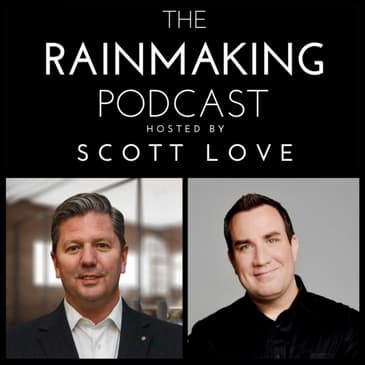
In this episode of The Rainmaking Podcast, host Scott Love speaks with Dr. David Burkus, organizational psychologist and author of Best Team Ever, about the fundamentals of leading small teams effectively. Dr. Burkus explains that while leadership in large organizations is often about managing systems and processes, leading a small team requires a deeper focus on culture, communication, and accountability. He highlights that leaders of small teams have a unique advantage: they can directly influence the team’s culture and engagement, shaping an environment of trust, collaboration, and high performance.
Key topics include the importance of setting clear expectations and milestones, fostering healthy conflict as a tool for innovation, and the power of team-wide meetings for accountability and alignment. Dr. Burkus shares his three-question team huddle framework—asking team members what they’ve completed, what they’re focused on next, and what’s blocking their progress—to create a structured, transparent approach to performance tracking. He also discusses how leaders can provide constructive feedback, encourage psychological safety, and develop intrinsic motivation by reinforcing the impact of their team’s work. This episode provides practical strategies for professionals looking to enhance their leadership effectiveness and build high-performing teams.
Visit: https://therainmakingpodcast.com/
----------------------------------------
One of the world’s leading business thinkers, David’s forward-thinking ideas and bestselling books are changing how companies approach leadership, teamwork, and collaboration.
A skilled researcher and inspiring communicator, Dr. David Burkus is the best-selling author of five books about business and leadership. His books have won multiple awards and have been translated into dozens of languages. Since 2017, David has been ranked multiple times as one of the world’s top business thought leaders. His insights on leadership and teamwork have been featured in the Wall Street Journal, Harvard Business Review, The New York Times, CNN, the BBC, NPR, and CBS This Morning.
A former business school professor, David now works with leaders from organizations across all industries, including PepsiCo, Fidelity, Adobe, and NASA. David’s keynotes aren’t just entertaining and enlightening, they’re evidence-based and immensely practical—offering leaders at all levels a set of actionable takeaways they can implement immediately.
----------------------------------------
This show is sponsored by Leopard Solutions Legal Intelligence Suite of products, Firmscape, and Leopard BI. Push ahead of the pack with the power of Leopard. For a free demo, visit this link:
https://www.leopardsolutions.com/index.php/request-a-demo/
Links:
https://davidburkus.com/books/
https://www.linkedin.com/in/davidburkus/
Learn more about your ad choices. Visit megaphone.fm/adchoices
[00:00:00] You're listening to the Rainmaking Podcast, hosted by high stakes headhunter, author,
[00:00:19] and professional speaker, Scott Love.
[00:00:24] You're listening to the Rainmaking Podcast, and my name is Scott Love.
[00:00:27] Thanks for joining me on the show. Yeah, thank you so much for having me. I like the fact that you've got that credentialed expertise as a professor and you teach this.
[00:01:41] And so the people that are listening probably have a small team.
[00:01:45] It could be an attorney with a big firm with two or three associates. team you are the one people are looking for. You're the thing that's going to set the tone for how that team behaves and acts and what that culture looks like. Yeah, absolutely right. So as someone is looking to grow their organization with their small team, let's say there's some sort of a conflict that they have, or they see two employees that have conflict with each other. I would assume that the implications of those issues
[00:03:05] are much more significant in that small business compared to a larger one, right? of it. That's totally cool. It's when it devolves into personal conflict that we have a problem. It's when it devolves into, you know, you've always been wrong or you're an underperformer, how dare you say that, that sort of thing. That's when we really have unhealthy conflict that can sit and fester for a long, long period of time. But truthfully, when you look at small teams, even mid-sized teams, a lot of them are marked by a sense of healthy conflict.
[00:04:22] They're okay with the idea that they don't given you your performance objectives. You're a partner, the firm has given you the number of hours you're supposed to find and bill for the year. Right? But what you can still do is work with the team that you have to set out what those milestones are. Right? If we need this many, if this is the yearly performance objective that we have to hit,
[00:05:44] what does six months look like? What does timetables are. Again, even if the finish line has been decided, just giving them autonomy over how they're gonna run the race, that has a tremendous impact on their own intrinsic sense of motivation
[00:07:01] towards achieving those things.
[00:07:02] So that's number one that you're gonna notice.
[00:07:03] The second thing you're gonna notice
[00:07:05] is that when you have this discussion team-wide,
[00:07:07] you're gonna. I want to make sure that we're getting there so that we don't go too far without the outcomes that we want. How do you think a manager should do that? Yeah, I mean candidly you ask, right?
[00:08:23] So I'm simple as that, right?
[00:08:25] Right.
[00:08:26] Yeah.
[00:08:27] I mean, so I look forward over the next two weeks, where do I see the potential
[00:09:40] derailers?
[00:09:41] That could be internal, like a knowledge gap or a skills gap that could be external, like
[00:09:45] I need a resource or a report is each individual on the team sharing out what did I just complete?
[00:11:00] Okay, got it.
[00:11:01] Okay, so each individual talking about what they completed
[00:11:03] and is this done every week you think,
[00:11:05] or every other week, what do you think?
[00:11:06] I think for most that. That's what I've seen in my work in terms of recruiting, is that people want to come to the office.
[00:12:20] Maybe not every day, but they like,
[00:12:22] and I think they need that personal interaction.
[00:12:24] Those are really good insights, David.
[00:12:26] First, sharing out. So a meeting like this where people are checking in and saying, here are the things I'm putting on my plate for this week. Also make sure that everything that needs action is being committed to. Okay, great. So first we have, what did they complete? Second, what am I focused on next? These are commitments they're making this cycle or this sprint to the following week.
[00:13:40] And then what's the third thing we should talk about
[00:13:41] during that meeting?
[00:13:42] What's blocking my progress, right?
[00:13:45] Which is as I look to the do I need help. It's not where have I messed up. It's as I look forward, what's potentially blocking my progress. And this can be, again, like I said before, this can be internal. I'm working with this client. And the truth is, I just don't know how to put together this proposal. Or it could be external. I've been waiting for this resource from a different department of the organization or something
[00:15:02] like that forever, and I still don't have it. But it lets about it, just like you and I before the podcast, what do we talk about? Oh, how's the weather where you are? How's the family? What have you been facing? What have you? You get a little bit of personalization, but you also, to use the psychology term, you start to develop what are called uncommon commonalities between individuals on the team. Things that two people on your team may have in common. Maybe they are, you know,
[00:16:20] as we're recording this, I'm the nurse, I'm nursing the loss of my Philadelphia Eagles in the
[00:16:25] playoffs. And maybe you find out they're also Eagles genius that you've put into this. Yeah, you don't want to disappoint your comrades for sure. But also as a leader, I think this makes constructive criticism and performance feedback actually easier, right? Like it's hard, I get it.
[00:17:40] Nobody gets into this job because they want to tell
[00:17:42] other people they're doing a terrible job.
[00:17:44] I mean, understand the issue
[00:19:01] is that I'm a big fan of the industrialist
[00:19:03] and kind of management thinker, W. Edwards Deming, right?
[00:19:06] Big systems thinker, what have you. If it's the 15% of the time where it is an in-person issue, you've eliminated that excuse because you've already studied the situation. Yeah. Right. This is great. You already know, hey, no, I looked into it. You have what you need, et cetera.
[00:20:24] You're just underperforming. Right.
[00:21:23] 10% of the time, it's a motivation issue.
[00:21:28] And then hopefully, right, you've built enough uncommon commonalities. You've built enough candid feedback.
[00:21:30] You built enough psychological safety to have a real conversation with that person
[00:21:33] about whether or not they feel like they could continue to be motivated to do this
[00:21:37] job, or if we really are talking about.
[00:21:41] Inviting them to be successful somewhere else, somewhere where they're more
[00:21:44] motivated to do it, there is going to build trust and psychological safety. Are you candid enough? Are you vulnerable enough in front of the team where they will be vulnerable enough with you, especially when it comes to what's blocking
[00:23:00] my progress question?
[00:23:01] Right, right.
[00:23:01] So that's action step number three.
[00:23:03] And then action step number two.
[00:23:05] And then action step number three
[00:23:06] is I would develop a system. remind them of why the work that we do is so important, right? So number one, run those huddles. Number two, focus in on building that sense of psychological safety. And number three, get ready to start collecting those stories that'll speak to what in psychology we call pro-social motivation, the motivation to help other people, which is the strongest form of extrinsic motivation we can offer people, even above pay raises and what have
[00:24:21] you.
[00:24:22] And if you do that, you'll start...
[00:24:23] The book I just recently released is called Best Team Ever. Not like Scott Love, the domains were wide open. So DavidBergert.com is the best place to go for that. That's great, David. Thank you for being on the show. I'd love to have you back on the show as a guest in the future. And I wish you all all the success that you can handle because you've definitely helped me solve some problems today. And I know that you've given some great ideas to our listeners. Thank you, David. Oh, thank you so much for having me.
[00:25:44] Thank you for listening to the Rainmaking Podcast.