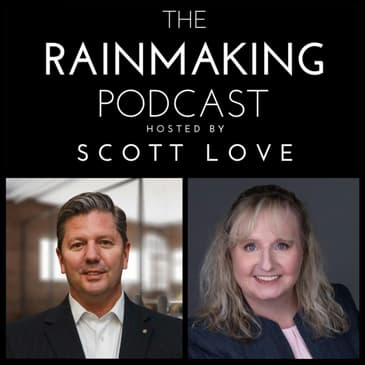
In this episode of The Rainmaking Podcast, host Scott Love speaks with Katherine Porter, a management consultant specializing in legal project management, about the power of human-centered design in attracting and retaining clients. Katherine explains that professionals, particularly those in legal and professional services, can improve business development by focusing on the client journey and creating a seamless, personalized experience. She emphasizes that human-centered design isn't just about delivering services—it’s about understanding client needs, mapping out their experiences, and making intentional improvements that enhance engagement and trust.
Key topics include the concept of client journey mapping, where firms outline every touchpoint in a client's experience, from onboarding to service delivery, to identify areas for improvement. Katherine discusses the importance of empathy in business development, sharing how professionals can conduct client interviews and gather feedback to refine their processes. She also introduces workflow mapping as a tool to streamline operations and ensure consistent client interactions. Additionally, she highlights common pitfalls such as resistance to change, lack of follow-through, and the failure to continuously update client engagement strategies. This episode provides actionable insights for professionals looking to elevate their business development efforts by designing a client experience that fosters loyalty and long-term success.
Visit: https://therainmakingpodcast.com/
----------------------------------------
Katherine is the founder of The Resourceful Lawyer and she works with lawyers and law firms who want to design and build more efficient and more profitable practices. Katherine blends the best of project management, human-centered design, and two decades of legal experience to tailor solutions for each of her law firm clients. She earned her law degree at UCLA, holds the Project Management Professional (PMP) credential, and is certified in Design Thinking. If you’re ready to think differently about the practice of law, subscribe to her newsletter Re-thinking Like a Lawyer here: http://tinyurl.com/mvuxt6v6
----------------------------------------
This show is sponsored by Leopard Solutions Legal Intelligence Suite of products, Firmscape, and Leopard BI. Push ahead of the pack with the power of Leopard. For a free demo, visit this link:
https://www.leopardsolutions.com/index.php/request-a-demo/
Recruiters! Join Scott in Las Vegas for his Recruiting MasterClass Seminar on Feb 15 – 16, 2024:
www.recruitingisagame.com
Links:
https://www.theresourcefullawyer.com/about/
https://www.linkedin.com/in/kporterjd/
Learn more about your ad choices. Visit megaphone.fm/adchoices
[00:00:00] You're listening to the Rain Making Podcast, hosted by High Stinks Headhunter, author and
[00:00:19] professional speaker, Scott Love.
[00:00:24] You're listening to the Rain Making Podcast, and my name is Scott Love.
[00:00:27] Thank you for joining me on the show. members. Go to theplacementclub.com and check it out if you're in the recruiting industry. Thanks for listening and I hope you get some really good ideas from my conversation with Katherine today. Hey, this is Scott Love with the Rain Making Podcast and our special guest today is Katherine Porter and our topic is human-centered design to attract and retain more clients. Katherine,
[00:01:43] thanks for joining me on the show today.
[00:01:44] Yeah, thanks. It I said to the managing attorney, I was like, well, so what would you say our specialty is? And she said, or who do we help? And she's like, businesses. It was like, okay, can we narrow that down a little bit?
[00:03:00] What would we do for them?
[00:03:01] Everything.
[00:03:02] And I was like, yeah.
[00:03:03] So I think part of humans are designed,
[00:03:05] let's narrow that down a little bit Remember how the plastic layers are on top of each other and you pull it off and it just comes neatly off and then just the way they even package it, you're right. And even the quality of the boxes that they would use to pack it in. You're like, I don't want to throw this box away. I could probably sell it and make some money somewhere. It's such a nice box. You just look at that. That's just a nice box.
[00:04:20] So that's interesting.
[00:04:21] So you're saying that we as professional take the time to understand the clients objectives might not, it might not be what we think it is. And so, I've taken the time to understand that will really help the client feel valid, the prospects feel valued like, okay, this person really understands me. And then hopefully,
[00:05:40] that and going through the like, hopefully they become clients. And then it helps that
[00:05:45] relationship just continue to plan. And I think that's really hard. All of business development can be challenging, right? You're just like, why am I investing all this time
[00:07:00] in doing this effort? It's not always a priority and they can be really high level or really detailed and you just kind of walk through the different touch points that the client has. Oh, wow. And you think about who, and by you, I mean anybody at your company.
[00:08:21] So it means, you know, who's sending the invoices?
[00:08:24] Like do they, that's all about iteration and trying and trying and getting better. And of course, once you've got some models already laid out, you can use those over and over again, because the client journey might be different for
[00:09:44] some types of matters. But overall, most of your clients ever reached out to their clients to get any feedback or input on the client journey map?
[00:11:03] Yeah, not that I know of.
[00:11:04] I know other clients or other businesses travels faster than good news. And so I think that you could use this for recruiting, for client development, for other types of ways that you have to get people to join or buy something. So that's really interesting. Have you seen any law firms kind of push back on this whole concept and maybe not necessarily just law firms, but any sort of larger organizations,
[00:12:20] like this is just too much work or anything like that?
[00:12:23] Yeah, it really depends signal as to what the culture is really all about. And we really care about our clients. We really want to make sure that they get the best experience possible. I'd be willing to bet that the side benefit is also retention of staff because they want to be with the winning team
[00:13:40] that's taking steps to really win the hearts and minds
[00:13:43] of their clients and retain their clients And I always, one metaphor that gets used a lot for this concept is the stage of theater. So the clients, the audience, managing attorney, or managing providers is a person on the stage. The backstage, you've got all the people that are making sure the scenery is moved and the props are in the right place and the curtains go up and down when they're supposed to.
[00:15:01] And you know, all that back room stuff that happens to make that production look great
[00:15:06] to the audience. Well, a lot of people like we've already talked about the resistance to change, but also the, you know, the kind of like, okay, we've done it. You know, we've done it. It's done. We don't need to do it again. And I think that that mindset of like, okay, we've done it. We never need to look at this again is just not, they'll get you stuck. You know, well, then maybe you don't need to check in for, you know, six months or a year even. And then, but if you're still, if you're not seeing the results, then maybe you need to
[00:17:43] tweak something and so you go back, you may't have to mention their name, but what were the challenges they had before they hired you? What were kind of the major areas that you focused on and where they made improvements? And what was the result? How soon was it that they started seeing some positive results from their efforts? Yeah, well, I was a firm that had a large client base
[00:19:03] and things were just really inconsistent.
[00:19:06] Like when they would make a phone call, do they send an email message? Yeah, I think you've probably talked about sales funnels before, so you think about like where are they in the funnel and what's that experience like for that client? And so I think that's, we did that work. And I have to give this a lot of credit, they were really open to it. And
[00:20:22] I mean, I'm in the position where people come to me, steps be? Yeah, well, the first one is probably the one you've heard me say about what 20 times is it would be like a quiet journey now. And it's, you know, just to really, and that involves a lot of interviewing, a lot of talking to clients, a lot of talking to your staff and your colleagues to see what what they their perceptions of the client experiences. And of
[00:21:42] course, you, if you can talk to actual clients, that's even
[00:21:45] better. And hopefully people do that, I need to make sure that I receive the discovery. And I've got the secretary preparing the shelves for the responses. So that goes up to their box or their lane. And then so just kind of goes up and down through the lanes. So telling
[00:23:03] you who does what. And I think it's really valuable because people see where their work fits in. Now I'm gonna know, okay, this is ready to go to the client for signature, or this is ready for the Secretary to mark the tables of authorities, which I learned is from doing them myself, but that has to be the very, very, very last thing. Right? What was that for? In terms of our structure, that's a really huge number one, the client journey map,
[00:24:20] and also the workflow mapping.
[00:24:22] And I wanna ask you about some resources
[00:24:24] on this here in a second,
[00:24:25] but if we could kind of tee him up for two more action steps, management tool would be able to do this. And also a CRM, if you sometimes you can use ClickUp or something else as a CRM, it might just take some customization. But a lot of other firms, like with law firms, I know it's Clio Grow, I think is basically CRM, any way of tracking that lead and how they go through the process to become a client.
[00:25:41] So that would be implemented.
[00:25:42] That's a way to implement the client journey.
[00:25:46] That's great, Catherine.
[00:25:46] And then tell us about your offerings. for clients or for my clients. So really get them on paper, you know, get them, understand what, what needs to go where and what the steps are. And because I think that we just don't take the time to do that and we it's all in our heads, right? That's what you're all about, it's all in our heads. And I was on a phone call with a person, yeah, lawyer. And she was like, yeah, you know, I really
[00:27:03] need more support from my staff. You know, I was a lot today and I know our listeners did also and I'd love to have you back on talking about project management because I know this rabbit hole can go pretty deep. There's probably a lot more that we can talk about. So thank you again for being here today, Katherine. Yes, thank you, Scott. It was great.